I have created a baseline assessment on entry to Reception, because I struggled to find a baseline assessment that matched the new Development Matters document. Therefore, I have used Development Matters, July 2021 to create this document and to look at what we would expect children to be doing when they enter Reception in September, to be 3-4 years secure. I hope this resource helps you too!
Literacy assessment:
Name writing
Word writing (higher achievers)
Letter formation
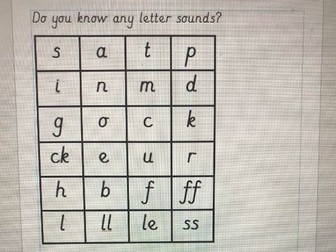
Any sounds known
Rhyme
Initial sound
Nursery Rhymes
Maths assessment:
Subitising
Oral counting
‘Number fingers’
1:1 counting
Number recognition
Match number and quantity
Shape recognition
Repeating patterns
Colours
More and Less
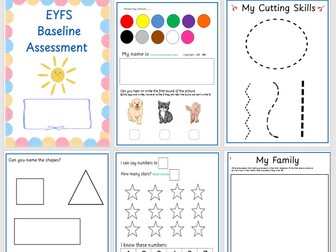
EYFS Baseline Assessment
Reception / Early Years children.
Assessment booklet
Mark making, name writing, maths, communication and language, PSED, gross and fine motor.
Name writing
Mark making sheets
Scissor Control
Year 1 Baseline Assessment
Year 1 / Primary 2 children.
Assessment booklet
Mark making, sentence writing, phonics, reading, maths, communication and language, PSED, gross and fine motor.
Name writing
Mark making sheets
Scissor Control
EYFS Baseline Assessment
Nursery / Pre School / Early Years children.
Assessment booklet
Mark making, maths, communication and language, PSED, expressive arts, gross and fine motor.
Mark making sheets
Scissor Control
A baseline assessment linked to my progression document.
Following checkpoints and statements from Development Matters, aged 3-4 statements.
Many of these activities can be done through teacher assessment observing children in play but also through CP enhancements and play-based learning. No RBA tablet-style assessing here!
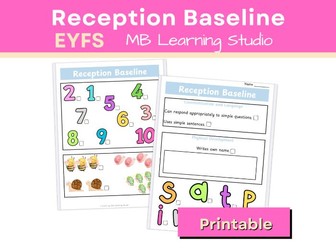
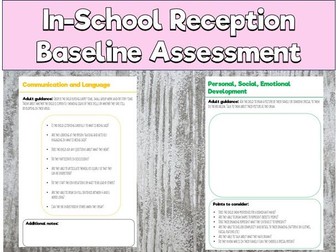
This concise 2-page Reception Baseline Assessment is designed for teachers and parents to gain a quick snapshot of children’s early skills at the start of EYFS. It focuses on four key areas: communication & language, name writing, letter recognition, and number knowledge.
What’s Included
2-page printable baseline assessment
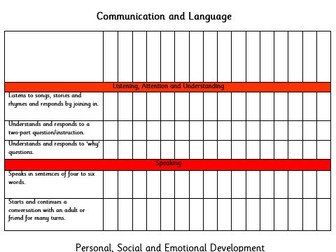
Communication and language
Space for children to attempt writing their name
Letter recognition activity
Number knowledge check (recognition and counting prompts)
Teacher/parent notes section for observations
Curriculum Links (EYFS 2021)
This resource supports assessment against:
Communication and Language
Literacy
Mathematics
Personal, Social and Emotional Development
Why Teachers & Parents Will Love It
Simple, low-prep assessment to establish starting points
Supports both classroom use (Reception baseline) and home learning (parents checking readiness)
Provides a clear snapshot to inform planning and next steps
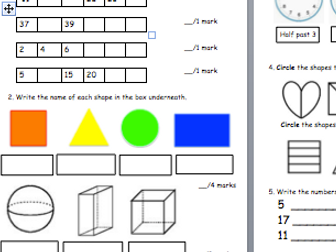
This editable assessment is set from the new National Curriculum objectives for Year 1.
It can be used as a baseline to assess where children are within their mathematical knowledge at the start of Year 2.
The total is out of 50 marks.
This is editable and there is space for children to do workings out etc.
I have previously uploaded a Year 1 baseline assessment which has been downloaded 100+ times.
This baseline assessment can be used for year 7 at any point during the school year. Could be a useful tool for differentiation at the start of the year, or even as a summative or formative assessment part way through the year.
This assessment covers the following areas which are commonly taught within the curriculum in year 7, but could be adapted for a more bespoke assessment:
Basic Skills - formal elements;
Colour theory - knowledge and key words;
Space and shape - problem solving and imagination;
African Art - comprehension, colour and pattern;
Surrealism - proportion, shape and observation.
This paper can be marked by the teacher and used to plan and sequence future lessons on basic skills.
This English language baseline assessment has been designed to work flexibly across both KS3 and KS4. I developed it for my own school in order decide upon the best qualification pathway to place our students on: GCSE English lanaguage or Step Up to English.
I created the assessment grid to match the GCSE 9-1 course.
Files included:
English Language Baseline Assessment for KS3 and KS4.
English Language Baseline Assessment Mark Scheme.
Assessment Marking Grid.
Lesson duration: 1 hour and 45 minutes.
Why purchase me?
I am being used successfully in a pupil referral unit as I am highly engaging. I have been broken down into accessible steps whilst maintaining a high level of challenge. I am especially useful for informing decisions regarding the placement of students onto suitable English qualification pathways.
Suggested general guide to pathways:
less than or equal to 1, consider Step Up to English Silver pathway in order to build graduated steps to achievement.
greater than 1 but less than 2, consider Step Up to English Gold pathway in order to build graduated steps to achievement and prepare for the demands at GCSE level.
greater than 2, consider direct entry onto the GCSE English Language pathway.
Editable EYFS Baseline Assessment Template for under 2s and 2–5 years. Covers all learning areas and allows teacher personalisation.
This Editable Baseline Assessment Template is designed to support early years practitioners in accurately recording and evaluating children’s developmental starting points across all EYFS learning areas. It includes two versions:
Baseline Assessment 1: For children under 2 years
Baseline Assessment 2: For children aged 2–5 years
Templates are aligned with the EYFS framework and cover the seven areas of learning:
Personal, Social and Emotional Development (PSED)
Communication and Language
Physical Development
Literacy
Mathematics
Understanding the World
Expressive Arts and Design
Each section is clearly laid out, allowing educators to make observations, record developmental levels, and note individual strengths or areas needing support.
The templates are fully editable, giving teachers the flexibility to:
Add setting-specific language or goals
Tailor assessment comments to their cohort
Include personal targets or next steps
These templates are ideal for use during the child’s settling-in period and provide a strong foundation for tracking progress throughout the year. They also support meaningful conversations with parents and can be used as part of ongoing documentation or inspection preparation.
Fifty-one multiple choice questions and one writing task designed to give you valuable insights into your students’ language abilities.
This test covers a range of topics including:
Basic Language Skills: This section assesses the students’ knowledge of the English language by testing their understanding of the alphabet, adjectives, verbs, nouns, adverbs, and connectives.
Sentence Structure Identification: This section tests the students’ ability to identify different types of sentences, including simple, compound, and complex sentences.
Noun Types and Modifiers: This section tests the students’ ability to identify collective nouns, plural nouns, fronted adverbials, expanded noun phrases, concrete nouns, and abstract nouns.
Figurative Language
This section tests the student’s understanding of figurative language, including similes, metaphors, personification, oxymorons, descriptive language, sensory details, alliteration, and assonance.
Punctuation Usage: This section tests the students’ knowledge of common punctuation symbols, such as full stops, question marks, exclamation marks, commas, quotation marks, and apostrophes.
Creative Writing Techniques: This section assesses the students’ ability to structure and organise their creative writing, as well as their ability to use different writing techniques to capture the reader’s attention.
Reading Comprehension
This section of the test helps you assess a student’s reading comprehension abilities. It can also help you to identify if your students may need additional support or instruction in this area. Additionally, this exercise can help you to gauge how well your students are able to extract and comprehend information from written material, which is an essential skill in many academic areas.
Creative Writing
This section is designed to help you assess your student’s ability to communicate their ideas in a clear and organised manner, their ability to engage and maintain the interest of the reader, and their ability to use appropriate grammar, punctuation, and vocabulary. This information can help the you tailor your instruction to meet the needs of individual students and to help them improve their writing skills.
------------------------------------------------------------------------
Not only will this test help you identify areas where your students need additional support, but it also comes with a mark scheme that includes low, mid, and high-ability example answers for the writing section. This makes it easy for you to quickly evaluate your students’ work and track their progress over time.
An on-entry, in school baseline assessment for your Reception children to be completed during the first half term. Used to better understand their on-entry attainment and starting place ready for the year ahead.
Assesses:
Name writing
Fine motor skills
Pencil control
Communication and language
Listening and understanding
PSED
Phase 1 phonics
Phonemic knowledge and skills
Alphabet and letter recognition
Number recognition
Counting and subitising skills
Early mathematics concepts (more/ less counting, ordering numbers)
Early play skills
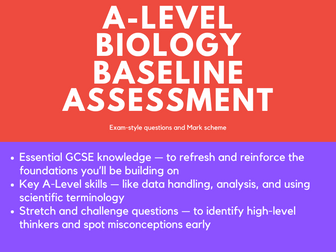
I designed this baseline assessment based on my knowledge of what students often find tricky when making the leap from GCSE to A-Level. It covers:
Essential GCSE knowledge — to refresh and reinforce the foundations you’ll be building on
Key A-Level skills — like data handling, analysis, and using scientific terminology
Stretch and challenge questions — to identify high-level thinkers and spot misconceptions early
Why is this useful?
A clear idea of what topics to revise
Building students confidence in using scientific language correctly
An early insight into the level of thinking expected at A-Level
Personalised next steps based on student performance
PDF and Word (editable)
A fully editable 9-page EAL screening form.
The aim of this screening form is to establish a student’s basic English language proficiency; to identify a student who requires EAL, EFL, ESL support and to identify topic areas a student may need to develop.
Before carrying out the screening form, it is helpful to say to the child, ‘During the task, I will circle some areas that you find a bit tricky. This is to help me know which areas I need to focus on in class so that I can make your English even better!’ By saying this, the student will be reassured from the start.
.
The following 23 topic areas are assessed:
Colours
Numbers (0 - 9)
Numbers (10 – 20)
Body parts
Head / Face
Clothes
Household objects
School
Shapes
Action words
Domestic Animals
Weather words
Food - Basics
Food - Fruit
Food - Vegetables
Fast food
Wild Animals
Gardening
Positional Words
Days of the week
Times of the day
Months of the year
Professions / Jobs
An updated EYFS Baseline designed to complement the statutory ‘Yellow Bear’ baseline assessment we all know and must use which only shows us so much of a child’s capabilities! It includes a series of short, adult-led tasks to help identify children’s baseline skills and knowledge. The information gathered can then be used to plan early interventions and targeted activities, ensuring children receive the right support to strengthen their learning and development from the very start.
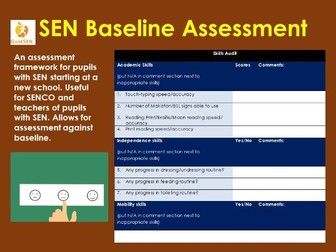
This resource assesses pupils with an EHCP when they join a new school or education establishment. It records the level that a pupil is functioning at and can help a new school understand the support that they need going forwards (at their new school).
This assessment can then be re-assessed year on year against the initial baseline to demonstrate progress against the baseline and the students entry into a new education establishment (also attached in this document). Always useful when Ofsetd or the LEA needs evidence of a pupils progress.
This is a very episodic scheme that I am currently using with Year 7 to introduce them to Drama and some of the basic skills needed to progress.
It is still a work in progress but hopefully it comes as some use to some of you!
Here is a very brief and short baseline checklist. I use this front page to check progression throughout the year at the end of each term. It is also lovely for the children to see how much progression they have made with regards to their handwriting and name writing.
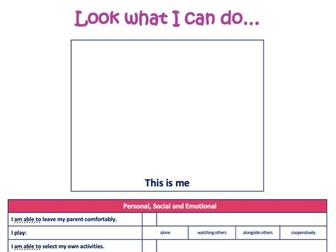
An on entry baseline assessment for reception children to be completed in the first half term of the year to assess children across all 7 areas of learning.
This is linked to Development Matters 2021.


 Quick View