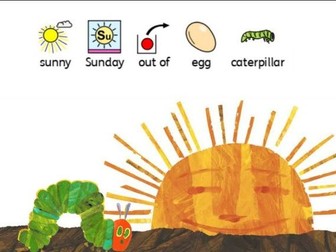
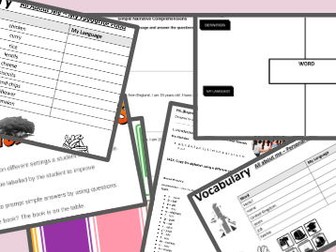
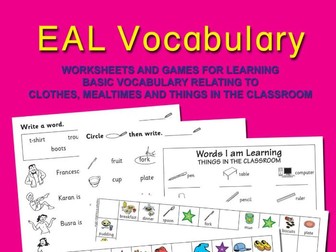
EAL Vocabulary helps children with very little English to increase their vocabulary and to learn the basic words they need in their everyday lives. The themes covered are clothes, mealtimes and things in the classroom. The words used are those suggested to us by EAL and EFL teachers. In addition to the worksheets, there are a number of coloured game sheets which can be used for many language games. Previously available through Easylearn.
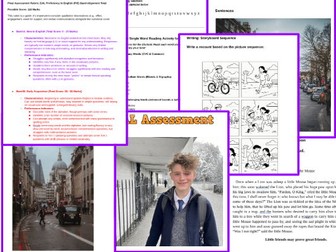
Use this assessment tool to establish a baseline and track the progress of EAL / ESL Learners with this Comprehensive Assessment Pack. Are you looking for a robust and reliable way to assess newly arrived English as an Additional Language (EAL) students in your setting? This meticulously designed EAL Assessment Pack, aligned with the widely recognized Proficiency in English (PiE) scale, provides everything you need to accurately assess proficiency across all key language skills.
This all-in-one resource covers the four core language skills:
Writing Assessment
Alphabet Recognition & Formation: A clear task to assess a student’s ability to write the alphabet in lowercase.
Vocabulary from Picture: An engaging activity where students list visible items from a detailed street scene.
Sentence Construction: Tasks for writing general sentences about a picture and sentences using specific openers.
Storyboard Recount: A visual sequence of six panels prompts students to write a coherent narrative, assessing their ability to recount events logically.
Reading Assessment
Alphabet Reading: Assess recognition of lowercase letters.
Graded Single Word Reading: From CVC words to more challenging multi-syllable words, this activity assesses decoding and recognition.
Fluency & Comprehension: A classic fable, “The Lion and the Mouse,” is provided for reading aloud, followed by differentiated comprehension questions ranging from simple recall to extended inference and opinion.
Speaking & Listening Assessment
Differentiated Questions: A carefully structured set of 15 questions, progressing from basic personal information (e.g., “What is your name?”) to more challenging hypothetical and reasoning questions (e.g., “Imagine you could travel anywhere…”). These questions are designed to encourage communication and investigate proficiency across tiers.
Why Choose the EAL / ESL Assessment Pack?
PiE Scale Alignment: Directly linked to the UK’s influential Proficiency in English (PiE) scale (Bands A-E).
Comprehensive Coverage: Assesses writing, speaking, listening, and reading elements in one convenient pack.
Graded Activities: Tasks are designed to progressively challenge students, suitable for various proficiency levels from “New to English” to “Developing Competence” and beyond.
Clear Mark Schemes & Rubrics: Includes detailed mark schemes for each section and a final comprehensive rubric to interpret overall scores against PiE bands.
Formative & Summative Use: Ideal for informing teaching and providing targeted support, as well as tracking progress.
Empower your EAL learners on their journey with accurate and insightful assessment!
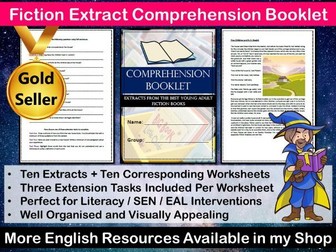
A twenty-one page comprehension booklet containing:
Ten extracts
Ten corresponding worksheets
Three extension tasks for each extract
Perfect for interventions or class work.
Check out my shop for loads more free and inexpensive KS3 & KS4, Literacy and whole school resources.
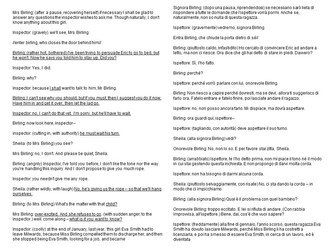
Copies of J. B. Priestley’s An Inspector Calls in bilingual format:
English - French
English - Urdu
English - Portuguese
English - Italian
English - Ukrainian
Plus the MASTER Copy for you to use and translate into any additional languages required via the REVIEW - TRANSLATE function on PowerPoint.
Translations might not be perfect as they have been translated using Microsoft Translations.
More translations to come in another bundle. Bundle fee covers the time required to format the script into a bilingual page presentation and translate into the other languages.
This pack contains a selection of EAL resources suitable for newly arrived KS1 and KS2 pupils with little or no English. The focus for this pack is to help EAL beginners to learn key vocabulary associated with school. The pack almost 50 worksheets with activities linked to more than 60 words. Activities include:
Handwriting
Drawing
Matching pictures and words
Multiple choice
Simple sentence work
The pack also contains a pupil information sheet, a phonics check sheet, pictures of all the referenced vocabulary (which could be enlarged and made into flashcards) and an assessment sheet to help monitor pupil’s understanding. The pack is designed to be used flexibly. Teachers can select worksheets as needed to support EAL lessons. Alternatively, teachers could combine all the sheets in the pack to create a workbook of materials which would allow newly arrived EAL learners to work fairly independently with some teacher support and guidance.
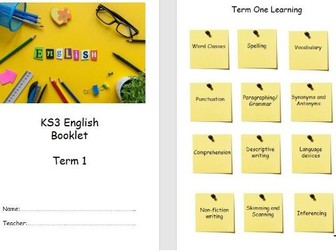
The booklet features practice in the following areas:
Parts of speech (Word Classes)
Spelling
Vocabulary
Punctuation
Paragraphing/ Grammar
Synonyms and Antonyms
Comprehension
Descriptive writing
Language devices
Non-fiction writing
Skimming and Scanning
Inferencing
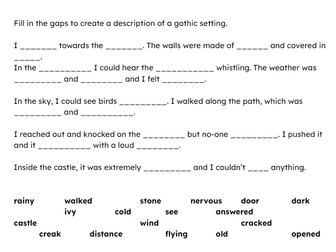
A gothic creative writing worksheet suitable for EAL or SEND students. It starts with a cloze exercise where students fill in the gaps to create their own descriptive piece. It also offers adjective and vocabulary practice where students choose adjectives to describe a gothic picture.
Perfect resource for low prior attainers (LPAs) or students with Special Edcational Needs (SEN) or students with English as an Additional Language.
The EAL pupils will learn how to talk about themselves and their hobbies. They will do some tasks to be able to achieve the learning objective. It’s about my name, my age, my country, my nationality, my language, my hobbies, my class and my teacher.
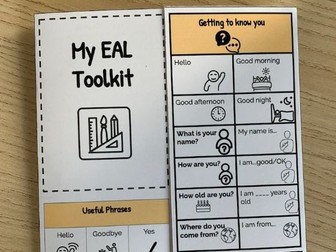
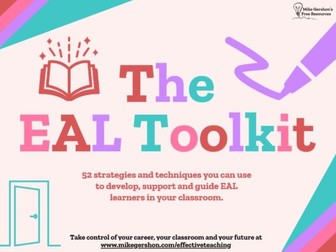
The EAL Toolkit provides over 50 strategies for helping learners across the Key Stages who are learning English as an additional language.
Each strategy is explained and accompanied by an illustration to aid memory.
The strategies are non-subject and non-age specific.
No more searching for EAL ideas now they are all in one place!
Build your confidence and skillset around teaching EAL learners.
Dozens of strategies to support EAL learners in primary and secondary classrooms.
Increase engagement and enjoyment of EAL learners in your lessons.
Discover techniques you can use with EAL learners, whether they are only just starting to learn English, or are already fluent.
Enjoy finding new ways to make your EAL learners feel fully included in the lessons you plan – and in wider school life.
Example Strategies You’ll Find Inside
Buddy Up
Picture Rules
Rehearsal
Concrete Starters
Support the Teacher
Thinking Time
Pre-Highlight
First Language
Allocate Roles
Plenary Prime
Barrier Games
Belonging
Language Types
Thinking Together
Linguistic Diversity
This extensive resource is designer to support newly arrived, EAL students who have very little basic English. It contains workbooks, picture prompts, model paragraphs and basic descriptions, as well as an EAL beginner pack.
The beginner pack provides a sequence to teach newly arrived, EAL students, moving from letter sounds, to basic vocabulary and sentences. It is full of useful ideas.
To compliment this resource picture prompts and some flashcards are included to provide a context for students to learn. These provide pictures of different settings EAL students will experience such as a classroom or living room. There are flashcards of the colours.
Once students have acquired these basic skills, there are two courses to learn to write simple descriptions and recounts. Each of these courses contain scaffolds, key vocabulary and paragraphs.
Updated - Three additional descriptive resources have been added. These are:
Describing a cafe
In the Distance workbook
Cat Rescue - One Sentence Paragraph Story, Storyboard and writing plan
This pack containing numerous pdfs will ensure the right support for newly arrived, EAL students!
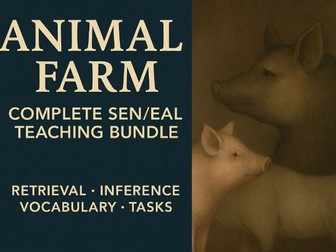
This complete SEN/ALN/EAL Animal Farm unit includes both a printable booklet and a simplified retelling PowerPoint, designed to support students through the full novel. A fully differentiated and illustrated Animal Farm unit of work for SEN, ALN and EAL learners. Includes a simplified teacher/student guide and a realistic-image PowerPoint retelling the novel with retrieval, inference and vocabulary tasks.
Includes:
• Full contextual guide (Orwell, Russian Revolution, Communism)
• Character analysis with allegorical links
• Simplified chapter summaries and key quotations
• Retrieval, inference and vocabulary questions for each chapter
• Discussion, creative and persuasive writing tasks
• PEE paragraph scaffolds
• Editable Word and PowerPoint files with realistic visuals (no film images)
Ideal for KS3–KS4 ALN, SEND or EAL students, nurture groups or GCSE foundation English. Suitable for WJEC, AQA and Edexcel courses.
Please check my shop for other adaptations and support materials for a range of GCSE texts.
Engaging Grammar Intervention for Key Stage 3 & EAL Learners
This resource offers 20 thoughtfully designed grammar intervention lessons, perfect for Key Stage 3 students and English as an Additional Language (EAL) learners.
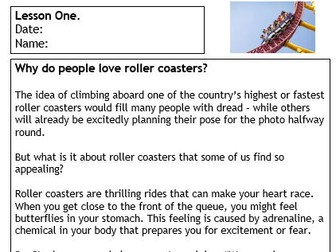
Each lesson is anchored in a high-interest topic—like roller coasters, K-pop, or wildfires—paired with clear reading passages, vocabulary support, and targeted grammar practice. Students develop foundational literacy and grammar skills while building confidence and real-world language proficiency.
Accessible texts and questions tailored for EAL and lower-literacy learners
Step-by-step grammar instruction with scaffolded practice
Engaging, contemporary topics to boost motivation
Vocabulary building in every lesson
Ready to use for interventions, small groups, HOMEWORK or independent studY
Roller Coasters: Capitalising names and the first word in a sentence
Scary Movies: Ending sentences with a full stop.
K-Pop: Using question marks for questions
Dogs: Recognising and writing basic nouns
Baking: Recognising and writing basic verbs
Phones: Recognising and writing basic adjectives
Banksy: Using “a” and “an” correctly
Labubus: Using “I” as a capital letter
Rats: Matching simple subjects and verbs
Lab Grown MeatL Using simple plurals.
Space: Sentence Types. Identifying and writing simple, compound, and basic complex sentences.
AI: Subject-Verb Agreement: Matching singular/plural subjects with correct verb forms.
Wildfires: Verb Tenses: Using past, present, and future tense verbs accurately.
Moon Landing: Punctuation Basics: Using capital letters, full stops question marks, exclamation marks, and commas in lists.
Kidfluencers: Pronoun Use: Selecting appropriate pronouns and ensuring pronoun- agreement.
Hair: Using Compound Sentences: using coordinating conjunctions (and, but, or, so) in compound sentences.
Animal’s Mental Health: Apostrophes: Using apostrophes for contractions and possessives.
Music: Adjectives and Adverbs: Understanding the difference and using both to describe nouns and verbs.
Feelings: Prepositional Phrases: Recognising and using prepositions and simple prepositional phrases.
Mental Imagery: Common Homophones : Distinguishing between words like their/there/they’re, to/too/two, your/you’re.
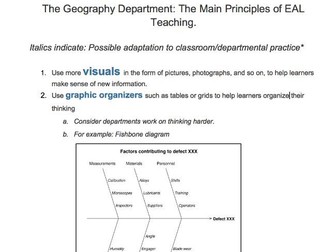
The Main Principles of EAL Teaching - English as an Additional Language - Humanities - Geography
This document was created off the back of research I conducted on how best to enable EAL learners to progress in a literacy classroom (with a focus on Humanities/Geography). Designed while working at a school in West London that displayed over 80 languages spoken an over 90% EAL learners, it contains a mixture of easy wins and more structured classroom approaches.
Happy to answer any questions and any feedback welcome…
jacobspong@gmail.com
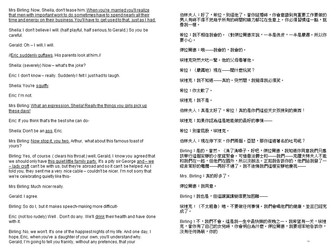
Chinese traditional and Arabic translated parallel texts for An Inspector Calls.
Translated using the translate function on Word so may not be perfect.
Also included is the MASTER copy to use for further language translations.
This lesson is for EAL/ESL learners, based on difficult sounds to pronounce in English
Especially effective for French speakers, but suitable for all
Examples and tongue twisters on the powerpoint help students to practice the difficult sounds.
There is a pronunication poem which accompanies the powerpoint, a video, and a document with the poem
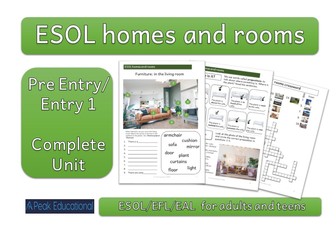
A complete unit on homes, furniture and rooms for adults and teens.
No prep- just print and teach.
Contains activities, exercises and texts that will help students learn vocabulary about houses, rooms, furniture, prepositions of place, ask questions, and use adjectives to describe their homes. Real life colour photos are used throughout - no cartoons or clip art.
Includes
** reading comprehension
class survey
writing prompt
question formation exercises
adjectives to describe houses and rooms
types of houses vocabulary
crossword and more.**
UK ESOL QCF levels: Pre-Entry/Entry 1 UK SQA level: National 2 CEFR levels: pre-A1/A1. Suitable for adults and older teens.
I find teaching functional skills English , I’m getting more and more students who in fact need ESOL specialist classes. I’m not an ESOL tutor but due to the increasing demand to teach English as a second language and fill ESOL gaps in students knowledge I have developed a number of resources of common problems ESOL student have, which I have complied into a 35 page support booklet which I now give my ESOL learners. The idea is the students use this booklet to support their own self-study and English language development or I use it to set targeted and individual homework. The booklet has explainers and tasks to comeplete and ideas on how to further develop own self-study. I find it quite useful and I hope you do to. You can adapt the booklet to suit your own cohort or levels. Please be aware the the TES preview can distort the look of the resources, and this is not always a true reflection.


 Quick View