I created this resource as I wanted a simple script with as many playscript features on as possible.
It can be used for Key Stage 2/3. I used it for Year 5 & 6. There is a playscript template with prompts for pupils to use following teacher input.
Playscript template
KS1 & 2Playscript planning template. A resource for pupils to use to plan their own playscript. Includes a bullet point reminder of the rules for writing a play and spaces for pupils to develop character description, setting and plan the structure of their story.
Great to use following an playscript writing lesson or drama. Can also be used with topics : Setting the stage, performances, Shakespeare.
This stimulating and thought-provoking lesson enables students to create playscript texts containing appropriate and accurate structures, using rules and knowledge to accurately organise their ideas. In particular, students learn how key features such as character lists, stage directions, act/scene labelling, and character speech referencing enable playwrights to create clear and authentic playscripts.
The lesson follows a clear, logical, bite-size learning journey, which guides students towards differentiated learning objectives. Over the course of this journey, they become able to:
- Define and exemplify the key structural devices of playscripts;
- Identify the key features within an extract of an existing playscript, commenting upon organisation;
- Gaining an in-depth understanding of the application of some of the more complicated structural features;
- Completing short, fun, application tasks to check their understanding;
- Write their own playscripts, with accurate structures;
- Self/Peer assess their playscript attempts.
This resource pack includes:
- A visually engaging whole-lesson PowerPoint presentation;
- An engaging and appropriate Frankenstein extract;
- An logical, informative checklist, that enables students to understand how to apply structural features;
- A clear and helpful template;
- A detailed lesson plan, complete with what the teacher and students should aim to achieve at each stage of the lesson.
All images are licensed for commercial use, and are cited on the final slide of the PowerPoint.
This stimulating and thought-provoking lesson enables students to create playscript texts containing appropriate and imaginative content choices, using knowledge of genre and narrative structure to form engaging subject matter. In particular, students learn how key features such as the setup, confrontation, and resolution, in addition to characters (such as heroes and villains) can aid the creation of original and engaging playscripts.
The lesson follows a clear, logical, bite-size learning journey, which guides students towards differentiated learning objectives. Over the course of this journey, they become able to:
- Define and exemplify the different genres of playscripts;
- Research and identify the key features of different genres;
- Gaining an in-depth understanding of the narrative structure of playscripts;
- Applying this understanding to popular playscripts, and then using this information to create their own playscripts;
- Write their own playscripts, with interesting, varied, and appropriate subject matter;
- Self/peer assess their playscript attempts.
This resource pack includes:
- A visually engaging whole-lesson PowerPoint presentation;
- A helpful and well-structured research template;
- A comprehensive planning sheet for designing their own playscripts;
- A detailed lesson plan, complete with what the teacher and students should aim to achieve at each stage of the lesson.
All images are licensed for commercial use, and are cited on the final slide of the PowerPoint.
Looking for something a little different that’s guaranteed to have your students spellbound!?
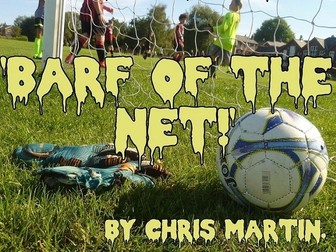
‘Barf of the Net!’ is a comedy whodunit script which, when read out aloud, provides not only for a hugely engaging courtroom-style drama classroom event, but can also be scaled up into a whole school show. In true ‘Murderplays Mystery Shorts’ fashion, your actors/readers read from their scripts while standing in a line thus, with ‘the minimum of preparation’, your show will be ready to engage and entertain your audience. The piece itself (outlined more fully below) is a comic whodunit for six readers of any age which explores what happens when ‘foul play’ is suspected during a school soccer match. It’s full of character, accusation and comedy, and parodies the ‘win at all costs’ nature of school sports. And, being a whodunit, your audience will be challenged to suggest which two of the four suspects they think is guilty of tampering with the opposition striker’s halftime drink! The script is accompanied by a full event explanation plus all relevant answer sheets (and even poster and ticket templates for larger performances). General running times are…
10 minutes. Audience read through their character sheets.
20 minutes. Act 1 is read out by your performers.
10 minutes. Audience fill in their answer sheets.
15 minutes. Act 2 is read out.
5 minutes. The winners are announced.
(The script parodies British football in particular… but the emotion involved is relevant to any competitive school cup tie.)
Ex-schoolteacher Chris Martin, writing as murderplays, has written a series of murder mystery/whodunit plays which have been staged multiple times worldwide. ‘Barf of the Net!’ is a piece which has been specifically created for classroom use and has been repeatedly staged in both Primary and Secondary settings.
Website description…
The football whodunit that’s in a league of its own!
The ‘Maradonna and Child School’ soccer team have never been in a cup final before and things are not looking good when they find themselves 3 - 0 down at halftime against bitter rivals, ‘Canton Academy’. Yet much of Canton’s success is down to the prowess of their star striker ‘Beef Cake’. Yet when ‘Beefy’ is forced off with a mystery illness ‘Maradonna’ are finally able to seize the initiative and claim victory. But who’s about to be ‘red carded’ for tampering with Beefy’s halftime drink? Jinx Dribbler, Maradonna’s school team captain? Kitt Bagg, Maradonna’s goalkeeper? Miss Chelsea Bunn, the home side’s Cookery teacher?Or… Referee, Stanley Accrington?
‘Barf of the Net!’ is a short whodunit play which captures youngsters’ love of football via a comic exploration of ‘the beautiful game’. The names of its six characters are non-gender specific meaning that the school team involved can be male or female, either 4M/2F or 2M/4F. All characters have significant roles.
A beautifully presented, editable programme template for your school Nativity play – perfect for Reception and Key Stage 1 performances.
Designed to complement a traditional Nativity story, this ready-to-use document includes a clear running order, full cast list, and a warm thank-you message for families. Simply add your own date, time, and venue details – and print!
What’s Included:
Editable Word document (.docx)
Nativity title: “The Nativity – A Very Special Night”, a bonus Bethleham got talent playscript.
Cast list and scene order
Welcome message and thank you section
Clean and clear layout, perfect for printing and sending home
Ideal For:
School Nativity plays
EYFS and Year 1/2 Christmas performances
Small class or whole school shows
Sharing with families and visitors
Print-ready format – just fill in the blanks
Pairs perfectly with any Nativity script or role cards
Easy to customise to suit your school’s version
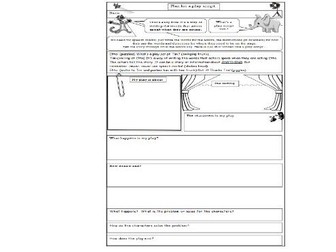
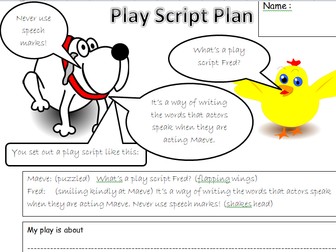
KS1 & 2 play script planning template. A resource for pupils to use to plan their own play. Includes a bullet point reminder of the rules for writing playscripts and spaces for pupils to develop character description, setting, the problem and the structure of their play.
Great to use following a drama or speaking and listening lesson. Can also be used with the majority of topics involving stories and characters (real and fictional).
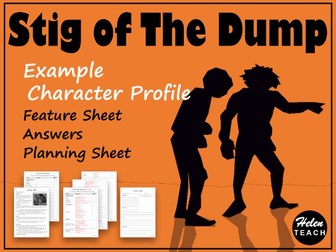
Example character profile text based on information up to Chapter 3 from the children’s novel Stig of the Dump by Clive King.
This exemplar character description of Stig is perfect to use as a WAGOLL when studying Chapter 3 of the text or beyond (not to be used before this point due to spoilers).
The model character profile comes with a feature identification worksheet for children to fill in, plus an answer sheet that can be uploaded for remote learning or shared in class.
After identifying the features of the text, pupils can write their own character description of Stig, Barney, Lou or any other book character, using the Character Profile Template (also included).
The language, grammar and punctuation features to be identified in the text include:
• Similes
• Metaphors
• Rule of three
• Onomatopoeia
• Alliteration
• Fronted adverbials followed by commas
• Synonyms to avoid repetition
• Expanded noun phrases
• Apostrophes for singular possession
• Apostrophes for plural possession
• Dashes
• Brackets
• Hyphens
• Colons
The resource could be used on World Book Day as an example character profile before children create their own.
Resources come as editable Word documents and as PDFs.
Other Stig of the Dump resources:
✦ Complete Unit of Work
✦ Reading Comprehension Tests
Stig of the Dump example texts, with feature find sheet and answers:
✦ Example Texts BUNDLE
✦ Chapter 1: Diary Entries
✦ Chapter 2: Instructions
✦ Chapter 4: Informal Letter
✦ Chapter 5: Dialogue
✦ Chapter 6: Playscript
✦ Chapter 7: Newspaper Report
✦ Chapter 8: Interview Article
✦ Chapter 9: Persuasive Advert
Visit Helen-Teach’s Shop for more resources.
An example character profile text about Varjak from the book Varjak Paw plus differentiated planning and writing templates, word bank, and character matching activity.
The exemplar text is perfect to use as a WAGOLL after reading Chapter 1 of S.F. Said’s fantasy adventure novel.
The character matching activity is ideal
Resources provided:
• Exemplar character profile WAGOLL text
• Planning template differentiated x2
• Writing template differentiated x3
• Personality traits word bank
• Character trait matching activity differentiated x3
• Character trait matching activity answers
Matching Activity
After reading Chapter 1, pupils match the character names with their character traits and relationship with Varjak. This activity will help pupils to learn the characters’ names and their roles, and think about their personalities.
Character Profile Resources
Pupils read the model character description of Varjak based on Chapter 1 and then plan and write their own character profile about Varjak (or any other character such as Julius, Holly or Elder Paw) using the differentiated templates and word bank.
The resource could also be used on World Book Day as an example character profile before children create their own about a character from any story.
The resources are available as PDFs and editable Word documents.
Other Varjak Paw resources:
✦ Varjak Paw WAGOLL Example Text Pack BUNDLE
✦ Varjak Paw Diary Entry Example Text Pack
✦ Varjak Paw Playscript Example Text Pack
✦ Varjak Paw Newspaper Report Example Text Pack
Other popular resources:
✦ The Iron Man Unit of Work | Four Weeks | Year 3/4
✦ Stig of the Dump Complete Unit of Work | Six Weeks | Year 3/4
✦ Moon Landing Diary Complete Unit of Work | One Week | Year 3/4
✦ Stone Age Boy Example Texts BUNDLE
✦ The Twits Example Texts BUNDLE
✦ Journey: Example Writing BUNDLE
✦ How to Train Your Dragon BUNDLE
Visit Helen-Teach’s Shop for more resources.
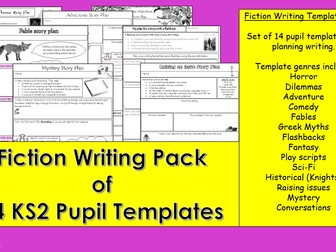
Fiction Writing Genres. Pack of 14 KS2 pupil templates.
Template genres include: Horror, Dilemmas, Adventure, Comedy, Fables, Greek Myths, Flashbacks, Fantasy, Playscripts, Sci-Fi, Historical (Knights), Raising issues, Mystery, Conversations.
Each template includes a bullet point reminder list of the rules for writing in a specific genre and spaces for pupils to develop ideas, character description, setting, the problem and the structure of their stories. Depending upon the genre there are prompts for descriptive vocabulary and phrases, character emotion and responses.
The templates can be used to develop story writing linked to most cross curricular topics and drama particularly Celebrations, Famous People, Explorers, Fairytales and stories, Animals, Greece etc.
I have used these templates with Years 3 to 6 and with HA Year 2 pupils.
An example newspaper report based on Chapter 7 of the children’s novel Stig of the Dump by Clive King.
This exemplar newspaper article is perfect to use as a WAGOLL when studying Chapter 7 of Stig of the Dump.
The model newspaper report comes with a feature identification worksheet, plus an answer sheet that can be uploaded for remote learning or shared in class, enabling pupils to become confident in the genre before an independent or shared writing activity.
Planning sheet and newspaper report templates have also been included.
After identifying features, pupils write their own newspaper report based on the example text by either re-writing the model text, choosing a different event from Stig of the Dump to report or inventing their own adventure for Barney, Lou and Stig.
The language, grammar and punctuation features in the text include:
• Headline in the present tense
• Byline
• Date
• Introductory paragraph containing the 4 Ws (who, what, where, when)
• Quotes, with inverted commas
• Photograph with caption
• Passive voice
• Alliteration
• Past tense
• Third person
• Relative clauses
• Fronted adverbials
• Present perfect tense
All resources come both as editable Word documents to easily adapt for your class and in PDF format.
Other Stig of the Dump resources:
✦ Complete Unit of Work
✦ Reading Comprehension Tests
Stig of the Dump example texts, with feature find sheet and answers:
✦ Example Texts BUNDLE
✦ Chapter 1: Diary Entries
✦ Chapter 2: Instructions
✦ Chapter 3: Character Profile
✦ Chapter 4: Informal Letter
✦ Chapter 5: Dialogue
✦ Chapter 6: Playscript
✦ Chapter 8: Interview Article
✦ Chapter 9: Persuasive Advert
Visit Helen-Teach’s Shop for more resources.
A full scheme of work (12 lessons) based on the playscript Noughts and Crosses.
Students will explore the script in many different ways. They will be introduced to Bertolt Brecht and Epic Theatre. They will then use these skills to devise an assessment using inspiration/stimulus from the play and stories of BLM.
Ideal for Year 9 upwards. Great for giving an insight into GCSE. Includes a Practical and Written Assessment.
Includes:
Full SOW PP
Brecht resources cards
Assessment plan template
Written Evaluation template
Information sheets for assessment
Assessment criteria for both practical and written
Example interview article based on Chapter 8 of the children’s novel Stig of the Dump by Clive King. This exemplar interview write up with Barney’s sister Lou is perfect to use as a WAGOLL when studying Chapter 8 of Stig of the Dump.
The model interview article comes with a feature identification worksheet, plus an answer sheet that can be uploaded for remote learning or shared in class, enabling pupils to become confident in the genre before an independent or shared writing activity. A planning sheet and interview article template have also been included.
After identifying features, pupils plan and then write their own interview article based on the example text by continuing the interview with Lou, or writing an interview for Barney or Stig. This provides the perfect opportunity for the children to role play before they write.
The language, grammar and punctuation features in the text include:
• Repetition for effect
• Onomatopoeia
• Alliteration
• Similes
• Metaphors
• Idioms
• Show don’t tell
• Commands
• Questions
• Fronted adverbials followed by a comma
• Synonyms to avoid repetition
• Expanded noun phrases
• Apostrophes for contraction
• Apostrophes for possession
• Brackets
• Colons
• Semi-colons
• Dashes
• Hyphens
All resources come both as editable Word documents to easily adapt for your class and in PDF format.
Other Stig of the Dump resources:
✦ Complete Unit of Work
✦ Reading Comprehension Tests
Stig of the Dump example texts, with feature find sheet and answers:
✦ Example Texts BUNDLE
✦ Chapter 1: Diary Entries
✦ Chapter 2: Instructions
✦ Chapter 3: Character Profile
✦ Chapter 4: Informal Letter
✦ Chapter 5: Dialogue
✦ Chapter 6: Playscript
✦ Chapter 7: Newspaper Report
✦ Chapter 9: Persuasive Advert
Visit Helen-Teach’s Shop for more resources.
A four week literacy unit of work based on The Iron Man (The Iron Giant) by Ted Hughes for Years 3 & 4, with 20 complete lessons, including all plans, presentations and resources.
This scheme of work for Lower Key Stage 2 contains the following:
• 20 daily lesson plans with differentiation
• 20 lesson presentations with over 200 slides in total
• 48 additional teaching resources with 80 pages in total (model texts, worksheets, feature finds, answers, word banks, etc)
Here are some of the objectives covered in this unit of work:
★ Writing
Diary (with WAGOLL)
Character profile (with WAGOLL)
Dialogue (with WAGOLL)
Playscript
Different point of view
Menu
Similes
Book review
★ Comprehension
Asking questions
Making predictions
Discussing interesting words and phrases
Drawing inferences
★ Spoken Language
Performing
Improvising
Role play
Discussion
★ Grammar & Punctuation
Speech punctuation
Noun phrases
Apostrophes for possession
Fronted adverbials
This unit is ready to teach - just a copy of the novel is required!
All resources and lesson plans come as both Word documents and in PDF format. All lesson presentations come as Smart Notebook, Powerpoint and PDF files.
You may also be interested in:
✦ The Iron Man Quiz With 75 Questions
✦ Oranges in No Man’s Land Example Diary Text with Feature Identification & Answers
✦ Letter to an Ogre Example Persuasive Text, Feature Identification & Answers
✦ Stone Age Boy Example Diary Text with Feature Identification & Answers
✦ The Twits Example Diary Text with Feature Identification & Templates
✦ How To Train Your Dragon Example Diary Text with Feature Identification & Templates
✦ Unicorn Persuasive Letter Example, Feature Identification & Answers
Visit Helen-Teach’s Shop for more resources.
4 great Performance-based resources!
Features of a play script PowerPoint and activities.
A Role play assessment rubric.
Planning a Playscript + 2 Writing Templates.
Drama activities.
** A fully editable unit of work focusing on Holidays.
** A PowerPoint about weather around the world - 13 slides.
** Playscript templates.
** Holiday transport and jobs worksheets.
** Camping holiday resource pack.
** Colouring in activities and MORE!
** Ideal for 6+
Writing for different genres is a downloadable key stage 2 English pack featuring seven original comic strips as prompts to engage and inspire reluctant writers.
The pack includes lesson plans, scaffolded writing templates and worksheets to support children in writing for different text types: a fictional diary, a formal letter, a playscript, a fictional recount, a list, a poem and their own comic strip. It also includes additional teaching ideas to develop children’s own writing skills, including an activity to develop their understanding of metaphor and simile.
The pack comes with a PowerPoint which features a starter activity for each session and useful checklists of the language features and structure of each writing genre.
What’s included?
Includes lesson plans and scaffolded writing templates for each writing genre
Features seven original comic strips as writing prompts
Includes a PowerPoint with starter activities and checklists for the language features and structures of each text type
The sessions can be taught in any order and adapted for different year groups. Perfect for your key stage 2 English lessons to develop children’s skills in writing for a range of purposes.
What’s inside?
‘A Week’s Excuses’ – writing a diary (pages 4-11)
Teaching notes
Comic strip
Diary writing template
Sentence starters
Using direct speech
‘Something Odd Out There’ – writing a formal letter (pages 12-19)
Teaching notes
Comic strip
Letter template with prompts
Letter template without prompts
Blank-bubbled version of ‘Something Odd Out There’
‘Alien Arrival’ – writing a playscript (pages 20-14)
Teaching notes
Comic strip
Playscript template
Blank-bubbled version of ‘Alien Arrival’
‘Jennifer Jones’ – writing a recount (pages 25-28)
Teaching notes
Comic strip
Match report planning template
‘Jennifer Jones’ – all of a muddle
‘Sad I Ams’ – writing a bulleted list (pages 29-32)
Teaching notes
Comic strip
‘Happy I Ams’ – metaphors
‘Happy I Ams’ – list template
‘StereoHead’ – writing poetry (pages 33-36)
Teaching notes
Comic strip
A sense poem planning template
A sense poem writing template
‘The Dark Avenger’ – writing a comic strip (pages 37-42)
Teaching notes
Comic strip
Blank comic strip template and checklist
Blank-bubbled version of ‘The Dark Avenger’
Example newspaper report based on the fantasy adventure novel Varjak Paw by S.F. Said.
This exemplar newspaper article is perfect to use as a WAGOLL when studying Varjak Paw. The example text reports on the events at the end of the novel.
After using the WAGOLL to identify the features of the text, pupils use the templates provided to plan and write their own newspaper report based on the novel.
This resource comes with the following documents:
• Example newspaper report WAGOLL
• Newspaper report planning template
• Newspaper report writing templates x2
All resources come as both easily editable Word documents and PDFs.
Other Varjak Paw themed resources:
✦ Varjak Paw WAGOLL Example Text Pack BUNDLE
✦ Varjak Paw Diary Entry Example Text Pack
✦ Varjak Paw Character Profile Example Text & Character Matching Pack
✦ Varjak Paw Playscript Example Text Pack
Other popular resources:
✦ The Iron Man Unit of Work | Four Weeks | Year 3/4
✦ Stig of the Dump Complete Unit of Work | Six Weeks | Year 3/4
✦ Moon Landing Diary Complete Unit of Work | One Week | Year 3/4
✦ Stone Age Boy Example Texts BUNDLE
✦ The Twits Example Texts BUNDLE
✦ Journey: Example Writing BUNDLE
✦ How to Train Your Dragon BUNDLE
✦ The Boy Who Grew Dragons: Example Text BUNDLE
✦ The Butterfly Lion: Example Text BUNDLE
✦ The Hodgeheg Example Text Packs BUNDLE
✦ The Firework-Maker’s Daughter: Example Text Pack BUNDLE
✦ Charlotte’s Web: WAGOLL Example Text Pack BUNDLE
✦ Flat Stanley WAGOLL Writing & Punctuation BUNDLE
✦ Beowulf: Example Texts & Grammar BUNDLE
Visit Helen-Teach’s Shop for more resources.
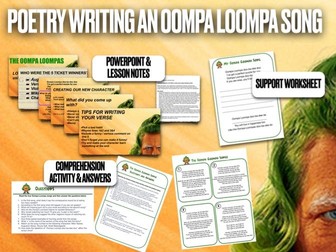
This is a two lesson English based KS2 resource based on the Oompa Loompa songs from Charlie and the Chocolate factory.
Children look at the Oompa Loompa songs featured in the Roald Dahl book ‘Charlie and the Chocolate Factory.’ They are then asked to produce their own song verse / poem based on this model.
A comprehension activity looking at the lyrics of the other Oompa Loompa songs is also included with questions and answers.
This English resource is suitable for year 4 but could easily be used with years 3-5.
Included in this resource is…
-PowerPoint
-Lesson notes
-Supporting worksheet template
-Formatted poems (the Oompa Loompa songs)
-Comprehension questions based on the four songs.
-Teacher copy and answers
A completely unique resource you won’t find anywhere else!
Before the lesson: You might like to complete the ‘Oompa Loompa song comprehension activity’ (included) before this lesson to familiarise the children with the songs. Analysing the rhyming patterns and ‘rules’ of the songs with highlighters.
The lesson
Using the PowerPoint ‘writing an Oompa Loompa song’ as a prompt get children to identify the 5 ticket winners, tell children that they will be looking at one of the Oompa Loompa’s songs in particular that they sing about Augustus Gloop. Play the scene from the original movie from the link on the bottom of slide 2. You might like to get the class to sing the song along with the lyrics too!
Look at the lyrics of the song(s) using the handout ‘Oompa Loompa songs.’ Explore the rhyming patterns, highlight the similarities between the songs and the pattern that is used. Ensure that children understand the main bit that differs in the songs is the middle verse. The lyrics for Augustus Gloop is featured on the PowerPoint.
In groups have children think of other fictional characters that a song could have been written about. For example someone who is permanently on their mobile phone. As a class come up with a bank of examples.
Whole class model an example of writing a middle verse based on one of these examples ensure that this follows a similar pattern to the Augustus Gloop verse (lines 1&2 and 3&4 rhyme and a serious / funny comment is featured on line 5.)
Activity
Children write their own verse for their fictional character either in their books or using the template worksheet as an aid.
If you liked this resource check out my new https://www.tes.com/teaching-resource/playscripts-shrek-boys-writing-converting-text-into-a-playscript-using-movie-clips-11159997 based on the Shrek movie, ideal for boys writing.
This resource covers the integral, surface and deep features of Theme-Based Learning. It contains full-on activities and assessments to cover the skills of literature in an easy, structured, cover-your-bases system. It includes everything you need to get going with theme-based learning in your classroom for 2 weeks (13 days).
This resource includes:
Synopsis: Act 1 and 2
1 STORY ANALYSIS
• Lesson Plan
• Story Analysis Guide
• Critical Appreciation Guide & Format
• Story Analysis Rubrics & Details
2 STORY SETTING
• Lesson Plan
• Setting Template
• Setting Description Format
• Story Setting Details
• Story Setting Rubrics
• Story Setting Exercises - 4
3 CHARACTERIZATION
• Lesson Plan
• Character Types Chart
• Character Description
• Character Description Guide
• Adjectives to Describe
• Character Description Template
• Identifying Character Traits
• Character Description Rubrics
• Character Description Exercises - 2
4 STORY PLOT
• Lesson Plan
• Plot Elements
• Plot Format
• Plot Elements Details
• Plot Summary
5 REVIEW WRITING
• Lesson Plan
• Review Types Chart
• Movie Review Guidelines
• Book Review Guidelines
• Place Review Guidelines
• Sample Reviews
• Review Rubrics
• Review Exercises - 4
6 LETTER WRITING
• Lesson Plan
• Word Bank
• Letter Rubrics
• Sample Letter
• Letter Prompts
• Letter Format
7 ALTERNATIVE RESOLUTION STORY
• Lesson Plan
• Fable - Hare and Tortoise
• Story Components
• Story – Velvet Ribbon
• Genre Features
• Story Rubrics
• Story Exercises - 5
8 POEM WRITING
• Lesson Plan
• Poem Elements
• How to write a Poem
• Poem Rubrics
• Sound Devices
• Comparison Devices
• Literary Devices
• Poem Exercises - 4
9 DIARY WRITING
• Lesson Plan
• Diary Rubrics
• Diary Format
• Sample Diary
• Diary Entry Exercises - 4
10 REPORT WRITING
• Lesson Plan
• Report Rubrics
• Report Writing Tips
• Key Elements of a News Report
• Report Exercises - 3
11 DEBATE
• Lesson Plan
• Debate Rubrics
• Conducting a Debate
• Debate Format
• Balloon Debate
12 PLAYSCRIPT
• Lesson Plan
• Lesson Starter – Jack and Jill
• Play-script features
• Play-script Rubric
• Play-script Exercises
• Play-script – Les Miserables
13 ROLE PLAY
• Lesson Plan
• Role Play Steps
• Role Play Rubrics
• Role Play Exercises – 4
Teachers can use this to enhance the comprehension and language skills of the learners, especially the technique required to get involved in a theme-based learning project.