This child-friendly reflection form supports social-emotional development by guiding children to think about their behaviour, its impact on others, and positive choices for next time. With visual prompts and simple sentence starters, it’s ideal for EYFS and KS1 settings. Use it after incidents to promote accountability, emotional awareness, and restorative conversations in the classroom or pastoral space.
This is a thinking/reflection sheet to be used after a behavioural incident has occurred.
Use this to help the child reflect on what happened, how they were feeling when the incident happened, and what they can do next time to change their behaviour and the outcome.
This resource creates an opportunity to use restorative practice instead of a punitive response.
The think sheet provides evidence to show parents, SLT or external agencies and helps to build up a picture of behavioral triggers and patterns.
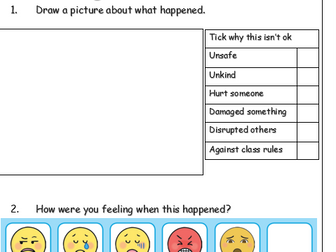
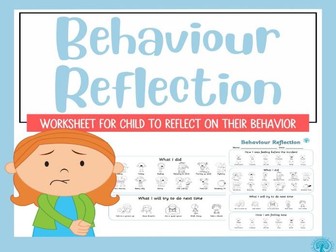
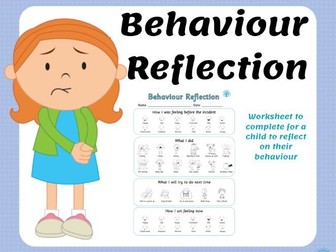
Worksheet for children to complete following an incident in which they can reflect on their emotions prior to the incident, what they did, what they will try to do next time and their emotions now. Included are 2 different versions of the behaviour reflection.
Why do you need this?
A behaviour reflection worksheet provides students with an opportunity to reflect on their actions and behaviours. By guiding students through a structured reflection process, teachers encourage self-awareness and accountability. It also allows children to take ownership of their actions and behaviour and allows them time to think about the consequences of their actions and consider alterative choices they could have made
How and when might you use this?
This worksheet would most commonly be used directly following a behaviour incident or disruption as a tool for children to reflect on their actions. It can also be incorporated into restorative practices or conflict resolution.
What’s included?
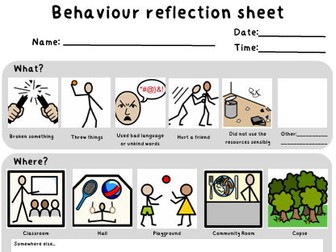
Included are 2 different versions of the behaviour reflection. One which has questions for children to answer in blank spaces and one with pictures that does not require the child to do any writing, just to look at pictures and choose and circle or colour the appropriate one.
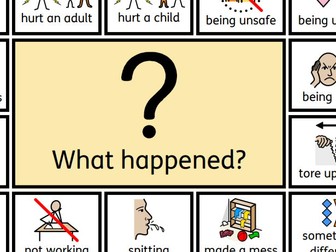
A resource for students with SEN to guide them to reflect on their behaviour. Pages include: What happened?
What were you thinking or feeling?
Who has been affected?
What needs to happen to put it right?
How do you feel now?
Visuals to support reflection of an event/behaviour.
3 books are the same, just different skin tones.
Laminate and make into a booklet, either with treasury tags or in a ring binder.
Worksheet for children to complete following an incident in which they can reflect on their emotions prior to the incident, what they did, what they will try to do next time and their emotions now. The worksheet does not require the child to write, just to look at pictures and choose and circle or colour the appropriate one.
Clipart images courtesy of Kari Bolt Clip Art
Hi all,
This is a simplified reflection book. There is a page for ‘who did this effect’, where you could put in your own pictures.
Hope you like it,
Vicky
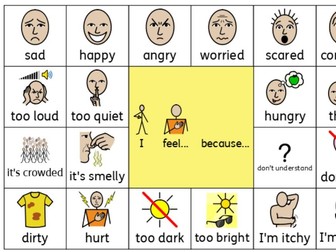
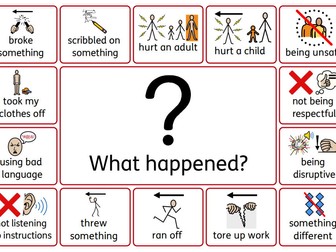
Four symbolised grids that can be used for reflection. To prompt and talk about an event that has happened, the behaviour that was displayed and the reason behind it - allowing adults and children to have restorative conversations.
This document is used for a child to reflect on their learning attitude, behaviour and emotional wellbeing throughout the school day. This document has proved invaluable in nurturing children with little to no self confidence in school!
The child should mark, periodically, where they are on the 'smile scale' throughout the school day enabling supportive reflection 1:1 with a member of staff. I often use a variety of open questions to enable the children to open up and talk about their emotional wellbeing and reinforce the positive aspects of the school day but reminding them, 'It is okay to feel sad'.
I welcome any questions and welcome all feedback.
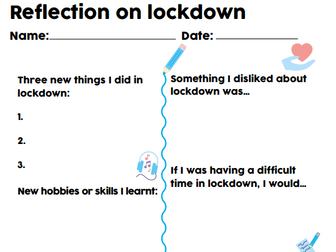
A resource to support children to reflect on the changes that have occurred over the last few months due to Coronavirus.
Some children may find the transition back to school difficult after lockdown. It may be useful in the first few weeks of school to reflect on the lockdown period. This resource helps children think about what they have experienced and cope with the changes that have occurred.
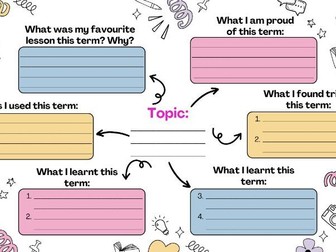
A mind map template with thinking prompts to gauge pupil’s understanding of what has been learned over the term/topic/half term. Fully adaptable for all subjects, and works very well with pupils to reflect on their achievements in the term.
The boxes:
Box 1: What was my favourite lesson this term? Why?
Box 2: What I am proud of this term
Box 3: Skills I used this term
Box 4: What I found tricky this term
Box 5: What I learned this term (1 and 2)
Box 6: What I learned this term (3 and 4)
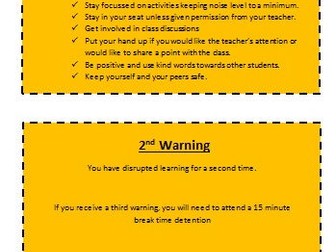
Yellow- 1st Warning
Orange- 2nd Warning
Red- 3rd Warning
Print these cards back to back. Students will recognise the colours and understand the closer they are getting through the warnings. It also reminds students of what is expected of them in the classroom. It also means students are crystal clear on the warning they are on and it’s also easy for class teachers to remember who they have given warnings to without writing student’s names on the board.
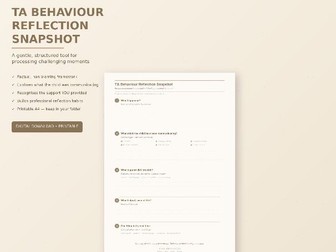
Challenging moments can leave Teaching Assistants questioning how situations were handled and what might help next time.
The Behaviour Reflection Snapshot is a one-page reflective tool designed to support Teaching Assistants after a challenging incident, helping them process events calmly, professionally, and without self-blame.
This resource supports reflective practice around behaviour, regulation, and support strategies, without replacing school systems or increasing workload.
⸻
This resource supports
• Reflecting on behaviour incidents calmly and factually
• Separating observation from emotion
• Identifying possible triggers or unmet needs
• Recognising the support provided by the Teaching Assistant
• Considering small, realistic adjustments for future situations
⸻
How it is intended to be used
This resource is designed for personal professional reflection by Teaching Assistants and education support staff.
It may be used:
• shortly after a challenging incident
• at the end of the day to process events
• to support reflective practice and professional learning
It does not replace school behaviour logs, safeguarding systems, or official records.
Always follow your school’s policies and procedures.
⸻
Format
• Printable PDF
• Digital download
⸻
Related resources
This resource forms part of the SAND framework for Teaching Assistant professional practice.
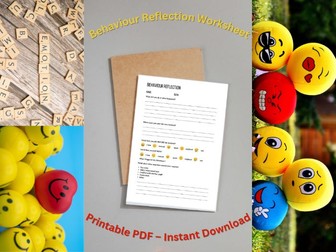
Help pupils understand and reflect on their behaviour with this structured Behaviour Reflection Worksheet.
Perfect for: SEMH support, PRU classrooms, alternative provision, SEND learners.
What’s included:
– 1 behaviour reflection worksheet
– 2 A4 pages (prints over front and back)
– Printable PDF – instant download
Encourage pupils to think about:
– What happened
– Their feelings and triggers
– How to make better choices
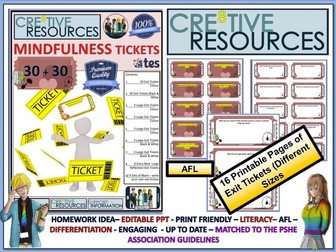
30 Mindfulness Reflection Tickets for students to complete - Use as the perfect plenary or starter task. Product Code: CIT/C8/TL/20
What specific expectations are addressed?
Students will really enjoy reflecting on their learning with these 30 different exit tickets! It also allows you to quickly assess what students have learnt and find any areas where students might need further assistance. These work for any class and any subject and they are so simple to use!
What is included in this product?
16 PAGE pack of classroom-ready activities that will educate and engage students. - Just Print and Go!
Answer Keys:
Student input creates the answers.
Description of Product
x 30 Mindful Exit tickets in Colour version (10 per page)
x 30 Mindful tickets in a Second version (10 per page)
x3 Large Mindful Exit tickets selection (3 Per Page x 3 different copies)
x3 Large Mindful Exit tickets Second version selection (3 Per Page x 3 different copies)
x10 Blank Editable Mindful Exit tickets Version 1
x10 Blank Editable Mindful Exit tickets Version 2
Our Philosophy
We aim to help you equip students with the knowledge and skills to take ownership of their own learning. Products come ‘Ready-to-Teach’ with everything you need to teach fun and creative lessons/ activities . Our products are teacher-designed, classroom tested & student approved.
Find “Cre8tive Resources” on Social Media:
Follow us on social media (Instagram, Twitter and Facebook) to be the first to know about new product releases, giveaways and contests.
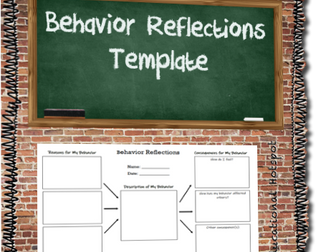
Facilitate students’ reflection on misbehavior with this organized flowchart template. Students are prompted to reflect and identify the reason for their behavior, the description of what the behavior is and what are the consequences of the behavior in class. There are then lines to describe the next steps plan for improvement as well as lines for the student, teacher and parent. This is a great way to transfer ownership of the misbehavior to the student as well as equip them with the skills to problem-solve said behaviors.
Ready-to-use engaging personal development resources preparing young people for adulthood. Including relationships, community, travel, daily & digital living skills. Part of the Life Skills Series.
This maths reflection tool is aimed at students aged 6 - 14 gives a great insight into how your students feel about their abilities in maths, and what areas they still need to work on in the future.
This task allows for both artistic and mathematically minded students to share what they know in the areas of the four operations and general maths.
It takes anywhere from 45 minutes to 2 hours to complete depending upon your students age and ability.
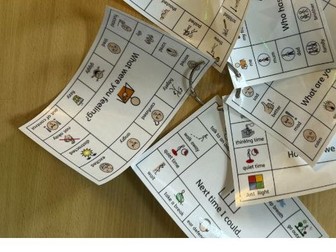
This series of visual choice boards is designed to guide children through calm, structured reflection following periods of emotional dysregulation. Each board supports an emotion coaching conversation, helping the child to make sense of their experience and develop self-regulation skills in a supportive, non-judgmental way.
The boards use visual prompts, symbols, and simple language to scaffold understanding and communication, making them accessible for children with a range of ages and communication abilities.
The series aims to:
Help children identify and name their emotions after moments of upset.
Encourage reflection on what happened, including their actions, choices, and triggers.
Support discussion around the impact of behaviour on themselves and others.
Facilitate collaborative problem-solving to explore how to “fix” the problem, make amends, or choose different strategies next time.
Reinforce emotional literacy, empathy, and accountability in a safe and supportive way.
Each visual choice board focuses on a different stage of emotional reflection:
‘What were you feeling?’ – identifying the emotion(s) experienced.
‘What caused it?’ - – sequencing the events or triggers.
‘What happened?’ – reflecting on actions or choices.
‘Who has been affected?’ – understanding consequences and impact.
‘What are you feeling now?’ - identifying the current emotion(s).
‘How can we fix it?’ – exploring solutions, repairs, or next steps.
‘Next time I could…’ – choosing new strategies or calming tools for future success.
Intended Use:
These boards are designed for use by teachers, support staff, therapists, or parents as part of a restorative and relationship-based approach to behaviour. They can be used 1:1 after a child has returned to a calm state, promoting connection, reflection, and growth rather than punishment.
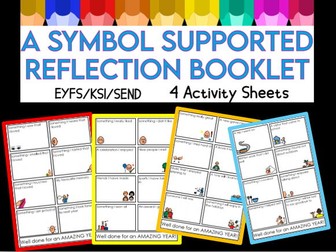
Support your young learners — including those with SEND — with this engaging, easy-to-use 4-page end-of-year reflection booklet, thoughtfully designed with symbols to aid understanding, communication, and emotional expression.
This printable resource helps children reflect on the past year and look ahead to the next, promoting well-being, emotional literacy, and memory skills in a gentle and accessible way.
Each page includes simple visual prompts and open-ended sentence starters with symbol support, making it ideal for EYFS, KS1, and SEND settings.
Children can draw, write, or use assisted communication methods to complete the booklet.
Ideal for:
• End-of-term reflections
• SEND and inclusive classrooms
• PSHE and emotional literacy activities
• One-to-one or small group work
Boardmaker Licenced


 Quick View