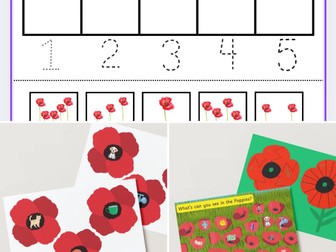
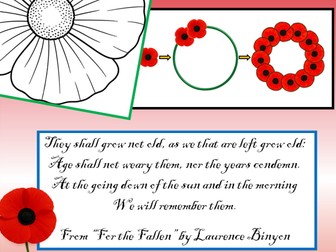
Have your class make their own poppies to write in or draw in to help remember this important day.
Instructions included on the templates.
Print the poppies onto red paper as needed and the leaves onto green paper (3 per page).
You could get children to write:
words of remembrance inside
words to describe our heroes
a poem
information on remembrance or the war
This bundle contains three Remembrance Day resources.
1. A fully editable and informative 80-slide PowerPoint presentation on Armistice Day/ Remembrance Day.
2. A two-minute silence slideshow containing powerful, poignant and carefully selected images for use during the two-minute Remembrance Day silence , beginning with the Last Post and ending with the Reveille. It is set to play automatically.
3. War poems and veteran interviews PowerPoint lesson resource providing insight into the lives, experiences and feelings of World War 1 soldiers. This resource contains a variety of reflective tasks linked to the PowerPoint resource. There are four worksheets and a copy of all the war poems in the PowerPoint.
For more detailed information click on the individual resource links.
Thinking of publishing your own resources or already an author and want to improve your resources and sales? Check out this step-by-step guide:
How to Become a Successful TES Author: Step-by-Step Guide
Deliver a powerful and meaningful Remembrance Day Assembly with this professionally designed, fully editable PowerPoint and worksheet pack.
Perfect for KS1 and KS2, this assembly helps pupils understand the importance of remembrance, respect, and gratitude while promoting kindness, integrity, perseverance, and diversity.
Editable PowerPoint Assembly Includes
Professionally designed slides exploring remembrance, courage, and peace
Fully editable text, images, and transitions for complete flexibility
Detailed teacher notes for confident delivery
Key discussion questions to promote empathy and understanding
Visual, inclusive design suitable for KS1 and KS2 pupils
Bring the story of remembrance to life with respectful imagery, historical context, and opportunities for reflection suitable for all primary ages.
Printable Worksheets and Follow-Up Activities
Reinforce learning with differentiated, ready-to-use worksheets linked to the assembly theme.
Perfect for:
Classroom reflection
PSHE or citizenship lessons
Tutor time discussions
Cross-curricular writing or art activities
Reflection and Discussion Prompts
Encourage deeper thinking with thought-provoking questions designed to help pupils:
Make personal connections to remembrance and gratitude
Reflect on peace, bravery, and sacrifice
Build character and empathy within their school community
Why Teachers Love It:
No preparation required – ready to use instantly
Fully editable and reusable each year
Clear teacher notes and guided reflection prompts
Visually engaging design – ideal for assemblies or classrooms
I used this 15 minute assembly with year 10, but it is suitable for use across all of KS3, KS4 & KS5.
Includes:
-The importance of remembering
-The symbolism of the poppy
-2 minute silence (with video clip to The Last Post)
-Reflection/Prayer
This resource contains a slideshow with sample slides from a more detailed presentation on Armistice Day / Remembrance Day / Remembrance Sunday / Poppy Day. See details below
Remembrance Day Presentation
This is a fully editable, informative and poignant 80-slide lesson/assembly presentation. It could be used for an assembly or lesson on Remembrance Day.
The presentation focuses on:
What is Remembrance Day?
World War 1
Armistice Day
Remembrance Day
The Poppy
The British Legion
How soldiers who gave their lives are remembered
The resource contains extracts from a soldier’s diary, hyperlinks to a recitation of Robert Binyon’s poem For the Fallen, Rudyard Kipling’s My Boy Jack, World War 1 veteran, Edward Francis’ poem about his friend Spotty, a short interview with Harry Patch, Rupert Brooke’s poem The Soldier, John McCrae’s poem In Flanders Fields, interviews with veterans of the First World War, the song The Green Fields of France by John McDermott, a recitation of Moina Michael’s poem We Shall Keep the Faith.
The last slide contains the Last Post.
You may also be interested in:
Remembrance Day Two Minute Silence Slideshow
This is a 65 slide presentation designed to be used for the 2 minutes silence. It begins with the Last Post and ends with the Reveille and has been set to play automatically. The powerful and poignant images have been carefully selected and show scenes of
World War 1
World War 2
Current soldiers in the Armed Forces
War Graves
War memorials
This slide show will help pupils who find it difficult to focus during the two minutes silence to understand why we have Remembrance Day and what was like for both the soldiers on the front line and their families back home.
Thinking of publishing your own resources or already an author and want to improve your resources and sales? Check out this step-by-step guide.
How to Become a Successful TES Author: Step-by-Step Guide
REMEMBRANCE DAY
Are you looking for an assembly resource for your Remembrance Day commemoration this year?
If so, here’s my 10-slide assembly presentation (complete with a poem and prayer) and short drama script.
1: Title
2: What is Remembrance Day?
3: The Poppy; A symbol of Remembrance
4: Remembrance (To)Day
5: Two Minute Silence introduction
6: Two Minute Silence - What could you think about?
7: Prayer
8: What role did children have to play?
9: Poem; The Soldier by Rupert Brooke
10: Title
2 Remembrance Day lessons with a poetry focus suitable for year 7 or lower ability year 8. The first lesson analyses the poem ‘For the Fallen’ by Laurence Binyon. Looks at the language of the poem and the idea of commemorating the fallen hero. The second lesson considers the forgotten heroes and students generate their own poetic tributes to honour them. Literary links to the text The Lion Above the Door by Onjali Q Rauf.
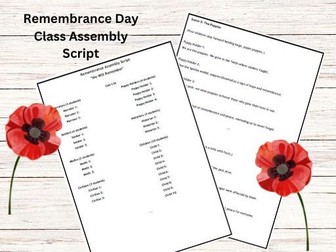
This thoughtful and respectful Remembrance Assembly, designed for 30 primary school children, honors the bravery and sacrifices of soldiers, medics, and civilians who lived through war. Each child has a speaking part, taking on roles such as soldiers, medics, historians, and poppy holders, highlighting the importance of remembering the past and promoting peace for the future. The assembly includes the traditional bugle call “The Last Post” and ends with a heartfelt reflection on the significance of peace and remembrance. It is a powerful way to teach young children about the value of gratitude and hope.
Plan a thoughtful, low-stress Remembrance art unit in minutes.
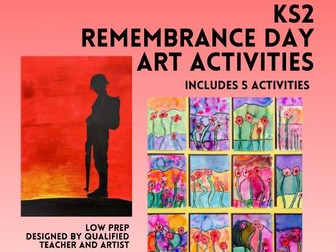
This KS2 Remembrance Day Art Pack gives you five complete art lessons, a pupil fact sheet, SEN support, extension tasks and assessment sheets, all in one editable 20-page Word document. It’s written by a qualified teacher and artist, so every lesson is practical, curriculum-linked and ready to teach.
What’s included
5 step-by-step art activities (each with a materials list, timings, techniques explained, teacher tips and plenary questions):
Poppy Resist: oil pastel and watercolour wash
Tissue Paper Poppy Field collage
Flanders Sky sunset silhouette landscape
Poppy relief print
3D paper poppy wreath for a class display
Plus:
A pupil-friendly Remembrance Day fact sheet with key vocabulary and a quick quiz (answers included)
SEN support and differentiation for every activity
Extension ideas for early finishers
A pupil self-assessment sheet
A teacher assessment rubric (working towards / expected / greater depth)
A class tracker for recording outcomes
A teacher guide with National Curriculum links, planning options and notes on teaching Remembrance respectfully
Why teachers will love it
Clear, numbered steps that a non-specialist can follow with confidence
Techniques explained in plain language, so pupils learn skills as well as making a poppy
Flexible: teach a single lesson, a three-lesson mini-unit or the full five-lesson unit
Calm, respectful and inclusive, focused on gratitude, remembrance and hope for peace
Uses everyday classroom materials
Cross-curricular links to History, PSHE, English and RE
Suitable for: Years 3, 4, 5 and 6 (ages 7-11), classroom teachers, art leads, cover supervisors, teaching assistants, home educators and after-school clubs.
File details: Digital download. One editable Word (.docx) file, A4, 20 pages. No physical item will be sent. Please note this pack contains no photographs, so you can add your own examples.
Two simple but effective lessons and activities. Made this for my LA Year 3 class, but could be adapted for any KS2 class. Includes pictures of WW1 soldiers and key facts and figures about Rememberance Day. Also has a few weblinks.
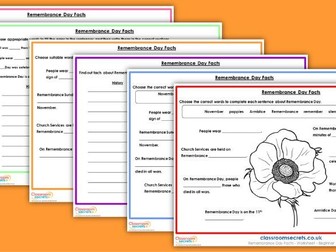
This Ks1 and KS2 Remembrance Day Facts has six differentiated activities linked to historical facts and information about Remembrance Day. It has been designed to be an independent task but can be completed as a class or with a group.
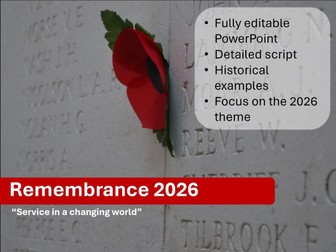
A school Remembrance Assembly exploring how service has changed across generations while maintaining the core values of duty, sacrifice and helping others.
This engaging and reflective assembly has been designed to help students understand the significance of Remembrance beyond simply learning about military history. Using the 2026 theme, “Service in a Changing World”, students are encouraged to consider how service has evolved from the First World War to the present day and how ordinary people continue to serve their communities in many different ways.
What’s Included
Fully editable PowerPoint presentation
Detailed speaker script for every slide
Historical examples
Exploration of modern service
Reflection on the meaning of remembrance in the modern world
Remembrance Day 2026 – Whole-School Assembly PowerPoint & Script
A thoughtful, child-friendly whole-school Remembrance Day assembly designed to help primary-aged children understand why we wear poppies, remember those who have served and think about how we can build peace in our own school community.
This ready-to-use assembly combines history, storytelling, interaction, reflection and a two-minute silence, making it easy to deliver to a whole school with minimal preparation.
Slides include:
Why do we wear poppies?
Children learn about the connection between the red poppy and the First World War, and how poppies became a symbol of remembrance and hope.
The end of World War I
A simple introduction to the end of the First World War and why Remembrance Day continues to be important today.
Understanding generations
Children explore what a generation is and consider how stories of remembrance can be passed from one generation to the next.
Interactive Peace Pledge
Children take part in a simple whole-school activity focusing on kindness, helping others, remembering the past and hoping for peace.
Two-minute silence
A dedicated section guides the school through a respectful two-minute silence, with instructions for teachers and children.
Together, We Remember. Together, We Hope.
The assembly finishes with a positive message about hope, peace and kindness.
Perfect for
Whole-school assemblies
Remembrance Day
Armistice Day
KS1 & KS2
Primary schools
Collective worship
History
PSHE
November assemblies
Remembrance activities
Schools looking for a ready-made assembly
2-3 hours content - 2x lessons and one quiz all about Remembrance / Armistice and World War I. All editable and well differentiated. Perfect for KS3/4 form time, History lessons or Citizenship / PSHCE. The World War I lesson was originally used with a History class but is easily adapted for tutor time.
Many more Tutor Time, Citizenship and PSHE lessons available here:
A tribute to the fallen with appropriate music (Green Fields of France). The emphasis is on commemoration rather than education although some thought provoking statements and images appear throughout the presentation.You may wish to change a few of the photographs to reflect your school, local area, or country's contribution. Contains some famous and powerful images.
11 November is a very special day. It is called
Remembrance Day because it is a day when we remember the end of World War I and the soldiers who have given their lives fighting for Britain. Here we find out about the important tradition of remembrance. Download this resource to read more...
This 15 page workbook is suitable for KS1/2 with pieces of original prose and poetry written by me.
Flash Fiction ;The Belfast Lad. I was delighted when this poem was published a few years ago by Readers Digest. It is based around The Battle of The Somme:-I have created a worksheet to accompany it asking the children to create their own flash fiction about the First World War
Poem;The Breaking of Day I wrote this poem after three young British soldiers were killed in N.Ireland. It reflects modern warfare and can be related to what took place during, The First and Second World Wars, The Irish Rising or recent battles in the Middle East:- I have included a worksheet for the children to write An acrostic Poem The Somme
Poem ;We Will Remember Them:- This poem could be used after any tragedy when people have lost their lives. I have included a worksheet Critical Thinking why and how?
Poem ;Uprising:- An original poem About The Irish Uprising with a worksheet for Internet research
Other activities include
Poetic terminology
Dictionary Work
Types of Poetry
Creative Writing worksheet write your own poem
Discussion questions on Poetry
A Poetry analysis sheet


 Quick View