KS3 new for the Activate 1 unit ‘Particles and their Behaviour’.
Full lesson ready to use straight ‘out of the box’.
Similar structure to my other power points following the input - activity - review phasing
plenary sections for progress checking
Clear learning objectives and outcomes
Modern and engaging layout
Little adaptation needed
Covers an hour lesson of content matched to the specification
31 ppt slides
Please give constructive feedback :D
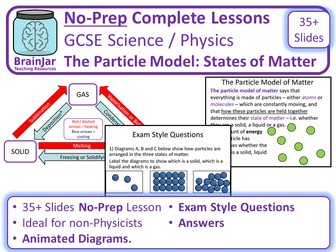
Complete No-Prep lesson with exam questions, tasks and answers on States of Matter, Particle Model (Kinetic Theory), and Changes of State for AQA GCSE (9-1) Science / Physics. This was updated 31st Jan 2022 as I realised that I had not included answers to a couple of questions, and then I made some mainly cosmetic changes 3rd April 2022 - please download again if you are one of the many people who purchased before then.
As a Secondary Science teacher and Deputy Headteacher for many years I make high quality no-prep lessons so busy teachers can teach outstanding lessons without spending hours planning. This high quality lesson includes explanations, different types of in-lesson assessment (all with answers) and unique exam questions.
My lessons are ideal for non-Physicists - as a Biologist who retrained as a Physics teacher I know how to take learners on a journey that builds up their understanding step by step, while still going into a lot of depth. The preview video shows a representative sample of slides from the resource so that you get a good idea of what it includes before you buy.
What’s Included:
• Two Starter / Do Now activities so you can extend this over two lessons if needs be.
• Explanation slides in “chunked” sections with animated diagrams.
• Multiple questions in different question styles and difficulties - no need for worksheets. Each “chunked” explanation section typically includes a set of “learning check / quick questions” followed by a set of in-depth questions on the learning from that “chunk” of the lesson. All questions have answers.
• Exam-style questions on the whole lesson at the end of the lesson- these are unique, based on real exam questions but not just copied from exam boards.
• Answers for all questions
• All easily editable to adapt to your teaching or to use in existing lessons.
• Slightly humorous, at points, if you like that sort of thing.
Learning objectives:
Describe the states of matter – the properties of solids, liquids and gases.
Describe the changes of state between the different states of matter.
Describe kinetic theory - how the particles are arranged and move in solids, liquids and gases.
Link the forces between particles to the arrangement and movement of the particles and to the properties of solids, liquids and gases.
Explain why mass is conserved when a change of state occurs.
Written for AQA GCSE Science and Physics but likely to be applicable to other exam specifications and certainly adaptable for a more able KS3 class.
Please leave a rating / review and all other feedback gratefully received!
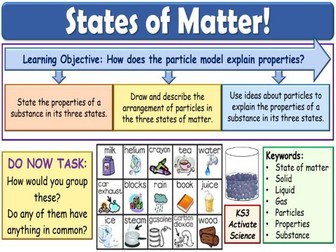
Perfect lesson resource for KS3 Chemistry! A fully differentiated and resourced lesson that assists students in learning about how the particle model explains the properties of the three states of matter. Students will state the properties of a substance in its three states, draw and describe the arrangement of particles in the three states of matter, and use ideas about particles to explain the properties of a substance in its three states.
The resource includes a detailed and engaging lesson PowerPoint with differentiated activities, quizzes and class practical activities for students to complete. This resource is part of the Particles and their behaviour topic and has been created for the delivery of the Activate KS3 Science course. Also great for KS2 Science.
32 slides in total for the lesson PPT
This worksheet contains various questions to help your students learn (or review) basic concepts about Changing States of Matter (Solids, Liquids, and gases). This engaging worksheet can easily be used for science class practice, test prep, morning work, early finisher work, homework assignments, quizzes, or assessments.
In this worksheet, students will answer questions about the following terms:
States of Matter
Change of state
Phase change
Solids
Liquids
Gases
Melting
Freezing
Vaporization
Condensation
Sublimation
Deposition
Melting point
Boiling point
Freezing point
What is included in this resource?
✓ Printable and editable Student Worksheet (PDF and Word document)
✓ Paperless digital version for use in Google Drive (Prepared with Google Slides)
✓ States of Matter and Phase Changes - Crossword Puzzle Activity (Printable)
✓ Complete Answer Key
A PowerPoint with information and tasks designed for recapping the features and properties of solids, liquids and gases and changes of state.
I created this as a revision resource for entrance exams but it could easily be adapted for introducing the topic too.
New for the AQA GCSE 1-9 Combined Trilogy Unit ‘C3 Structure and Bonding’.
Full lessons ready to use straight ‘out of the box’.
Lesson meets the full criteria for this unit
Similar structure to my other power points following the input - activity - review phasing
Plenary sections for progress checking
Clear learning objectives and outcomes
Modern and engaging layout
Little adaptation needed
Each lesson covers at least an hour of lesson time
43 ppt slides
Practice questions and Mark scheme
Please leave constructive feedback :D
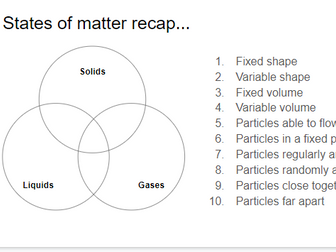
Simple Venn diagram worksheet. Students have to place the statements in the correct place on the Venn diagram. Another plenary I find works really well with this topic is to arrange pupils into groups of two or three and provide each group with a petri dish lid or base and a lump of plastacine. Get the students to make particles out of the plastacine, then arrange them in the petri dish as you would find them in solids, liquids etc. The nice thing about making the partcles in the petri dishes is that you can put them on the projector and get the rest of the class to assess them.
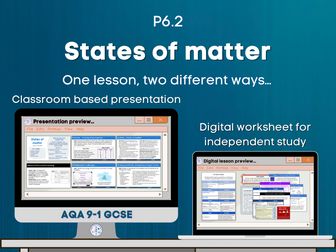
This lesson bundle covers the content for the AQA GCSE Physics P6.2 States of matter lesson in two formats- classroom based lesson presentation and digital worksheet Ideal for distance learning or covering missed content after absence. Students work through a variety of tasks to develop their understanding of the different properties of solids, liquids and gases using the particle model.
Aimed at a mixed ability class covering content 1-8.
1. Classroom based presentation-
Bell work activity
Lesson objective and success criteria
Information slides
Challenge activities (group work)
Practical activity
Demonstrate understanding tasks (with answers)
Please note: Kerboodle worksheets from scheme are not included due to license.
2.Digital worksheet-
Teacher guidance and answers
Engage- Self-assessed vocabulary task using Google Sheets (fact of the day).
Explore- Links to articles, video clips, virtual labs, and simulations for students to explore.
Explain- Embedded Google Slides™ presentation (includes lesson objectives, information slides, self-assessed questions).
Apply- Resources and task in which students apply their knowledge gained during the lesson.
Extend- Resources and task for students to extend their learning.
Please note: This resource works best as a Google Doc ™
If you require more assistance, please contact me at-
cmgeducationresources@gmail.com
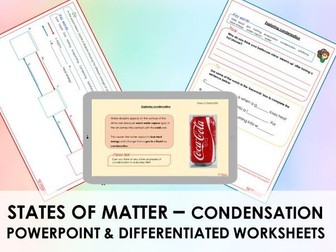
This is the 6th lesson in our States of matter topic. It can be used as a standalone lesson or as part of the sequence.
This lesson pack contains:
A PowerPoint enabling pupils to:
Appreciate the links between all the changes of state through a simple diagram
Gain a deeper understanding of the process of condensation
Explore condensation through real-life examples
2 pages of worksheets containing 4 tasks following a ‘Think, Try, Do, Extend’ format which pupils should be able to work through independently following the PowerPoint.
Differentiated sheets enabling pupils to demonstrate their knowledge and understanding of all the changes of state.
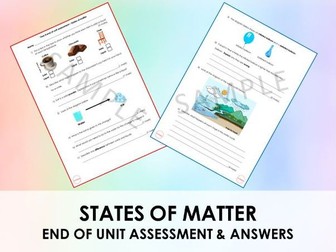
This is an end of unit assessment to support our ‘states of matter’ topic. It is intended for use with our 7 lesson sequence, though could be used as a standalone assessment.
It tests:
Identifying solids and liquids
Changes of state
Properties of gas
The water cycle
Answers are included.
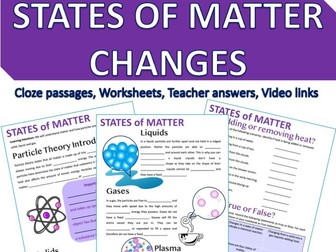
Cloze passage doodle notes and worksheet activities for solids, liquids and gases, changes of states of matter and particle theory. Explains melting, evaporation, sublimation, condensation, freezing and deposition.
This file also includes adjustment / differentiation options for students who may need extra support:
two different word bank options
cloze passage with first letter prompts
Includes teacher answers, supporting video links and worksheet activities to consolidate their learning.
Could be used in class, as flipped learning, online learning or homework. Suitable for junior and middle school science - class 6, class 7, class 8
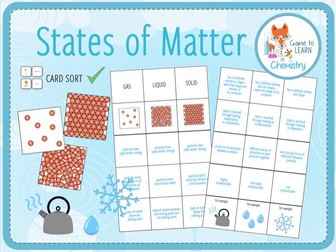
Card sort on solids, liquids and gases and their characteristics
great as starter, plenary or revision activity
30 cards per set
IGCSE Chemistry Topic 1: designed for Edexcel IGCSE (9-1) Chemistry course, but also suitable for other exam boards.
This lesson is designed for the NEW AQA Trilogy Physics GCSE, particularly the 'Molecules & Matter ’ SoW.
For more lessons designed to meet specification points for the NEW AQA Trilogy specifications for Biology, Chemistry and Physics please see my shop: https://www.tes.com/teaching-resources/shop/SWiftScience
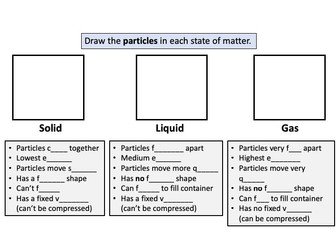
The first activity of this lesson requires pupils to sort cards of information regarding particle arrangement, movement of particles and closeness of particles, into either solids/liquids/gases. Students will then need to copy and complete the table of information, this task can be self-assessed using the mark scheme within the PowerPoint presentation.
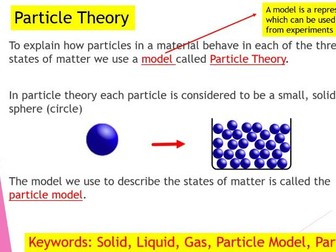
Next, students are introduced to the kinetic theory of matter which applied to solids, liquids and gases. Pupils are given some information on the way particles in these three states of matter behave in relation to each other, particularly the speed/direction particles move in.
Students will now need to watch a video on states of matter and will need to answer a set of questions, once this task is complete students can use the mark scheme provided to either self or peer assess their work. Using information from the video students will complete a diagram to show the transitions between different states of matter, students will need to match the correct process to the correct label on the diagram. Students can then mark their work using the answers provided.
Lastly, students are introduced (or reminded of) the law of the conservation of mass and how this applies to changes of states of matter, before then completing a ‘Quick Check’ task which requires students to answer a set of questions based upon what they have learned this lesson. Again, the mark scheme for this task is included in the PowerPoint so students can assess and correct their own work.
The plenary activity is for pupils to write a twitter message to summarise what they have learned this lesson. including #keywords from the lesson!
All resources are included at the end of the presentation. Thanks for looking, if you have any questions please let me know in the comments section and any feedback would be appreciated :)
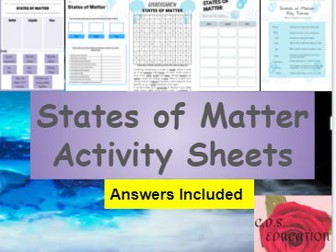
A selection of worksheets that can be used as a revision or during the teaching of the states of matter.
Also ideal material to be left with a substitute as all answers are provided.
Included are:
A starter activity listing solids, liquids and gases
A wordsearch comprising a literacy comprehension with underlined key terms
A properties sorting worksheet
A key word match up
A home learning worksheet that recaps students learning during the lesson on the particle diagram of a solid, liquid and gas as well as the properties.
Answer are included.
Have you also seen my festive Christmas comprehension
https://www.tes.com/teaching-resource/resource-12602253
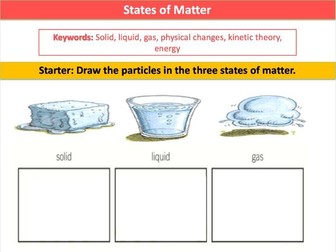
Task 1 - Diagrams of solids, liquids & gas (Printed or drawn into book). Students to sort the statements on slide 2 to decide if it is describing a solid, liquid or gas. Answers included.
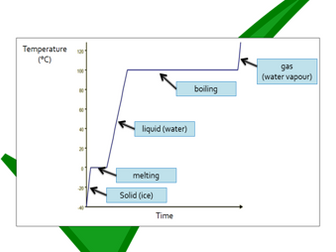
Task 2 - Change in state diagram with keywords for students to use to label the diagram. Answers included.
Task 3 - Differences between chemical & physics changes - Students to decide if the examples are chemical or physical changes. Answers included.
Task 4 - Independent student task to apply their learning. Answers included.
This is an informative and engaging lesson, which has been designed for GCSE but is perfectly suitable for younger students who are studying the states of matter. Students will have encountered this topic at KS3 and potentially before, and therefore the aim of this lesson is to consolidate that knowledge and to deepen in critical areas. A number of quick competitions have been written into the lesson to maintain engagement and to test prior knowledge in a different way. In addition, progress checks are found at regular intervals so that students can constantly assess their understanding. The start of the lesson looks at the different properties of the three states and ensures that particle diagrams are not only recognised but can be explained. A lot of students consider elements to be in one state only at all times and therefore time is taken to show them how the specific temperature is the determining factor on the state. Students are guided through using the melting and boiling points to determine which state a substance is in at a given temperature. The rest of the lesson focuses on changing state and the change in the particles at each of these stages.
Students to draw what solid/liquid/gas states of water look like in the beaker. Then they are to 'zoom in&' to the particles and draw what they would look like for each state. Students to then complete a short extended writing activity using as many keywords as they can to describe the process of ice melting and water boiling. Higher ability students should be able to refer to the movement and arrangement of particles in this piece.


 Quick View