In this lesson students learn words for areas of the school (school grounds) and how to construct basic sentences with prepositions. Some prior knowledge of school subjects is needed for the do-now starter activity. You may wish to substitute some of the tasks with listening and reading exercises from a textbook, however there should be enough material to cover a full lesson without.
Contents:
Do-now activity: translation of school subjects
Learning objectives
Vocabulary introduction with pictures and words
Beat the teacher with pictures: teacher calls out words, students only repeat if it matches the image
Writing: students write down the vocabulary. print out the table to give to students or have them write it down in full.
Grammar: Introduction of preposition vocabulary. Have students write this down.
Translation: ideal for mini-whiteboards but can be done in exercise books
Listening: Make up 5 sentences on the spot if you have time, or skip to the final game
Treasure hunt: English into German and German into English sentences. Play as a whole class.
Small (mini) projects designed to be conducted around your school grounds.
They require students to conduct data collection, presentation, methods, evaluate and create conclusions.
The maps used will need changing for your school, but this is simply just a matter of copying it from Google maps.
This will save you a lot of time and effort.
I have included one PowerPoint to enable you to amend it as you see fit.
My kids loved doing these and we schedule them in for the end of the year.
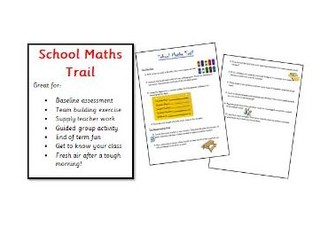
This is a maths trail that I devised for my pupils and involves them exploring the school grounds. It consists of two A4 pages of questions that can be really easily adjusted to suit your school grounds and the age/ability of your pupils. A great way for pupils to apply their mathematical skills and knowledge in context. The questions touch on many areas of maths including: percentages, measures (length), area, difference, calculation, time, shape, symmetry, reasoning and perimeter. I used this as a general baseline assessment at the start of the year and got lots of data to work with - not only from marking their work, but also from observing how confident they were with maths and listening to the things they were saying whilst going around the grounds. The resource is provided in WORD format as well as PDF so that you can adjust to suit your school grounds or the ability of your pupils if necessary.
Ideas for use:
Moving Up Day: get to know the personalities and mathematical abilities of your new class before September.
End of year fun outdoor activity - no prep but can stretch out for a whole afternoon!
Small guided group activity or assessment opportunity.
Make it a team building exercise by using mixed ability groups and introducing a prize for the first team back with the answers!
Baseline assessment at the start of a new school year.
Activity to be left with a supply teacher or a group of pupils who are staying behind from a school trip/residential.
Guidance written by Felicity Robinson to help schools get maximum value from their school grounds/outdoor environments for their pupils’ peaceful learning and play.
Plastic field work (school grounds) is a Key Stage 3 (KS3) lesson. This lesson provides a framework for conducting plastics fieldwork in the school grounds. As per most fieldwork, it consists of three phases: preparation, conducting fieldwork, and then analysis and conclusions. Depending on your school timetable and ability of your class, you will need to set aside three to four hours to complete this fieldwork activity. Suggestions for challenge tasks are included for more able students, if you teach a mixed ability class.
This is a single lesson from Ocean Plastic Geography. Ocean Plastics Geography is a Key Stage 3 (KS3) resource. The lessons address the issue of marine plastic pollution, the harm caused by plastics to the environment and communities, how we deal with all the waste, ending with a debate on approaches to reducing ocean plastic pollution. Fieldwork templates for investigating plastics in the local area are included as well as a wealth of case studies exploring both the human and physical elements of plastic pollution.
Get the whole unit’s resources here:https://encounteredu.com/teachers/units/ocean-plastics
If you liked this resource, please rate and review below. This will help to promote oceans education in schools worldwide.
Some ideas to teach perimeter using the school grounds in a purposeful way. EWAP - Everything with a purpose.
(Please note, no worksheets are included with this free resource).
With science week coming up you might be looking for inspiration. This is a 12 slide powerpoint to take you through the lesson. You will just need to sort your own containers, magnifying glasses and big paper to sort your samples on.
Also included within the lesson are discussion questions.
Information about the career of an Environmental Scientist
Suggestions on sorting characteristics
An end of lesson quiz.
I’ve used this with lower Ks2 but it could be easily adapted/tweaked for other ages.
Inspired by the primary science teaching trust - how and why?
A presentation that has some interesting facts of the mini beasts of your school grounds. A worksheet is also included that students can use to jot down notes, go outside, find the critters and draw and annotate them.
A chance to get students in the great outdoors.
A booklet that allows pupils to practice a wide and varied number of skills on school grounds.
It supports pupils in the development of key skills needed for GCSE geographical success. e.g. grid references, mapping, location, data presentation, data evaluation, questionnaires, methods and explaining.
Pupils use the booklet as a step by step guide to work through tasks, after collection of data on the school grounds.
Simple hypotheses are included along with the opportunity for conclusions.
It will require the changing of the Google earth image of the school, with your own.
This takes roughly half a term for year 7.
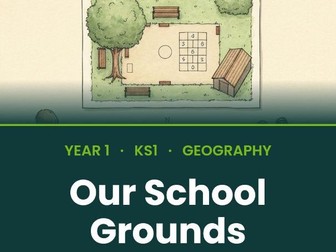
A no-prep, 5-lesson geography unit on Geographical skills and fieldwork: Our School Grounds. Written for Year 1 (ages 5-6). Pick it up at lunchtime, teach it that afternoon — every lesson has a full teacher plan, projectable slides, two differentiated pupil worksheets, and an exit ticket.
Driving question: What can we see in our school grounds, and how can we draw a map of it?
What’s included
5 × Teacher lesson plans (Word, fully scripted)
5 × Pupil worksheets in 2 differentiated tiers (Support / Core)
5 × Projectable slide decks (PowerPoint, 16:9 widescreen)
1 × Knowledge Organiser (Word, A4 landscape)
1 × End-of-unit assessment with baseline + mark scheme
Factually-accurate maps rendered from public-domain Natural Earth data — not AI-generated
Hand-coded diagrams for the unit’s key processes and labelled features — never AI-generated
Original illustrations for every lesson hook and teaching scene
Lesson outline
Looking Around — What Can We See? — To observe and record what we can see in our school grounds.
Bird’s-Eye View — Looking Down on a Place — To understand what a plan view is and how it differs from a side-on view.
Drawing a Map of Our Playground — To draw a simple plan of part of the playground with symbols.
Which Way? — North, South, East and West — To use the four compass directions to describe where things are.
Aerial Photo vs Map — Same Place, Different Pictures — To compare an aerial photograph with a simple map of the same place.
A simple school grounds based project in a self-contained booklet.
The project looks at the best location on the school grounds to build a picnic site.
It involved data collection, presentation, analysis and evaluation. All crucial geographical skills.
It outlines hypotheses and students complete a conclusion based on their findings.
A great end of year activity when the weather improves a little.
Takes about 5-6 lessons to complete.
There is a handbook that accompanies these lesson resources called micro-climate. Theory about micro-climate is introduced first then students plan their own fieldwork . They identify suitable sites on a base map of the school grounds. They then take the measurements and then write up the findings, using the micro-climate theories to support their analysis. There is some student exemplar work attached to support .
This series of lessons uses the Eden Project’s Story-Inspired Learning approach to connect children with the biodiversity in their own school grounds and develop their understanding of the nature and process of scientific enquiry.
https://www.edenproject.com/learn/schools/teaching-resources
Overview of the lesson series
At Eden we use stories as starting points (hooks) and play on children’s natural curiosity to engage our learners. The human brain is hardwired for engaging with storytelling. The ‘Paradise Pastures’ lesson series demonstrate how we take this playful, narrative-led approach and apply this to scientific enquiry. This series of immersive sessions would be best delivered during the summer term. The sessions begin with a period of exploration where the children touch on a range of enquiry types, skills and areas of science knowledge and understanding, and have a range of science experiences outdoors. These experiences act to spark their curiosity.
Key to this lesson series is the idea that science enquiry is about much more than carrying out a ‘fair test’. There are actually 6 types of scientific enquiry: Observation over time, Researching, Identifying, Classifying and Grouping, Pattern Seeking, Problem Solving and Fair/Comparative testing. Once we come to realise and become practised in these different and equally valid ways of ‘finding out’, beyond trying to shoehorn everything into a ‘fair test’, then teachers and their children have more freedom to enjoy the nature of science.
To find out further information about the types of scientific enquiry and the enquiry skills we recommend visiting the Primary Science Teaching Trust website.
After these initial exploratory sessions, the students are encouraged to draw on their experiences and to develop their own scientific question: something which they themselves have become curious about. They are then supported to choose the most suitable enquiry type to investigate their question and complete an investigation before reporting back their findings.
The investigations take place within your school grounds in an area which will come to be known as ‘Paradise Pastures’. It’s likely that the children will already be familiar with the place, however, this series of lessons invites them to take another look at that place and explore it with a fresh focus.
Included are various resources relating to microclimates that formed part of our field work in Year 7 Geography. Students review how to measure the weather, are introduced to microclimates and then label a diagram. Other resources are for use on the day of the field work, where students walk around the school grounds to pre-determined location to measure the weather; they then think about land use and make decisions.
I have also included an 'Exploring Microclimates' PDF provided by School Grounds UK/Learning Through Landscapes. This gives instructions on how to carry out microclimate field work.
You will need a map of your school grounds to complete this activity, Fun sports quiz to help students learn the basics of navigating using a map. I stuck all of the checkpoints to cones and placed them around the school grounds and marked them on the school map as I went along. Great activity that the students really enjoyed.
An introduction of different sampling techniques- simple random sampling, stratified and opportunistic in preparation for the new GCSE. Students collect information on chewing gum around the school grounds and analyse the different sampling techniques.
This lesson looks at footpath erosion and provides people with the opportunities to complete some local fieldwork- perhaps on the school grounds.
This lesson includes:
1. PPT
2. Worksheets
This resource features a PowerPoint art project inspired by the works of Hundertwasser. The goal of this project is to investigate and understand Hundertwasser’s art by analysing its key characteristics.
Students will incorporate Art elements into their own creations, using formal aspects to craft a personal response to Hundertwasser, including imagery from the school grounds.
This download an excellent template for your project, and will need to be adjusted to include imagery of your own school grounds.
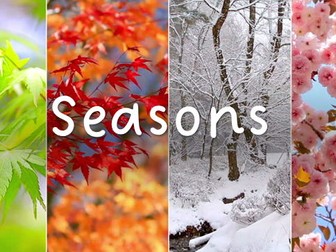
A perfect powerpoint for discussing Winter and the changes that take place during the season, with many helpful question prompts. There are also two activity sheets to complete after the carpet input, in which the children go on a hunt in the school grounds to spot signs of winter. A lovely, simple lesson for EYFS and Year 1, there are two sheets, so you can differentiate which sheet to complete depending on if the activity is for EYFS or Year 1!