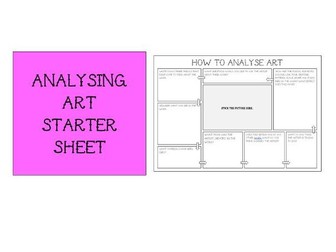
Artwork Analysis Worksheet
Complete with question prompts.
Can be used multiple times over with groups as individual images of art can be stuck in the middle of the sheet.
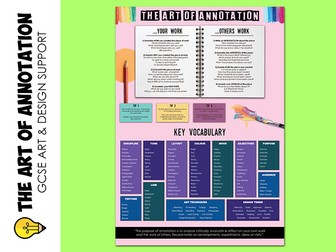
A3 Printable Poster or Helpsheet designed to support GCSE Art & Design students when annotating coursework.
The resource contains questions to guide students when annotating their own work or the work of others (eg. famous artists/designers)
Includes three ‘top tips’ when annotating.
Includes an indepth list of art vocabulary/keywords to use when annotating
You will get:
Printable A3 JPEG
Printable A3 PDF
Print for inside your students sketchbooks or for the wall of your Art classroom!
A collection of Artwork analysis help sheets - designed to help students across KS3 . Pack includes:
Art Vocab sheet/class display - a collection of words suitable for all students, basic art vocabulary linking to visual elements of art. Complete with sentences starters to guide students how to write about their own work and artist work.
KS3 Vocabulary with definitions - glossary for KS3 students to be stuck in their books -a basic guide on common words used across KS3 and their meanings.
Key Terms and words worksheet - again with sentences starters (aimed at a class completing a Cubism project - Cubism specific terms included).
Analysing artwork - a breakdown of how to write an artwork analysis using 4 different areas of analysis: Describe, Analyse, Interpret and Judge.
Giving students the opportunity to use the bullet points to come up with their own ideas and potentially use these bullet points as sentence starters also.
A fun and engaging way to get students to think about analysing Art. The grid is used to help promote discussion points, using dice to decide which question to talk about.
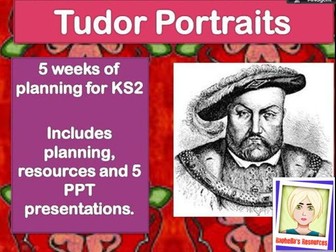
A full Scheme of work for KS2 based around Tudor Portraits.
Objectives covered include:
Exploring and discussing Tudor portraits
How to structure a portrait
How to observe and sketch faces and Tudor clothing
Putting it all together to create a Tudor style portrait.
Each lesson includes all resources and a high-quality presentation.
Please leave feedback.
ART & DESIGN LITERACY MAT - Analysing Art
Colourful and pupil friendly range of Art literacy mats.
Ideal to enlarge to A3 and laminate to display in the classroom or use on tables in the Art room.
MS Word format to enable editing.
This resource provides Secondary school students with guidance for analysing artwork. The structured approach encourages students to stretch their understanding and therefore develop a growth mindset.
This resource can be used in conjunction with other resources from Start Creative Resources.
Browse a huge range of educational resources at https://www.tes.com/teaching-resources/shop/mael
A fun and engaging way to get students to think about analysing Art. The grid is used to help promote discussion points, using dice to decide which question to talk about.
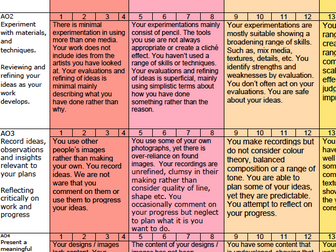
A brilliant resource : AQA GCSE student friendly mark-sheet combined with taxonomy. It is relevant to the current grade 1 to 9, with numbering up to 24 for each assessment objective. A invaluable resource to use with students to mark their own Art & Design work.
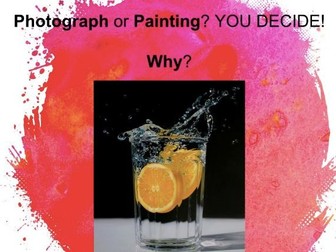
I have created a huge PowerPoint presentation with over 45 starter or plenary activities for your art classes.
The activities are all art-related and can be used in KS3 or KS4 art lessons, either as entry tasks, starters, plenaries or exit questions. Sometimes I put the question on the board at the start of the lesson then come back to it at the end.
The slides are made up of questions, challenges, thought prompts, image analysis, riddles, true or false competitions, thunks and more. Some are very general so can be used across any class or topic, and some are more specific and related to different art movements - for example, Pop Art or Graffiti.
You can use the slides to generate discussion or have students discuss things in groups/pairs etc. I have made them to be as adaptable to your lessons/teaching as possible.
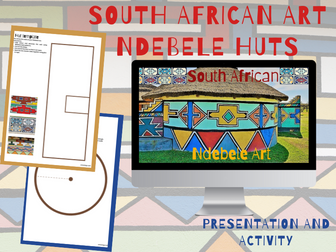
This resource introduces children to the colourful world of Ndebele art found in South Africa.
Children can view the video or presentation and then, inspired by what they have seen create their own model Ndebele hut from paper.
This activity enables children to consider art from a different culture, allows them to explore the use of pattern and colour along with providing an opportunity for model making.
For this activity children will need something to add colour with (crayons, pens, pastels and pencils are all good) scissors and glue or tape.
This resource includes:
Presentation (pdf format)
Presentation (video format)
Printable template and instructions
Ideal to for children at KS1 and KS2.
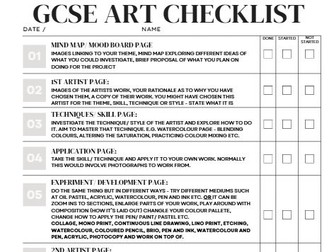
This checklist has been instrumental in our GCSE students achieving grades 5+. It’s a great resource to hold students accountable for their work and it ensures that the students hit all of the assessment criteria.
I explain to my students that this checklist is the minimum needed for a grade 5 and that in order to achieve higher they would spend more time on the experiments and refinement.
HA students use it independently whilst LA and MA use it alongside structured support.
Aimed at KS3, great for a series of 3-4 lessons or for cover.
Includes:
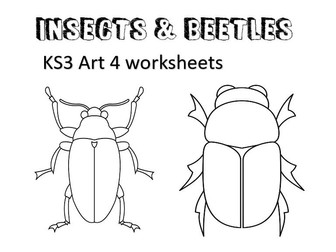
2 worksheets on designing beetles with patterns and collage
1 worksheet on comparing two artists who work with beetles as a theme
1 worksheet getting students to practice their drawing skills by drawing one half of a beetle from a photograph.
Powerpoint lesson walk through - emphasis on visual examples from previous students work, with bullet point/note style explanations of the key things students need to consider when working towards their own final piece idea.
Colour coded breakdown of all four Assessment objectives (AQA) to guide students and show them how each AO links in with their final piece and final idea development.
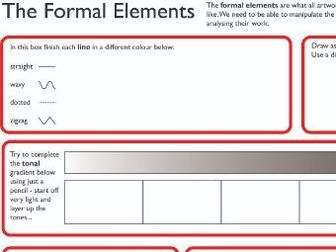
An activity sheet to help familiarise pupils with the formal elements of art. An activity each for: line, shape, tone, form, colour, texture and pattern. Great for a starter, homework or cover lesson.
Requires a range of skills - adding tone, creating pattern and replicating texture.
Simple and easy to use sheets to help aid GCSE students with analysing the work of artists and their own annotations using key words to structure a piece of extended writing.
Can be used as worksheets, posters and or placemats.
Please leave feedback if you found this resource helpful!
Happy Teaching :)
Summary:
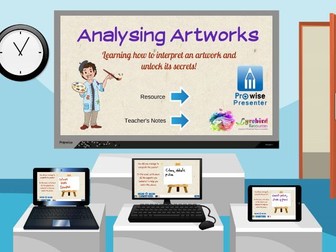
In this lesson students learn how to analyse any artwork by looking in detail at media, composition, context, view point, subject matter, to name a few. The artwork used in this lesson is Franz Marc’s “Regen”, however the skills can be applied to any piece. The aim is to support students to analyse their own artworks and those of other artists creatively and independently with artistic insight.
Australian Curriculum Links:
Explore ideas and practices used by artists, including practices of Aboriginal and Torres Strait Islander artists, to represent different views, beliefs and opinions (ACAVAM114)
Explain how visual arts conventions communicate meaning by comparing artworks from different social, cultural and historical contexts, including Aboriginal and Torres Strait Islander artworks (ACAVAR117)
Identify and connect specific features and purposes of visual artworks from contemporary and past times to explore viewpoints and enrich their art-making, starting with Australian artworks including those of Aboriginal and Torres Strait Islander Peoples (ACAVAR124)
Analyse a range of visual artworks from contemporary and past times to explore differing viewpoints and enrich their visual art-making, starting with Australian artworks, including those of Aboriginal and Torres Strait Islander Peoples, and consider international artworks (ACAVAR131)
UK Curriculum Links:
Review, think about and discuss their own work and the work of others, develop a critical and technical vocabulary relevant to art, craft and design and to the creative, media and design industries and the museum and gallery sector
Become visually perceptive and visually literate through looking, thinking, recognising, interpreting and understanding art, craft and design as a medium of communication and meaning which uses visual symbols and icons
Develop reading and writing skills alongside speaking and listening skills as they research, communicate, analyze, critically evaluate and review their own work and the work of significant artists, craftspeople, architects and designers and make visits to the museum and gallery sector.
USA Curriculum Links:
Explain how a person’s aesthetic choices are influenced by culture and environment and impact the visual image that one conveys to others (VA:Re.7.1.8a)
Compare and contrast contexts and media in which viewers encounter images that influence ideas, emotions, and actions (VA:Re.7.2.8a)
Interpret art by analyzing how the interaction of subject matter, characteristics of form and structure, use of media, artmaking approaches, and relevant contextual information contributes to understanding messages or ideas and mood conveyed (VA:Re8.1.8a )
Create a convincing and logical argument to support an evaluation of art (VA:Re9.1.8a)
A word list, organised by the formal elements of art, which students can use when writing/discussing art work. Can also be printed on bigger sized paper to be displayed in the classroom.
Students are introduced to the topic of energy by analysing research articles and creating a Wordle cloud. Wordle is a free word art tool that crunches any chunk of text and produces a visual representation of the content. The resulting word could emphasise the most common words by amplifying their size based on frequency. Students will increase their knowledge of subject-specific vocabulary and use this knowledge to create an energy limerick.
 Quick View

 Quick View
 Quick View
 Quick View
 Quick View
 Quick View
 Quick View
 Quick View
 Quick View
 Quick View
 Quick View