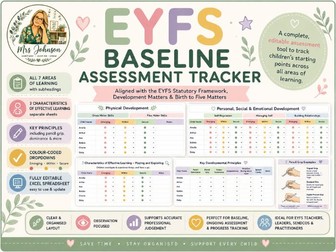
EYFS Baseline Assessment
Nursery / Pre School / Early Years children.
Assessment booklet
Mark making, maths, communication and language, PSED, expressive arts, gross and fine motor.
Mark making sheets
Scissor Control
EYFS Baseline Assessment
Reception / Early Years children.
Assessment booklet
Mark making, name writing, maths, communication and language, PSED, gross and fine motor.
Name writing
Mark making sheets
Scissor Control
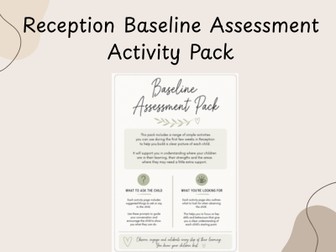
I have created a baseline assessment on entry to Reception, because I struggled to find a baseline assessment that matched the new Development Matters document. Therefore, I have used Development Matters, July 2021 to create this document and to look at what we would expect children to be doing when they enter Reception in September, to be 3-4 years secure. I hope this resource helps you too!
Literacy assessment:
Name writing
Word writing (higher achievers)
Letter formation
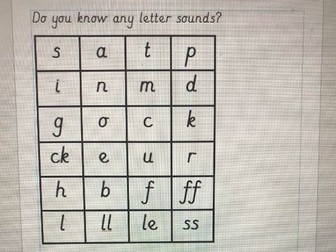
Any sounds known
Rhyme
Initial sound
Nursery Rhymes
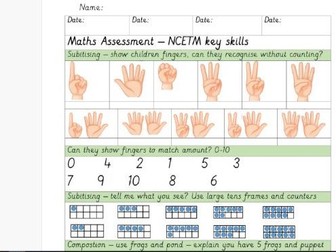
Maths assessment:
Subitising
Oral counting
‘Number fingers’
1:1 counting
Number recognition
Match number and quantity
Shape recognition
Repeating patterns
Colours
More and Less
A completed example of the NPQSL SAT from April 2023 with BPN, which was awarded 49/50.
While future SATs will be have different briefs, this example may provide some inspiration and reassurance as to what BPN and other NPQSL providers are looking for in this final part of the qualification.
The brief for this particular NPQSL was related to improving whole-school curriculum and staff CPD.
Year 1 Baseline Assessment
Year 1 / Primary 2 children.
Assessment booklet
Mark making, sentence writing, phonics, reading, maths, communication and language, PSED, gross and fine motor.
Name writing
Mark making sheets
Scissor Control
3 different formats for children with varying abilities.
These have been made to stick in reading records to share children’s progress with parents and inform them on what sounds/skills need to be developed.
Functional Skills English Reading and Writing Initial Assessment based on Pearson Edexcel criteria. Aimed at post 14- adult learners.
Reading Assessment contains a range of questions from Entry Level to Level 2. Writing Assessment contains three writing tasks aimed at Entry Level 3 - Level 2. Answers and marking criteria included. Also includes a powerpoint providing background to Functional Skills English, a short quiz and icebreaker activity. Takes 1.30 to deliver.
Ace your NPQSL! Summative Assessment Task.
Having successfully completed an NPQSL course in December 2024, I would like to share the summative assessment task that led to gaining the qualification.
**I want to clarify that the case study itself was authored and provided by the course provider, and as such, I do not hold the rights to publish or share it publicly. **
The task example was written in response to a scenario where you are a newly appointed senior leader at a school facing significant challenges - including poor attendance, low attainment, and behaviour issues in a disadvantaged area.
The task was to critically assess the situation, identify the key issues, and propose solutions underpinned by educational research and proven practice. The intention was to present a clear and structured response that could serve as a strong example of strategic thinking and leadership.
The task was divided into the following 3 subheadings:
Identify Problems (10% of marks)
Identify solutions (40%) and set out the rationale for your chosen solutions (15%)
Implementing your chosen strategy(ies) (35%)
I scored highly on the NPQSL Summative Assessment Task, demostrating strong leadership and strategic thinking.
The task did not exceed 2500 words and although this scenario might not be directly applicable to your assignment task, the structure, reasoning and references will give you an example to build a winning summative assessment task.
An end of unit test for year 7.
Includes all major map skills such as compass points, grid references, scale, longitude/latitude and relief. Also includes mark scheme, self reflection sheet and differentiated. DIRT tasks require foundations textbook or could be adapted to suit.
A baseline assessment linked to my progression document.
Following checkpoints and statements from Development Matters, aged 3-4 statements.
Many of these activities can be done through teacher assessment observing children in play but also through CP enhancements and play-based learning. No RBA tablet-style assessing here!
A 6 slide show about workshop regulations and risk assessments. Slide show includes tasks, videos and a relevant homework for pupils to discover more. Slide show work well with the risk assessment worksheet found here: https://www.tes.com/teaching-resource/risk-assessment-worksheet-12003670
This is a word document of the assessment grid from AQA all on one A3 page. e have them printed and laminated at our school and are very helpful for both staff and pupils when performing assessments. This version has the rounded up grade boundaries on from the 2018 exams.
4 different formats for children with varying abilities.
These have been made to stick in reading records to share children’s progress with parents and inform them on what sounds/skills need to be developed. Linked to Read Write Inc assessment 3.
An easy to follow assessment based around Scratch and key programming concepts. Q1 covers “sequencing”, Q2 covers “variables”, Q3 covers “sequencing”, Q4 covers “operators” and Q5 covers “iteration” and “debugging”. There is an easy to follow mark scheme and a revision powerpoint which could be set as homework, prior to the assessment. It is ideal for KS3, especially Year 7 or 8 and is really well differentiated, as there are easy questions and then increasingly trickier ones. It can be set as an end of unit assessment or as a baseline test to find out how much students already know about key programming terms, such as sequencing, variables, selection and iteration.
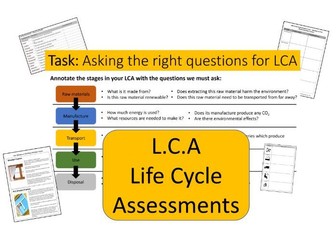
Includes and animated powerpoint with starter, tasks and end of lesson quiz + 4 worksheets.
This powerpoint covers the stages of an LCA for paper vs plastic objects and gets students to think about the questions they must ask themselves about each stage of a product’s life.
Tailored for the AQA Chemistry and combined science trilogy specifications.
Kind regards,
Lewis
The Preview may seem wierd but download format is fine!
Resource details what type of tasks count towards each objective for the Edexcel GCSE Specification in Art and Design.
Students and teacher can in different pens tick the appropriate box- have they completed no work towards, minimal, secure or in depth amount towards that objective.
You can then tally up how many grades you got in each section and therefore clearly see in each AO where students are struggling.
You can then convert the grades on to the grid- so majority of minimal amount would be 2/3 grade. Secure- 4/5/6 and in depth 7,8,9 grades.
There are then four boxes where student and teacher can write in clearly what tasks need to be complete to improve each assessment objective.
Workpack for pupils to prepare for controlled assessments on 'My Town' including: Reading comprehensions and short written tasks, complex structures list and GCSE grammar checklist.
Excel spreadsheet which can be used to analyse test results for a class so you can see where to target your revision? Graph shows poorly answered questions. There is a set of example data already in the data set page. This is help, so that you can see how to fill in. To remove the data, highlight and then CLEAR CONTENTS