

Autism Spectrum Disorder
This is a powerpoint to be used as a presentation ideally in order to aid mainstream staff better work with any autistic pupils. Please make use of the notes sections as they elaborate in more detail. I’ve based the information on here on research undertaken for a book, currently being typed, working with pupils with ASD and my own experience as a teacher who has ASD. Feedback would be appreciated, as would any questions if you have them.
 Quick View
Supporting Students: Autism Spectrum Disorder
This PPT training module with focus on how to support students with ASD.
Supporting students with Autism Spectrum Disorder (ASD) is crucial for their overall development, academic success, and social integration. Here are several reasons why it is important to provide support for students with ASD, along with the role of differentiated learning:
Individualised Instruction: Students with ASD often have unique learning profiles, strengths, and challenges. Differentiated learning allows educators to tailor instruction to meet the specific needs of students with ASD. By providing individualized instruction, educators can capitalise on the strengths of these students while addressing areas of difficulty, optimising their learning experience and promoting academic growth.
Sensory Sensitivities: Many individuals with ASD experience sensory sensitivities, which can affect their comfort and attention in the learning environment. Differentiated learning takes into account these sensory needs by creating a sensory-friendly classroom environment. Educators can adjust lighting, noise levels, seating arrangements, and provide sensory tools or breaks to accommodate the sensory sensitivities of students with ASD, enhancing their engagement and focus.
Communication and Language Support: Communication difficulties are common among individuals with ASD. Differentiated learning strategies can include augmentative and alternative communication (AAC) systems, visual supports, and structured language activities. These strategies assist students with ASD in expressing themselves, understanding instructions, and comprehending verbal and written information. By addressing communication barriers, educators foster effective communication and support language development in students with ASD.
Inclusion and Acceptance: Supporting students with ASD promotes inclusion and acceptance within the classroom and the broader school community. By fostering an inclusive environment, educators help all students appreciate and value neurodiversity. This promotes a culture of acceptance, respect, and empathy, contributing to a positive and inclusive learning experience for students with ASD and their peers.
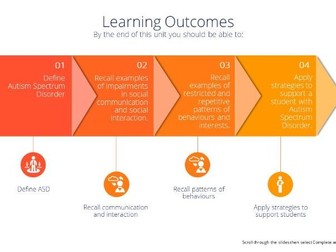
By the end of this training you should be able to:
Define Autism Spectrum Disorder
Recall examples of impairments in social communication and social interaction
Recall examples of restricted and repetitive patterns of behaviours and interests.
Apply strategies to support a student with Autism Spectrum Disorder.
First Holy Communion Social Story Template ASD class, special needs, autism Ireland
I made a little booklet for a student in my ASD class who was making his first holy communion. Just insert photographs of your church and details of time and date. A social story about what you might expect when you go into your local church on the day you make your First Holy Communion. It covers when, where, going into the church, sitting in pews, listening, singing songs and going up for the Eucharist.
SOCIAL STORIES are valuable tools for teaching social interaction skills in an exacting way to people with learning difficulties and/or disabilities. They are particularly effective for those individuals with Autistic Spectrum Disorders (ASD).
Thanks.
 Quick View
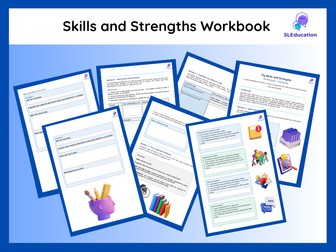
My Skills and Strengths Workbook | Life Skills for Autism | Employability Skills | ASD
This resource is designed for individuals with ASD and those with social communication differences. It helps students recognise their own skills using specific, observable statements rather than vague self-assessment questions, then teaches them to turn those skills into concrete evidence they can use in interviews and applications.
The workbook is a fully interactive, fillable PDF — students click directly into the checkboxes and text boxes to complete it on screen. It can be completed independently or with guidance from a tutor, parent, or support worker.
What is covered:
Section 1 — Spot Your Skills: six skill categories (Reliability & Organisation, Focus & Attention to Detail, Following Instructions, Working with Others, Solving Problems, Communication), each with specific, behavioural tick-box statements and space for their own
Section 2 — Turn a Skill Into Evidence: a worked example followed by three guided writing activities to build their own skill evidence
Section 3 — Matching Your Skills to a Job: a table matching common job advert phrases directly to the student’s own skills
Section 4 — Personal Reflection: guided reflection questions on which skills were easiest and hardest to recognise
Section 5 — Skills Others Have Noticed: a structured activity gathering outside observations from people who know the student well, with guidance for setting it as homework between sessions
*** An Instructor Review page for tutor comments**
Suitable for:
Individuals with ASD and those with social communication differences aged 16+
Students preparing for job applications and interviews
Independent study, or 1:1 sessions and small group work with guidance
SEN specialists, therapists, tutors, support workers, and parents
Format: Interactive fillable PDF
Important: Please download the file and open it in a PDF app or PDF viewer. Fillable fields will not work when viewed in a browser or Google Drive preview. The digital workbook can also be printed and used as a physical copy.
All content uses clear, literal, and neutral language throughout. Resources are universally applicable, with no political, ideological, or religious content.
SLEducation — Where rehearsal meets real life…
 Quick View
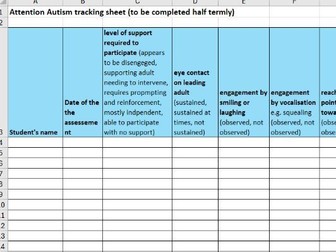
Attention Autism progress tracking sheet
An Excel spreadsheet to track the progress of students targeted for Attention Autism intervention using RAG (Red, Amber, Green) rating.
undefined
Bullying and autism spectrum disorders - a guide for school staff
If you work in a mainstream or special needs school, you will inevitably come across instances of bullying from time to time. While most schools have a clear policy for dealing with bullying, it may not always take account of the needs of pupils with with autism spectrum disorders (ASDs), who are among the pupils at greatest risk of being bullied.
 Quick View
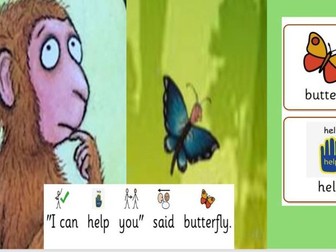
Monkey Puzzle Adapted story for ASD and communication needs
A simplified version of Monkey Puzzle supported with widget symbols to aid reading.
Additional symbols throughout to support comprehension and symbols to answer questions and teach the words yes/no.
Individual communication boards to be used to engage listeners and monitor comprehension while reading.
 Quick View
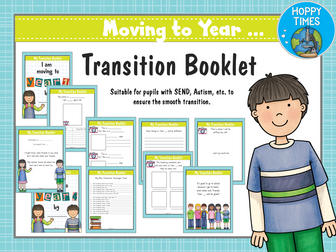
Transition Booklet ( SEN, Autism)
Transition Booklet for KS1/ KS2 - end of year, new class, social story.
Pages 1 - 6 Booklet Cover page (Year 1 - 6)
Page 7 About Me page (name, age, space for a photo, likes/dislikes)
Page 8 Introduction to transition
Page 9 New teacher’s name and space for a photo/ drawing
Page 10 A note from new teacher (to be completed by the teacher)
Pages 11 - 13 Introducing the staff (space for photos and notes to be completed by the Year Group staff)
Page 14 For photos/ drawings of a new classroom
Page 15 New Classroom scavenger hunt activity
Pages 16 - 18 For photos/ drawings of the areas in the new year group (playground, toilets, lunch trolley, etc.)
Page 19 Things that will stay the same in the new year group (to be completed with the pupil)
Page 20 Things that will be different in the new year group (to be completed with the pupil)
Page 21 Blank page
Page 22 Closing page
Page 23 Credits page
For most pupils, transition to a new Year group is an exciting time. For some, however, it can be worrying and unsettling. This booklet is created to be used in KS1 and KS2. Teachers and teaching assistants work on completing the booklet together with their pupils, once completed - the book can be used as a Transition Social Story.
The document is in .pdf format and not editable. 23 pages included.
 Quick View
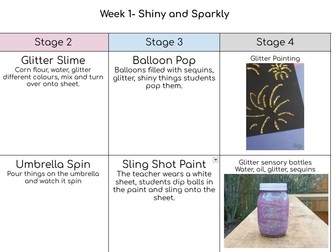
Attention Autism bucket 6 week plan
6-week Attention Autism bucket programme with 3 sessions per week using exciting sensory themes to build attention, engagement, communication and shared enjoyment.
This ready-to-use 6 week Attention Autism bucket plan is designed to support the development of attention, shared focus, anticipation and early communication skills through highly motivating, sensory-rich sessions.
Perfect for EYFS, SEN, Autism provision and specialist settings, this structured programme follows the Attention Autism approach with 3 engaging sessions per week, allowing for repetition, familiarity and skill-building across a half-term.
Each week is built around a motivating theme to maintain curiosity and excitement while supporting predictable routines that help learners feel safe and ready to engage.
Weekly Themes
Week 1: Shiny & Sparkly
Captures visual attention through light, reflection and sparkle to hook even the most reluctant learners.
Week 2: Colour
Bright, bold and visually stimulating activities that build joint attention and anticipation.
Week 3: Animal Beauty
Engaging animal-themed surprises that encourage curiosity and shared enjoyment.
Week 4: Spring Awakening
Seasonal sensory experiences linked to growth, nature and new life.
Week 5: Music & Sound
Highly motivating auditory elements to promote listening, turn-taking and anticipation.
Week 6: Water
A favourite sensory theme designed to maintain engagement and end the programme with high motivation.
Structure
Each week includes:
3 fully themed bucket sessions
Predictable structure to support understanding
Opportunities for repetition and progression
Sensory-rich, visually engaging activities
Built-in anticipation and shared moments
 Quick View
Autism Awareness. ASD. SEN.
Autism Awareness. **
ASD
SEN**
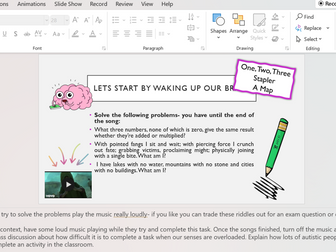
This is an interactive lesson to help both raise awareness of Autism Spectrum Disorder, as well as to help students understand what it may be like to experience some of the potential characteristics of Autism.
This presentation can be used in Tutorial or Study Skills and can also be valuable in Units 2, and 12 of Pearson BTEC Level 3 National Certificate in Health and Social Care
All instructions on how to carry out activities can be found in notes. The different activities include:
experiencing sensory overload
barriers to communication
creating timetables to support routines
creating Wordclouds/ posters to raise further awareness
Autism (ASD) Screener
A simple ASD screener for primary and secondary school pupils.
Please note, this screener does not provide a confirmed diagnosis of ASD but is designed to help professionals/families to identify whether an individual may be presenting with some of the behaviours typical of an individual with ASD. The results of this screener then may help to evidence a referral for a neurodevelopmental assessment if it is felt this would be necessary. Please note, the questions below are taken from a combination of the following documents: DSM-5 Diagnostic Criteria for ASD, SRS-2 ASD Questionnaire, NHS NDD Teacher Observations Questionnaire. Please remember, the autism spectrum is not linear and it is common for an individual to show more difficulties in one area than another.
This was created by an inclusion coordinator of a multi-academy trust and an experienced SENDCO.
 Quick View
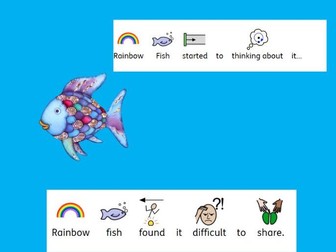
Rainbow Fish with widgit symbols and 4 activities Special Education ASD
Hello Educators!
•This is a PPP of the story The Rainbow Fish (with a few changes)
•Curriculum Links: Literacy, PSHE (friendship, sharing, emotions)
•Topic Links: Sea Animals, Under the Sea, Rainbow, Colours, Friendship etc.
•Props you need: Fish, starfish, Octopus, Glitter for the scales, torch for the cave, emotion cards for the emotions.
• Visual board with Widgit symbols is included.
• Word mat file is included.
•Number Visual for the PPP activity (1-12).
•4 extension activities are included in this pack!
-Activity 1: Counting Rainbowfish
-Activity 2: Bingo mats (Vocabulary)
-Activity 3: PPP counting fish (1-5) PMLD and SLD Level
-Activity 4: Connect picture to visual SLD Level
Enjoy and do not forget to follow me:
Instagram: Special_Education_Classroom
Facebook: Special Education Classroom Group and Page
 Quick View
Social Skills for Autism Workbook
The resource is designed for young people, aged 12+, who have social and communication related difficulties. It may benefit those with Autism or Neurodiversities but will also suit a range of learners who find social interaction, relationships, communication and independence more difficult for any reason. The workbook is packed full with 50 pages of activities that are designed to be used in the classroom or at home. This workbook can be used as a programme of work on social skills for learners who wish to develop these skills. It’s important for the teacher or adult working with the learner to check each activity for suitability for their individual student and that the programme is suitable for the individual.
The topics covered include: Knowing Yourself, Relationships, Emotions, Independence and Social Scenarios.
The booklet is in read-only PDF format.
It can be used with compatible text-to-speech software and coloured backgrounds have been used on most pages so that the booklet is dyslexia-friendly.
Victorian Children and Toys, presentation and activities, ASD
Designed for Y7 pupils, all with autism.
Two PowerPoint presentations - one on Victorian Childhood and one on Victorian toys.
TEACCH style questions (for both topics) to ensure that activities are structured.
Cut and paste activity - cut out pictures of Victorian toys and complete the table.
 Quick View
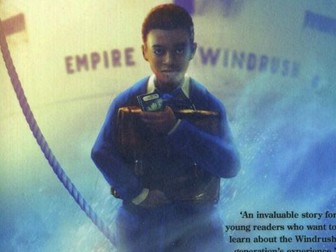
Windrush Child adapted for SEND and Autism
Unti of work adapted for children with SEND and/or Autism based on Windrush Child by Benjamin Zephaniah.
Includes summary of each chapter (in widgits) and reading/writing activities suitable for children with SEND/autism.
Also includes overview planning and sensory activity ideas to support children individually or in small groups.
 Quick View
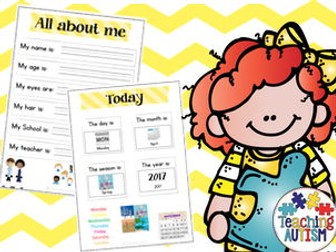
Autism Morning Work Book
This activity includes a morning work book in two different difficulty levels and an editable PPT and Keynote file for you to create and add your own symbols/answers to be included with the easier option.
A morning work book is a great way to encourage students to settle down and prepare them for the day ahead. It provides them with a consistent morning routine when used everyday and they know what to expect.
This book will target some general day-to-day life skill questions that your students will hopefully begin to master with regular use.
There are 3 different types of covers for the morning work books included for you to use as you wish.
There are two difficulty levels included to differentiate for different student individual work levels. The harder work book is where students are able to write their answers - writing lines are provided. The easier work book is where students are able to place symbol cards into the boxes as their answers.
★ If students are not yet at this level please see my easier level good morning greeting book please click here ★
The pages included are;
♦ All About Me
My name, my age, my eyes, my hair, my School, my teacher.
♦ My Family
I live in, I live with, I have _ sister(s), I have _ brother(s), my family's names are.
♦ Where I Live
My address is, the country I live in is.
♦ Today
The day, the month, the season, the year, the date (harder book only for date).
♦ The Weather
What is the weather like today? What should we wear?
♦ My Clothes
What col clothes am I wearing today?
The PDF first page is instructions on how to get the best use out of this book.
UK/British Money/Coins - Matching Task/Autism/ASC/SEN/Maths
Cut out and laminate to create a coin recognition/matching task. Match pictures to pictures or match pictures to value.
 Quick View
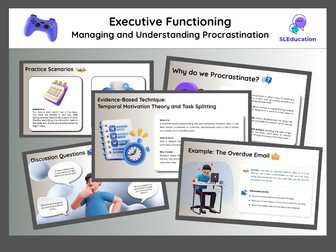
Understanding and Managing Procrastination | Executive Function | Autism | ASD
This structured PDF presentation (full lesson) is designed for individuals with ASD and executive functioning deficits. It explores why procrastination happens, including emotional avoidance, time blindness, and dopamine-driven reward differences, and teaches practical, evidence-based strategies for starting and completing delayed tasks.
What is covered:
What Is Procrastination — the difference between procrastination and laziness
Why Do We Procrastinate — emotional avoidance, task size, distant deadlines, and short-term relief
Why This Can Be Harder for Individuals with ASD — task initiation difficulty, distress tolerance, time blindness, and dopamine-driven hyperfocus
The Universal Struggle — reassurance that procrastination is one of the most common human experiences
What Procrastination Struggles Can Look Like — recognising the signs before they build
Examples — the overdue email, and the assignment left too late
Strategies for Reducing Procrastination — the Five-Minute Start, Temptation Bundling, the Next Physical Action, and Precommitment
Evidence-Based Techniques — Temporal Motivation Theory and Task Splitting, and Self-Compassion research
Practice Scenarios and Generalised Feedback — realistic scenarios with feedback
Practical Tips and Key Takeaways
Suitable for:
Individuals with ASD and executive functioning deficits aged 13+
1:1 sessions or small group work
SEN specialists, instructors, support workers, and parents
Format: PDF presentation
Session time: Approximately 50 minutes
All content uses clear, literal, and neutral language throughout. Resources are universally applicable, with no political, ideological, or religious content.
SLEducation — Where rehearsal meets real life…
Tags:
procrastination, understanding procrastination, managing procrastination, executive function skills, executive functioning autism, ASD executive function, procrastination autism, task avoidance autism, dopamine and autism, hyperfocus autism, time blindness autism, self-compassion strategies, CBT procrastination strategies, special education executive function, SEN executive functioning resource, autism life skills 13+, evidence-based autism strategies, work skills autism, study skills autism, executive function presentation, ADHD
 Quick View
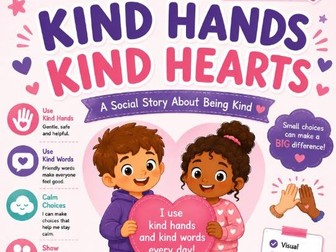
Kind Hands Social Story for Autism ASD
Teach kindness, safe behaviour and positive social interactions with this engaging, child-friendly social story.
This professionally designed Kind Hands Social Story helps children understand how to use kind hands, kind words and safe choices when interacting with others. Created with autistic learners and children with additional needs in mind, it uses simple language, colourful visuals and clear, structured sections to support understanding and emotional regulation.
Ideal for use in schools, nurseries, SEND settings, intervention groups and at home.
This resource includes:
Professionally illustrated social story
Child-friendly visual symbols
Positive behaviour prompts
Kind hands and kind words reminders
Safe choices for managing big emotions
Editable space for a child’s name
High-quality A4 printable format
Perfect for:
Autism (ASD)
SEN / SEND
EYFS
KS1
KS2
Social, Emotional and Mental Health (SEMH)
Special schools
Mainstream classrooms
Home education
This resource encourages children to build empathy, develop positive friendships and learn appropriate ways to manage emotions while promoting a safe and supportive learning environment.
Keywords: Autism, ASD, SEND, SEN, Social Story, Kind Hands, Positive Behaviour, Emotional Regulation, Social Skills, Visual Supports, Classroom Behaviour, EYFS, KS1, KS2, Printable Resource.
 Quick View
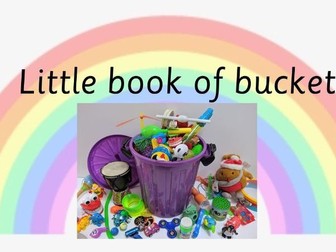
Attention Autism Pocket Guide
A little pocket guide for finding your way around Attention Autism for beginners.
Attention Autism is an intervention created by Gina Davies with the idea to support children on the Autistic spectrum focus and maintain attention. This is a little pocket guide I originally created for a friend of mine with information that I found online and collated together. It has some of the aims and rules of Attention Autism and also some great ideas for Stage 2 and 3. A handy guide to have.
Originally this guide was printed A5, laminated and bound with a key ring.