This Powerpoint covers 1.4.1 (g) - Representation and normalisation of floating point numbers in binary and 1.4.1 (h) - Floating point arithmetic, positive and negative numbers, addition and subtraction.
This presentation shows you step by step how to convert two numbers into floating point binary and it shows you the steps to do it. There are 5 questions at the end which will test your understanding and will give you the answers.
There is an example exam question for adding floating point binary numbers and it's broken down to show how to get the marks and how to get there.
The PowerPoint is plain white and isn't exactly appealing to the eyes but it shows you clearly what happens during each point.
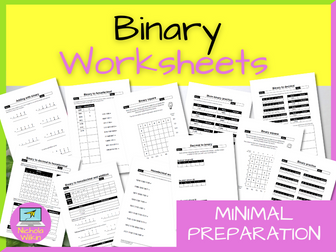
Here are 11 worksheets available for immediate use, requiring no preparation.
They cover binary, denary, hexadecimal and binary addition, making them a valuable addition to your teaching resources. Each worksheet includes a separate answer sheet.
These worksheets can be printed or completed on-screen as PDF files with editable sections for students to enter their answers.
The worksheets serve multiple purposes, including grab-and-go activities, homework tasks and cover worksheets. They are suitable for computer science teachers, non-specialists and new teachers.
The 11 included PDF worksheets are as follows:
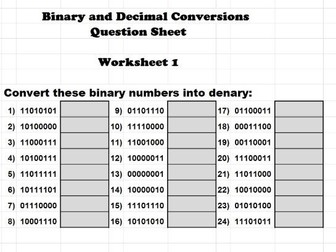
Binary practise: This worksheet features 16 binary numbers to convert into decimal values. It includes placement value headings to aid students in learning binary to decimal conversion.
Binary to decimal: This worksheet presents 5 challenges similar to the previous one, along with an additional 5 problems without bit placement headings. It also includes an extension activity that encourages students to contemplate the use of robots in different scenarios, making it an ideal homework task.
More binary practice: This worksheet provides 16 additional binary numbers to convert into decimal, omitting the bit value headings.
Binary square: This activity serves as a recap or starter exercise, where students input 0 or 1 in squares to form decimal values in rows or columns.
Decimal to Binary PRINT ONLY: This worksheet requires students to convert 3 decimal numbers into their binary equivalents. It can only be completed offline, as students use blank spaces to record their workings.
Binary to decimal to hexadecimal: This engaging worksheet prompts students to convert from binary to decimal and vice versa. It concludes with an exercise where students use a website to convert binary and decimal numbers to hexadecimal. It is suitable as homework before introducing hexadecimal in the next lesson.
Binary to hex: An introductory activity where students complete a conversion table to convert 4-bit binary numbers to hex. They then apply this table to convert longer binary numbers into hex.
Hex words: A fun activity where students convert binary numbers into hex to spell out short words.
Binary to hex and addition: This versatile worksheet serves as an ideal homework task, allowing students to recap converting binary and decimal to hex, as well as binary addition.
Adding with binary: This worksheet provides 6 problems for students to add 2 binary numbers, along with 2 extension challenges involving the addition of 3 binary numbers. It is well-suited for in-class activities.
Answer sheets are included for each worksheet, enabling self-marking or teacher reference.
These 11 worksheets will quickly become essential resources in your teaching toolkit. If you’re looking for more worksheets, you can find them by clicking here.
Purchase now to enhance your lessons instantly and save valuable preparation time.
These are converting Binary to Decimal and Decimal to Binary.
Also included are the teacher answer sheets and as these worksheets randomly generate the questions (and answers) whenever you make a change to a blank cell on the work sheet, these can be used to generate different versions of the quiz which students can self mark very easily (I stick the answers to different versions on the walls of the classroom for students to self check)
My resources vision:
As with all of my resources, a full answer key is included to absolutely<strong> minimise teacher prep time</strong>.
Please comment with any feedback, suggestions or improvements!
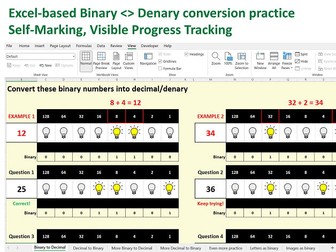
An Excel spreadsheet containing seven worksheets covering binary to denary and denary to binary conversions and representing images and letters using binary.
First worksheet takes students through basic binary to denary conversion using the concept of bulbs being switched on and off to represent 1s and 0s. Students are shown worked examples and provided with four questions to answer. They are given feedback on their answers, and when they have answered all questions correctly on the worksheet, the tab will turn green. This allows teachers to see progress easily and where students have moved on before getting 100% success in the previous tab. It also encourages students to persevere and compete with neighbours to ‘go green’ first.
Tab two introduces denary to binary conversion where students switch bulbs on and off to create the binary number for four denary numbers. Worked examples are provided and feedback given. Tab turns green when completed successfully.
Tabs three and four provide more practice of conversion with 8 questions with feedback on each. No bulbs to prompt this time.
Tab five provides more practice with another 11 questions, the last five without scaffolding.
Tab six is an extension task for students to try converting denary into binary then finding the letter represented by the code to discover the password.
Tab seven is an extension task where students can colour pixels using binary and then try creating their own image using binary.
NOTE: The spreadsheet uses macros which must be enabled in order to activate the feedback and tab colouring on completion of tasks.
Used successfully with GCSE Computer Science students and with Level 3 IT Year 12 students.
Also available – Binary to Hexadecimal conversion and Binary Addition spreadsheet activities.
Please provide feedback!
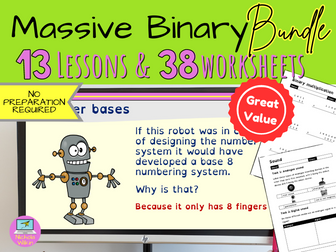
A huge bundle of binary lessons and worksheets covering:
Understanding Binary (2 lessons including 2 worksheets) suitable for KS3
Data Representation (3 lessons including 3 worksheets) suitable for KS3
Hexadecimal (2 lessons including 2 worksheets) suitable for KS3 or GCSE
Binary Calculations (5 Lessons including 5 worksheets) suitable for GCSE and A-Level
Moore’s Law (1 lesson including 1 worksheet) suitable for GCSE
Additional 11 worksheets on Binary
Additional 10 worksheets of Binary calculations
Additional 4 worksheets on Hexadecimal
.
This will give you more than enough content to teach from the very basics of understanding what binary it and converting binary to denary to looking at how text, images and sound are stored in binary and converting to hexadecimal. They also include the more advanced skills of binary addition, 2’s complement, binary subtraction and binary multiplication.
Please read the description in each individual resource to find out more.
You will save money by buying these resources in a bundle rather than purchasing them as separate resources and also save yourself hours of preparation.
EASY TO USE
These ready to use lessons are so straightforward that although I have included a lesson plan, most teachers can teach straight from the PowerPoint presentation without any further assistance. And best of all, the answers are included saving you time and energy.
This makes these lessons suitable for experienced computing specialist teachers along with non-specialists and early career teachers (ECTs).
EDITABLE RESOURCES
I understand that teachers want to adapt their resources, so I’ve made the bold decision to make the lessons editable.
Therefore, if you need to use a particular template style for your school, you can change the PowerPoint presentations to suit your needs.
If you have students with specific educational needs, you can change the lesson to suit them.
It gives you the flexibility to alter the lessons to suit your own particular needs.
SCIENTIFICALLY PROVEN TEACHING TECHNIQUES
These teaching resources have been specifically designed to aid pupils using educational psychology backed theories.
These lessons are highly interactive and engage students straight from the start.
Start reaping the benefits today of incredibly high-quality, professionally designed teaching resources that you can use with virtually no preparation.
Just click on the BUY NOW button to download them straight away. You’ll wonder how you ever managed without them.
Lesson aimed at year 7's to teach them binary. The "Magic Trick" is that you ask a pupil to think of a number and if the number is on the grid you add the number in the top left hand corner.
Practice makes perfect with this activity pack which includes over 1000 questions split between four different challenge levels, allowing students of all abilities to learn how to convert decimal numbers into binary!
Level 1: Eight activity sheets containing four sets of eight numbers each set within a progressive range.
Level 2: Eight activity sheets containing two sets of sixteen numbers both sets within a progressive range.
Level 3: Eight activity sheets containing thirty two numbers each page within a progressive range.
Level 4: Eight activity sheets containing thirty two random numbers within the range of 0 to 255.
Each pack includes 8 pages of 32 questions, converting the numbers 0 to 255 (a byte). Each challenge pack includes clear explanations on how to make conversions and calculation tables to support the given conversion techniques and make students feel confident in doing it themselves.
Each challenge pack is provided as printable pdf so that students can complete them on paper. All answers are included on both pdf and ppt to allow for both teacher or self assessment.
Ideal to use as starter activities, plenaries or homework!
A great introduction to understanding binary. These ready to use lessons will save you hours of preparation and can easily be adapted to meet your own requirements.
WHAT IS INCLUDED?
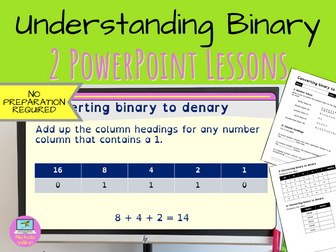
In this unit you have 2 ready-to-use lessons:
Converting 5-bit binary numbers into denary
Converting denary numbers into binary
.
Everything you need is included such as:
a very high-quality accessible PowerPoint presentation for every lesson that effortlessly leads the teacher through the lesson and includes all the answers to the many questions and tasks the students need to complete
a 2-sided editable worksheet for every lesson
an easy-to-follow editable lesson plan for every lesson
.
PRIOR LEARNING
This is the perfect introduction to binary and does not expect the students to have any previous knowledge of converting between denary and binary.
EASY TO USE
These ready to use resources are so straightforward that although I have included a lesson plan, most teachers can teach straight from the PowerPoint presentation without any further assistance. And best of all, the answers are included saving you time and energy.
This makes these lessons suitable for experienced computing specialist teachers along with non-specialists and early career teachers (ECTs).
EDITABLE RESOURCES
I understand that teachers want to adapt their resources, so I’ve made the bold decision to make these resources editable.
Therefore, if you need to use a particular template style for your school, you can change the PowerPoint presentation, worksheet and lesson plan to suit your needs.
If you have students with specific educational needs, you can change the lesson to suit them.
It gives you the flexibility to alter the lessons to suit your own particular needs.
SCIENTIFICALLY PROVEN TEACHING TECHNIQUES
These teaching resources have been specifically designed to aid pupils using educational psychology backed theories including dual coding, Mayer’s theory and the best techniques to alleviate cognitive load.
Your students will have a higher retention rate, better and deeper understanding of the subject matter and will build their confidence in a natural way which reduces distractions and helps them focus on the learning.
These lessons are highly interactive and engage students straight from the start.
TEACHING TO THE TOP
These lessons are designed to stretch all pupils. Instead of traditional differentiation which systematically underchallenges pupils, I raise the bar for everyone and then, as a teacher who knows your own students best, you can support individuals to reach their own full potential.
Start reaping the benefits today of incredibly high-quality, professionally designed teaching resources that you can use with virtually no preparation.
Just click on the BUY NOW button to download them straight away. You’ll wonder how you ever managed without them.
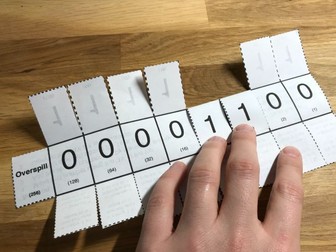
Simple Binary Calculator for teaching binary addition and subtraction, getting students well practiced in the carrying and borrowing required for developing fluency.
A nice tactile approach to binary arithmetic in Computer Science.
Print PDF as Double Sided and flip along the long edge.
A revision homework or class worksheet with answers that covers Binary Fission in B1 GCSE Biology. Topics include Cell Division, DNA, Bacterial Growth and Division Time with a variety of questions.
Tes bundles containing this resource:
94 Sheet GCSE Biology Mega Bundle
11 Sheet Cell Biology Home Learning Super Bundle GCSE
You might also like these resources on Tes:
Diffusion Home Learning Worksheet GCSE
Microscopy Home Learning Worksheet GCSE
Osmosis Home Learning Worksheet GCSE
Active Transport Home Learning Worksheet GCSE
Culturing Microorganisms Home Learning Worksheet GCSE
Browse resources in the same category
Biology resources (link in bio)
Cell Biology resources (link in bio)
❤️
You can also try out our free resources on Tes
What’s included? 👀
1 Revision/worksheet with a variety of different questions
1 Answer sheet with solutions
Which content does it cover? 📚
This practice sheet covers part of Topic 1 of Biology - Cell Biology.
It’s designed for both GCSE Triple Award Science (separate sciences) and Double Award Science (combined science) students.
It’s optimised for the AQA Grade 9-1 Specification 2021
It is also suitable for lower ability students but gets increasingly challenging
@rocketsheets (link in bio)
UPDATE - Please note that the issue stated in the 3 star review does not affect the use of this activity in Excel. Q1 works fine. This is an issue with using in Google Sheets.
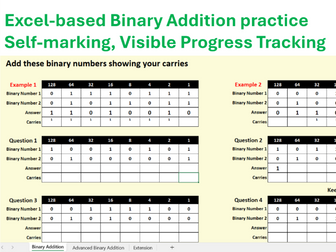
An Excel spreadsheet containing three worksheets covering binary addition.
The first worksheet takes students through basic binary addition including how to carry from one column to the next. Students are shown worked examples and provided with four questions to answer. They must include their carries and are given feedback on their answers. When they have answered all questions correctly on the worksheet, the tab will turn green. This allows teachers to see progress easily and where students have moved on before getting 100% success. It also encourages students to persevere and compete with neighbours to ‘go green’ first.
Tab two provides more advanced binary addition examples that include overflow errors. Students then work through four questions independently and receive feedback on their answers. Tab turns green when completed successfully.
Tab three provides an extension task where students are asked to create their own binary addition sums. They can then complete the answers themselves or can swap seats with a neighbour to complete each other’s sums.
The spreadsheet uses macros which must be enabled in order to activate the feedback and tab colouring on completion of tasks.
Used successfully with GCSE Computer Science students and with Level 3 IT Year 12 students.
Works well with my other number representation activity spreadsheets as a revision aid or as a task to be included in a lesson on binary addition.
Also available – Binary conversion and Hexadecimal conversion spreadsheet activities.
Please leave feedback!
A fully immersive course in binary that includes powerful powerpoint presentations, printable worksheets with answers, a Python binary to deanery calculator.
Binary, Binary Addition, Binary Subtraction, Hexadecimal, Two's Compliment workbook.
Each of the above is explained and practice exercises are included.
This activity has been reformatted from the resource uploaded by sgosrani (https://www.tes.com/teaching-resource/binary-numbers-binary-code-codebreaker-12082318) which was itself an update of the original posted by Tristan Jones (https://www.tes.com/teaching-resource/binary-numbers-lesson-6159776).
I used this in class as an extension activity following focus on counting in eight bit binary. Students had also previously completed a caesar cipher topic.
A quick introduction to the Binary number system (which has made it into the new draft maths curriculum). Binary-Bot explains how Binary is a base 2 number system and gives some examples of how numbers are represented using 0s and 1s.
I'm not an expert in Binary so if you notice any mistakes please let me know so I can edit the resource.
Comments much appreciated : )