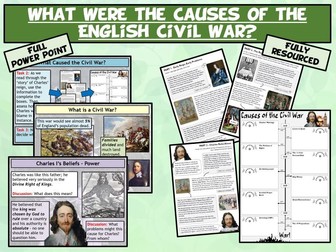
**This lesson provides students with a great selection of activities to help them understand and explain the main causes of the English Civil War in 1642. **
-Students are introduced to the idea of a Civil War and will discuss the role of a parliament in the 1600s.
-They will then read through a variety of different reasons why King Charles I and parliament argued in the years before 1642 and organise these reasons into economic, religious or political factors.
Finally, students will have an opportunity to fully explains the causes of the English Civil War in a piece of extended historical writing before completing a crossword which covers all the main terms from the lesson.
The 17-slide lesson contains a variety of discussion tasks, activities, printable resources, starters and learning reviews as well as engaging background information about King James I and the events which led to the start of the English Civil War.
Please be kind enough to leave a review of this lesson if you have found it effective. Thank you.
All images used in this lesson are in the public domain and are therefore copyright free at the time of publishing. Images which require attribution have been attributed in the notes section of each slide where the image appears. If you feel any errors have been made, please contact me at raschoolresources@gmail.com in the first instance to resolve any issues. Thank you.
This lesson forms a SOW on the English Civil War, there are two lessons on why the Civil war happened and then the other lessons look at the impact. This lesson includes starters with answers, a worksheet with tasks and time lines to build chronological understanding.
This resource was made for SEN students but could work well with less able main stream students. This lesson explores events and reasons leading to the American Civil war.
The resource is supported by a video clip and differentiated tasks and a word search activity
This lesson contains:
A starter task that has questions that can be amended or altered based on what you have been previously teaching.
An overview of the situation so far in the war and that neither side had won decisive victories. Students are then introduced to the new leaders Fairfax and Cromwell and the idea of a new ‘model army’, why it was created and what the intention was.
An activity to then use an information sheet to answer questions on the key information about the new army and then to explain how the new types of troops might help them win.
A task to study the rules laid out for the army. Students use the questions on the board to write about what made them religious, disciplined and brave. Students summarise the key provisions while doing so.
A plenary to recount key words.
Attachments:
1 x Powerpoint Presentation
1 x Publisher File
This lesson contains:
A starter task that has questions that can be amended or altered based on what you have been previously teaching.
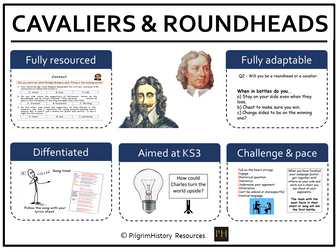
A brief introduction to the start of the war, and then students use the information presented on the PPT to complete the boxes on their worksheet to differentiate between the Roundheads and the Cavaliers, who they supported, what they wore and what their aims were.
An activity to study the information sheet and find out about the different way in which musketeers and pikemen fought, as well as then labelling the two different soldiers based on the descriptions on the sheet.
An activity to find out about the difficulty faced by soldiers when choosing sides. There are four large sources and for each, there is a question that analyses what is being said. The students answer these questions in their books with an extension to explain two reasons why soldiers found it hard to choose sides.
A plenary activity which can be done as a whole class on the board. There is a summary task on an interactive website from British Civil Wars. It is a drag and drop activity which can be done as a whole class discussion.
Attachments:
1 x Powerpoint Presentation
2 x Publisher Files
This is one lesson from a completely fully resourced and integrated series of 17 lessons on the Russian Revolution. It was designed for GCSE History but has also been used very effectively at KS3 level.
Each lesson contains as a minimum:
• Recap from previous lesson
• Keyword flashcards (in a unique ‘Pokémon card style’ template!)
• Writing skill challenges building up to fully developed PEEKA paragraphs (these increase in complexity as you move through the lessons)
• Text with comprehension questions
• A ‘reverse engineer’ essay question task.
• A model paragraph with a ‘how can you improve?’ task
• Stretch questions.
• Video links.
The 17 lessons are as follows:
Russia and its discontents (free)
1905 Revolution (free)
The First World War (free)
Rasputin
February Revolution
Mid-Module Revision Tasks and Knowledge Check
Provisional Government
October Revolution
Bolsheviks & Constituent Assembly
Treaty of Brest-Litovsk
Russian Civil War
Russian Civil War – Why did the Reds win?
Russian Civil War – War Communism
Russian Civil War – Kronstadt Naval Mutiny
Russian Civil War – New Economic Policy
Russian Civil War – Lenin’s Legacy
End of unit – all revision cards, revision tasks, assessment questions, models and criteria.
Hope they help.
Wolsey Academy, a non-profit resource provider, directs all profits to various charities, including refugee support, youth sports, educational programs, and carbon capture, achieving a carbon-negative status. Explore our site for resources and free history role-playing games loved by students. Thank you for your dedication to teaching and for supporting our mission.
#BetterTeachingBetterPlanet
This fun and engaging lesson has been designed by experienced teachers to help students understand and analyze the causes of the English Civil War, through the medium of a card sort. It has been extensively field tested in the classroom with middle and upper ability students aged 11 - 18. We have also included a short PowerPoint with additional tasks and activities so that this activity could be used as the key focus for a lesson. If this resource isn’t suitable for your students, please do check out our other lesson on this topic.
When you purchase this lesson, you will be able to download a two page Microsoft Word document which includes a lesson objective, instructions, three heading cards labeled ‘Political’, ‘Economic’ and ‘Religious’ as well as 24 information cards that can be cut out and sorted by your students. I usually give out page one to my middle ability students and give out page two extended my middle and higher ability students. Page two also includes a thinking skills review triangle to help students prioritize which factor was the most important as well as a consolidation extended writing activity. The PowerPoint includes aims, objectives, differentiated outcomes, starters, plenaries and instructional slides for the activities in the card sort.
The aims of this lesson are:
Theme: The Causes of the English Civil War
Know: Why did the English Civil War break out in 1642?
Understand: What were the political, economic and religious causes?
Evaluate: Which cause was the most important?
WILF – What Am I Looking For?
Identify & describe: Why did the English Civil War started in 1642?
Explain: What part did political, economic and religious factors play?
Analyze: What was the most important cause of the English Civil War?
If you like this resource then why not check out my other resources on this topic in my TES shop. You can also follow ‘The History Academy’ on Twitter, Google Plus, YouTube and Facebook for the latest updates or even to get in touch and chat about how you have used this resource or to ask questions. We aim to produce cheap and affordable resources for either the price of a good cup of coffee or a happy meal so that you can spend more time doing the things that you want.
Anyway, have fun and stay in touch via social media for the latest updates.
Kind Regards
Roy
Empower your students to explore one of the most transformative periods in modern history with this Civil Rights & Post-War Britain Bundle. Designed for KS3–KS4 History, this comprehensive pack examines how Britain and the wider world changed after 1945 — from migration and rebuilding to the fight for equality and justice.
Overview
This bundle brings together engaging lessons and resources covering:
Post-War Britain — rebuilding society, the welfare state, and the impact of the Empire Windrush.
Migration and Multiculturalism — experiences of new communities and the challenges of integration.
Racism and Civil Rights — comparing movements in the UK and US, including Martin Luther King Jr and British activists.
Changing Attitudes — how social, cultural, and political shifts reshaped identity and equality in the late 20th century.
Learning Outcomes
Students will:
Understand the causes and consequences of post-war migration
Evaluate the impact of racism and civil rights movements
Analyse historical sources and perspectives
Reflect on how attitudes toward race and equality evolved in Britain and beyond
Ideal For
KS3/KS4 History units on Post-War Britain, Civil Rights, or Social Change
Citizenship and PSHE cross-curricular links
GCSE thematic studies on equality and diversity
This lesson contains:
A starter task that has questions that can be amended or altered based on what you have been previously teaching.
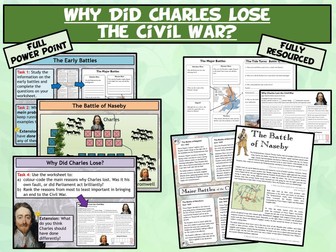
A video from YouTube which summarises the main events of the war. Students then use the information provided to find out about 4 such battles. The worksheet contains questions to elicit the key information. Students can extend their thinking by discussing what either side might have done differently to get a decisive victory.
A chance to take a detailed look at Naseby, the battle which turned the tide of the war. Students are introduced to the location and the alignment of the troops. There is a video summary of the battle and how it was fought, and then the PPT provides a ‘talk through’ opportunity with animation to show the progression of the battle.
A task to use the information to complete their worksheets and answer the questions.
A final task to colour-code the main reasons why Charles lost the war, and then do a write up to say what the main reasons were.
Attachments:
1 x Powerpoint Presentation
3 x Publisher Files
This lesson examines the Battle of Gettysburg, fought from July 1 to July 3, 1863, during the American Civil War. Students will learn about the key events, causes, and consequences of this pivotal battle. Activities include video analysis, timeline sorting, guided reading, and writing PEEKA paragraphs. The lesson concludes with a discussion on the significance of the Battle of Gettysburg and its impact on the Civil War’s outcome.
Lesson Content and Activities:
Introduction:
Discuss the Battle of Gettysburg and its significance in American history.
Introduce today’s keywords: Gettysburg, Robert E. Lee, George Meade, Pickett’s Charge.
Video Task:
Watch videos on the Battle of Gettysburg and write a short summary of the events.
Timeline Activity:
Sort the timeline cards into the correct chronological order of the battle’s key events.
Primary Source Analysis:
Read and analyze primary sources related to the Battle of Gettysburg.
Complete guided reading activities.
Causes and Consequences:
Categorize and sort evidence into causes and consequences of the Battle of Gettysburg.
Relay Activity:
Work in groups to relay information about the events of the battle using a diagram with icons.
Guided Reading Activity:
Complete guided reading activity, subtitling each paragraph and noting key facts.
The Gettysburg Address:
Read and discuss President Lincoln’s Gettysburg Address and its significance.
Storyboard Activity:
Create a storyboard for a video game featuring the Battle of Gettysburg, focusing on the environment, characters, and actions.
Writing Task:
Write two PEEKA paragraphs explaining two consequences of the Battle of Gettysburg.
Peer Assessment:
Read through a partner’s paragraphs, highlight each PEEKA section, and provide feedback.
Class Discussion:
Share and discuss the PEEKA paragraphs.
Recap Quiz:
Participate in a recap quiz to reinforce key points from the lesson.
Resources:
Video links on the Battle of Gettysburg
Timeline cards
Primary source documents
Guided reading text
PEEKA paragraph guidelines and planning sheet
From a series of over 50 lessons made by Wolsey Academy on the history of the United States. They provide a thorough foundation of knowledge in this vital period of world history and provide an excellent foundation for all future study. Each lesson looks to focus on a range of historical skills and exam techniques to equip students with knowledge and transferable research, analysis and study skills.
To find the complete bundle search on the Wolsey Academy website.
Wolsey Academy operates as a non-profit, with every penny we make going to one of our charity partners or into the Ipswich Initiative, funding good works across the town and county. Search for Wolsey Academy to see our website for more details and to purchase resources at a discount.
Use code ‘WOLSEY’ for 10% off at the Wolsey Academy Web Store.
Please help us, help you, help them. Thank you.
Hope it helps.
W
40 slide power point looking at the Russian Civil War
What is a Civil War?
Who was involved in Civil War - Source task
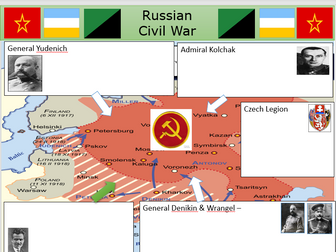
Overview of the Russian Civil War - info slide
The Whites
The whites - map work
The Greens - inc. task
The Greens - map work
The Reds - inc. task
The Reds map work
Source - Reds V Whites
Causes of the Russian Civil War - overview
Causes of the Russian Civil War - Constituent Assembly
Causes of the Russian Civil War - Treaty of Brest Litivsk
Causes of the Russian Civil War - intervention by great Powers
Great powers - source task
Events of the Civil War - overview
Causes of the Russian Civil War - task (inc. worksheet)
Key events from the Russian Civil War - Tsar’s murder
Key events from the Russian Civil War - Polish - Soviet War - Inc video link
Key events from the Russian Civil War - Kronstadt Rebellion
Key events from the Russian Civil War - Kronstadt Rebellion source task
Key events from the Russian Civil War - formation of the USSR
Why did the Reds win the Russian Civil War? - Overview
Why did the Reds win the Russian Civil War - Foreign forces throughout Russia
Why did the Reds win the Russian Civil War - Geography
Why did the Reds win the Russian Civil War - Propaganda
Why did the Reds win the Russian Civil War - role of Trotsky
Why did the Reds win the Russian Civil War - Role of Trotsky - source task x2
Why did the Reds win the Russian Civil War - genuine support
Why did the Reds win the Russian Civil War - Economic Policy (briefly)
Why did the Reds win the Russian Civil Wa - Red Terror
Why did the Reds win the Russian Civil Wa - Red Terror - source task
This 17th century lesson investigates the actions of women during the English Civil War. It looks at the lives of different women including the rich and the poor as well as case studies including Elizabeth the daughter of Charles I, Lucy Hay, Alice Stonier, Lady Lucy Hutchinson, Elizabeth Alkin, Jane Whorwood, Mary Lady Bankes, collective protests and ‘Mr Clarke’. This is such an important lesson to show that women also had a part to play and that they were not as invisible as may seem.
This download includes a fully editable powerpoint with all activities, instructions, clip links and worksheets/information sheets you need. It is differentiated 2/3 ways where possible with scaffolding and challenge options and is fully planned with plenty of activities for your students to complete including a starter, all clips and related tasks, think pair share mini plenary, case study information sheet, a consolidation explain written question and a plenary.
Activities are planned to encourage thinking and discussion.
This lesson can be used as a part of a growing bundle on ‘The 17th Century’ which includes Charles I & Civil War, Charles I Execution, Witch craze and Women in the Civil War: https://www.tes.com/teaching-resource/resource-12925088
And ENGLISH CIVIL WAR: https://www.tes.com/teaching-resource/resource-12925082
Please take a look at our growing TES shop where you can find free or inexpensive lessons:
https://www.tes.com/teaching-resources/shop/DiscoveringHistory
If you are happy with your resource, PLEASE LEAVE US A REVIEW! If, by any chance, you encounter any issues with the resource, please email us at discoveringhistoryuk@gmail.com and we’ll try to solve them for you.
We have a wide range of KS3 & GCSE History lessons on their way, please keep an eye out - follow our social media pages for freebies, new resources and interesting facts!
Got a lesson suggestion? Or looking for something in particular? Email us!
A whole lesson on the causes of the American Civil War, directed towards the AQA ‘America 1840-1895’ unit. This lesson includes all 9 different causes of the civil war, assessment focus, exam skills, differentiated sources and homework.
Dear Colleague,
This is the fourth lesson on the English Civil war. It aims to have students matching knowledge on the battles and main events while answering GCSE tailored exam questions.
All lessons are interactively assessed and have the same structure to get the students taught in a coherent manner, help them understand where they are at, during the delivery:
LO 1:To understand the key battles of the English Civil War.
LO 2: To explain the impact of the battles.
LO 3: To evaluate why Parliament won the English Civil War.
Three progressive tasks plus extension.
All tasks are assessed.
A very straight forward lesson.
The resources are at the end of the Power Point, ready to print and start.
There is an extension and a brain-warming introduction.
You might want to look at the full sets on Medieval, The Norman Conquest or the Civil War.
Please star review my resources, it will help growing this shop.
For any further query contact me at alepitirra@hotmail.it
Regards
Alessio
This lesson contains:
A starter task to check students’ chronological knowledge of the common monarchs studied at KS3. Feel free to change or alter (or add) as needed.
An overview of what a civil war is. Students have an opportunity to discuss this and then write down a definition. Students then find out it is between Charles and parliament. There is a chance here to discuss what parliament is, if the students don’t already know it. The students can then be shown an overview slide that shows the death toll and impact the war will go on to have.
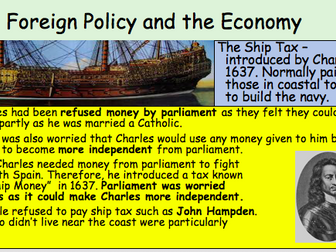
An activity to note down, from teacher-led slides, the beliefs which Charles held. This will help to build a picture of the reasons why a potential conflict might arise. This includes his power beliefs (divine right of kings), his religious beliefs and his financial beliefs. This helps later when the students categorise the reasons for the war into these groups.
There is a video giving an overview of the causes of the Civil War that students may find interesting. It is made by English Heritage.
A main activity which might span over the two lessons. This is to follow the narrative of events (a 3 page information booklet provided) and complete their timeline on the worksheet provided. This maps out the major events in the road to war. For each event, students summarise what caused the disagreement and then judge, using the scale, how much guilt Charles had for each event. The students will then colour-code the timeline to show whether the cause is to do with power, money or religion.
There Is then a chance to do a write up using the evidence they have gained. This is to decide whether Charles was to blame. The students could be asked to also do a ‘one hand, other hand’ piece of work if you prefer.
Attachments:
1 x Powerpoint Presentation
2 x Publisher Files
These detailed course / revision notes were specially written to give OCR A Level History students a comprehensive overview of the key knowledge from the specification for Y108 The Early Stuarts and the Origins of the Civil War 1603–1660
British Period Study: The Early Stuarts 1603–1646
a) James I and Parliament
b) James I and religion
c) Charles I 1625–1640
d) Charles I and the victory of Parliament 1640–1646
Enquiry Topic: The Execution of Charles I and the Interregnum 1646–1660
a) The failure to achieve a settlement 1646–1649
b) Commonwealth and Protectorate
c) The Restoration of Charles II
These extensive notes are especially useful for students whose note-taking in lesson isn’t as good as others, or whose organisational skills mean they are missing notes/handouts on certain topics/areas. These notes will certainly help reduce the time it takes them to catch up with their peers, and also students like to use these as a checklist of topics to go into in further detail. They give peace of mind that every corner of the specification/syllabus has been covered.
Hopefully these notes help to save your students (and you!) some time in the hectic run up to exams. Thanks for taking a look :)
This is the first lesson out of scheme of work on the English Civil War. Originally designed for the AQA GCSE Paper 2 (Thematic Studies, Power and the People, Challenging Royal Authority) however these resources could be used for any Key Stage 3, 4 or 5 lesson on the English Civil War. This lesson teaches pupils the main long and short-term causes on the English Civil War through a treasure hunt task which is differentiated in two different ways. The lesson culminates in a memory task about parliament’s demands in 1640 and what the King agreed in 1641.
Another in our series of cross-curricular Learning at Home units. Find out the facts about the British Civil Wars, some of the key events and people, the different roles of soldiers and how people chose a side. This is an interactive pdf which leads to all sorts of wonderful resources, all downloadable for free from the National Civil War Centre.
Trans-Atlantic Slave Trade
L10: What were the Cause of the American Civil War?
FREE Scheme of Work - Trans-Atlantic Slave Trade: https://www.tes.com/teaching-resource/-12843084
This SoW is designed in detail to be clearly differentiated and engaging. Using the latest researched teaching and learning techniques, such as Retrieval Practice and Dual Coding. This SoW allows you to move pupils through content efficiently. Each SoW is sequenced clearly and in line with the Edexcel Specification.
A colour scheme also runs throughout to ease both your delivery and students’ comprehension.
We provided an email address that is monitored daily, if you have any questions or issues with this purchase (teachercentralltd@gmail.com).
Below is a break down of the Bundle:
The Trans-Atlantic Slave Trade
L1: Why and How Did the Slave Triangle Operate?
L2: How did Slavers Often Capture People in West Africa?
L3: What were the Horrors of the Middle Passage?
L4: What were the Cause and Effects of Slaves Auctions?
L5: What were the lives of slaves like on Plantations?
L6: What Challenges did Runaway Slaves Face?
L7: How did Slaves use Passive Resistance as a form of Subversion?
L8: How did a Slave Rebellion Create the Nation of Haiti?
L9: What was the impact of Black Caesar’s Life?
L10: What were the Cause of the American Civil War?
L11: What were the Effects of the Fighting in the Civil War?
L12: How was Slavery Finally Abolished in America?
Any questions please do feel free to get in contact:
teachercentralltd@gmail.com
Best FREE Resources (Teacher Central)
https://www.tes.com/teaching-resource/britain-losing-and-gaining-an-empire-12973075
https://www.tes.com/teaching-resource/financial-literacy-12898983
https://www.tes.com/teaching-resource/romeo-and-juliet-12908635
https://www.tes.com/teaching-resource/shakespeare-12908634
https://www.tes.com/teaching-resource/macbeth-gcse-12863697
https://www.tes.com/teaching-resource/animal-farm-free-sow-12942163 (FREE SoW)
https://www.tes.com/teaching-resource/slavery-sow-12843084 (FREE SoW)
https://www.tes.com/teaching-resource/-12727408 (FREE SoW)
https://www.tes.com/teaching-resource/russia-1917-91-from-lenin-to-yeltsin-12834552
https://www.tes.com/teaching-resources/shop/TeacherCentral?sortBy=lowestPrice&p=5
I hope you find this SoW useful. If you have, I have created a series of resources.
You can check them out here.
https://www.tes.com/teaching-resources/shop/TeacherCentral
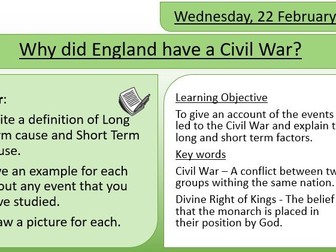
This is a whole lesson introducing long and short term causes of the English Civil War. My students struggled with what long and short term causes were so this lesson uses a clip from 'Benjamin Button' to give the students a visualisation and then gets them to come up with their own definitions to make it really clear.