Communication boards with WidgitsQuick View
sstledger12

Communication boards with Widgits

(0)
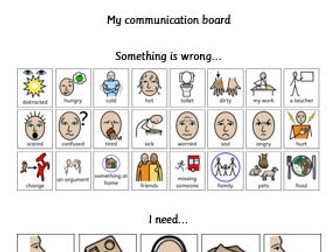
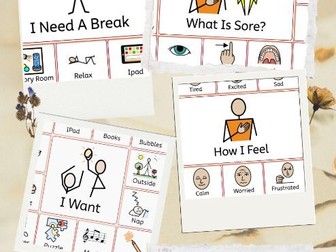
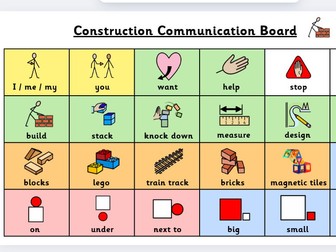
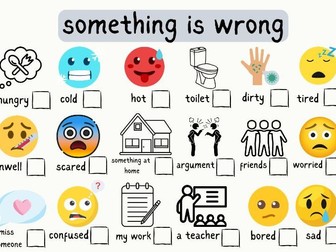
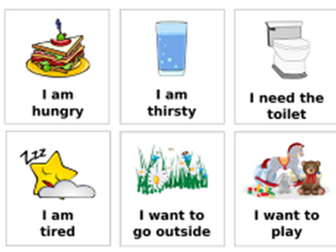
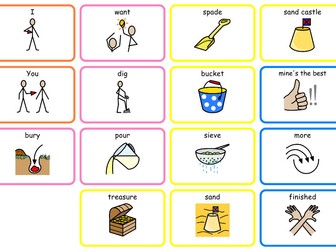
A selection of communication boards with Widgits to support children in expressing their needs, asking for help and answering questions. It includes Choices Needs Feelings School things Days Weather Colours If these are of interest but need adapting to fit the need of your children/school, please feel free to leave a comment for alternative ones to be made. Enjoy!
Community PSHEQuick View
EC_Resources

Community PSHE

(1)
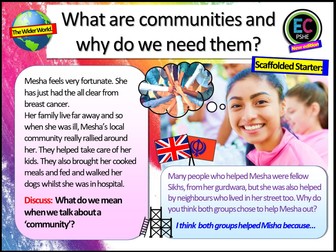
2026 RSHE DfE GUIDELINES COMPLIANT (see lesson plan included for details). NEW PSHE lesson all about what communities are, why they are beneficial to us, how our mental health improves when we become involved in off-line communities and how our mental health suffers when we lose contact with our off-line communities. Students will investigate different types of communities, how they develop, how they overlap and how they can lend support in time of need. They will also examine the phenomenon of the hikikomoris of Japan, individuals who choose to actively cut themselves off from all off-line communities, and explore the impact this has on their mental health. This has been written to cover the 2026 PSHE guidance on the importance of communities. The lesson will last you at least one hour and is best suited to upper KS3 or KS4. Includes detailed lesson plan. There are a variety of tasks, from creative to literacy, to clip and analysis. Everything is editable and ready to go. This lesson is taken from the new EC Publishing 2026 Complete Secondary Package which can be found at the EC Publishing website. Who are EC Resources? EC Resources are the top TES PSHE providers and are a group of teachers who work together to create easy to use, high quality and editable lessons and units of work. We have created lessons for The Children’s Commissioner, The Bank of England, The British Legion, MACS Charity, Tes, LikeToBe Careers, the Criminal Cases Review Commission (UK Gov) and have also completed PSHE and Citizenship commissions for schools across the UK. You can visit our website at EC Publishing for further discounts, complete school packages and much more, and can email us at info@ecpublishing.co.uk Check out our PSHE Packages on Tes here: Complete KS3 PSHE and RSE Complete KS4 PSHE and RSE Complete KS5 PSHE and RSE One Year of Citizenship and British Values Complete KS3 RE Complete Careers and Employability AQA Citizenship GCSE Mega Pack x68x Teaching PSHE, RE or Citizenship GCSE next year? Why not join our Citizenship and PSHE teachers Facebook group, with 12,000 other teachers, for guidance, advice and resource sharing.
Communication  PowerpointQuick View
Annworkshop

Communication Powerpoint

(0)
This presentation has 8 slides, encompassing various components: Learning objectives The importance of effective communication skills A scenario, suitable for individual or collaborative classroom engagement A section on verbal and non-verbal communication skills An enjoyable non-verbal activity that not only engages students but also maintains a peaceful classroom environment A plenary with an exit ticket task. for reference used this resource for a session that was 2 hours please leave feedback. Thanks
AQA GCSE Biology - Communities and InterdependenceQuick View
eleanor-crook

AQA GCSE Biology - Communities and Interdependence

(0)
A full 1-hour lesson designed for a mixed ability year 9 class studying the AQA GCSE Biology topic “Ecosystems”. This lesson covers interdependence in communities, stable communities and competition. This full 1-hour lesson resource contains: A 5-in-5 retrieval style starter An embedded YouTube video as a lesson hook Introduction slides on interdependence (reduced cognitive load, dual coding) Teacher model slides on interdependence in food webs A ‘thumbs up, thumbs down’ hand signals quiz, with answers An exam question for students to practice, with answer slides Introduction slides on competition, with pictures An embedded YouTube video on competition in plants A written recall task with answer slides on competition A guided ‘turn and talk’ A written exam question on competition, with answer slides Introduction slides on stable communities Exam question with answer slides on stable communities Plenary - written exam question
The importance of communitiesQuick View
CMGsSciencelessons

The importance of communities

(0)
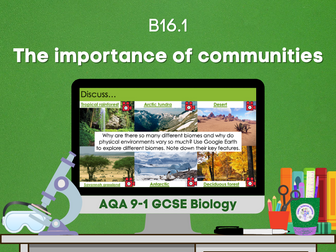
During this lesson (B16-1 The importance of communities) GCSE students work through a variety of tasks to develop their understanding of the relationship between communities and ecosystems, and the importance of stable communities. Based on the 1st from the AQA 9-1 GCSE Biology (OUP scheme) B16: Adaptations, interdependence, and competition chapter. Also available as a digital worksheet, which is ideal for distance learning, independent study or catch-up of missed work through absence. Presentation contains (33 slides)- Bell work activity Lesson objective and success criteria Information slides Challenge activities (group work) Practical activity (where appropriate) Demonstrate understanding tasks (with answers) Lesson resources (additional to scheme) Aimed at a mixed ability class covering content 1-8. Please note: Kerboodle worksheets from scheme are not included due to license.
Inclusion, community & Belonging Assembly KS2Quick View
Jonathan-Primary

Inclusion, community & Belonging Assembly KS2

(0)
This assembly explores the many ways and many reasons that humans come together in groups/ communities. It explores why inclusion and belonging are important and how we can nurture them within our groups. The assembly ends with an inclusion pledge. Through this interactive assembly students will come to understand the importance of being part of strong groups and how to play their role in nurturing an inclusive communities. Each slide is accompanied with notes as a guide.
Capitalism & Communism - What's the Difference?Quick View
RAResources

Capitalism & Communism - What's the Difference?

(0)
In this lesson, students are able to gain an understanding of the basic differences between capitalism and communism. This lesson can be used to pre-empt any topic where the terms are used such as the Cold War, inter-war years, Russian Revolution Vietnam War etc. ** The main key questions of the lesson are:** What is capitalism and communism? What are the features of capitalism and communism? What are the strengths and weaknesses of capitalism and communism? What are the common public attitudes towards capitalism and communism? You will be purchasing: 1 x A4 worksheet 1 x 21 slide Power Point The Main Power Point Includes: Slide 1: Title slide Slide 2: Progressive Learning Aims Slide 3/4: A choice of discussion questions for students as they enter the room Slide 5: The importance of learning about capitalism and communism. Slide 6: Starter Task - What do you know about capitalism or communism? Slide 7: Printable fact sheet Slide 8-9: Background information about capitalism and its strengths and weaknesses Slide 10-11: Background information about communism and its strengths and weaknesses Slide 12-15: Activity 1 - Problem solving scenarios and answers Slide 16: Instructions about the A4 worksheet - a sorting task to categorise communism and capitalism. Slide 17: Higher level challenge questions Slide 18: Learning Review 1 Slide 19-21: Learning Review 2 - Key term match up with answers. All images used in this lesson are in the public domain and are therefore copyright free at the time of publishing. Images which require attribution have been attributed in the notes section of each slide where the image appears. If you feel any errors have been made, please contact me at raschoolresources@gmail.com in the first instance to resolve any issues. My lessons are completed using PowerPoint and designed on widescreen formatting. Thank you.
Communication SkillsQuick View
EC_Resources

Communication Skills

(1)
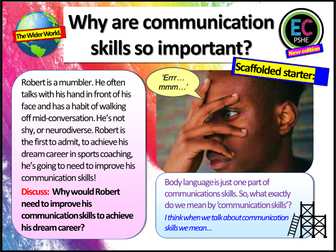
MEETS NEW 2026 DfE GUIDANCE - In this lesson students will investigate what communication skills are, why communication skills are so important and how everyone can develop or improve on them with practice. Students are given practical activities to help improve their communication skills in pairs or small groups and will set their own skills targets. Includes practical, analysis, clip and creative activities. Suitable for KS3 or KS4. Includes lesson plan. This lesson is taken from the new EC Publishing Complete 2026 PSHE Package which can be found at the EC Publishing website. Everything is editable and easy to pick up and run with and includes future DfE updates too. This has been written to cover the 2026 PSHE guidance from the DfE and PSHE Association for RSHE. You can contact us at info@ecpublishing.co.uk Who are EC Resources? EC Resources are the top TES PSHE providers and are a group of teachers who work together to create easy to use, high quality and editable lessons and units of work. We have created lessons for The Children’s Commissioner, The Bank of England, The British Legion, MACS Charity, Tes, LikeToBe Careers, the Criminal Cases Review Commission (UK Gov) and have also completed PSHE and Citizenship commissions for schools across the UK. Please visit our Tes store https://www.tes.com/teaching-resources/shop/EC_Resources for everything PSHE, RSE, RE and Citizenship. We still offer a free lesson of your choice for each time you leave a review! Just email info@ecpublishing.co.uk Check out our PSHE Packages on Tes here: Complete KS3 PSHE and RSE Complete KS4 PSHE and RSE Complete KS5 PSHE and RSE One Year of Citizenship and British Values Complete KS3 RE Complete Careers and Employability AQA Citizenship GCSE Mega Pack Teaching PSHE, RE or Citizenship GCSE next year? Why not join our Citizenship and PSHE teachers Facebook group, with 12,000 other teachers, for guidance, advice and resource sharing.
Communication Book EY-WidgitQuick View
a-leigh_howse

Communication Book EY-Widgit

(0)
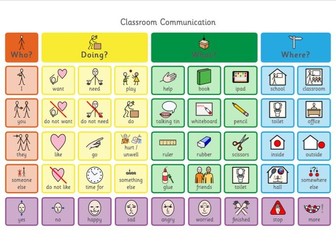
Communication book aimed for EYFS, can support children in answering questions about things that have happened etc. - widgit symbols and linked to Colourful Semantics sentence colours
Community CohesionQuick View
Cre8tive_Resources

Community Cohesion

(0)
A detailed lesson exploring community cohesion in Britain and how to promote it. Editable PowerPoint Lesson for Citizenship Studies. (60-120 Minutes worth of Material) suitable for KS3 or KS4 students. CIT/C8/LS/49 Learning Outcomes: Secure: To explore the concept of community cohesion Extended: To understand characteristics of communities with high and low cohesion Advanced: To evaluate the changing nature of community cohesion in Britain over the past 60 years Made by a team of Specialist Practicing Citizenship Teachers as part of one of the leading Citizenship Resources Providers in the UK - Cre8tive Resources . What is included in this product? Fully editable 21 slide PowerPoint Lesson 60-120 minutes Det of Debates Sheet Communities and respect information handout Revision Clock Activity sheet 20 Exit tickets Answer Keys: Student input creates some of the answers. Product Code CIT/C8/LS/49 Description of Product Ready-to-Use pack of classroom activities will enthuse and engage students! This lesson material is designed to be used for between one and two teaching periods and includes; activities, challenging and thoughtful questions, student hand-out (for use during lesson or as a homework), embedded URL links (where appropriate), differentiated tasks and, all relevant information to help students learn about issues relating to the topic. N.B This lesson can be taught with no printing (For those on tight budgets :) Our Philosophy We aim to help you equip students with the knowledge and skills to take ownership of their own learning. Products come ‘Ready-to-Teach’ with everything you need to teach fun and creative lessons. Our products are teacher-designed, classroom tested & student approved. With over 600 Citizenship and PSHE Products to pick from why not try looking at one of these: British Values Quiz Comparing electoral systems Voting systems and electoral reform GCSE CItizenship UNIT What is Identity
PSHE Community and BelongingQuick View
Leah_Wilson98

PSHE Community and Belonging

(0)
A lesson intended to introduce a Terrorism and Extremism unit, considering the psychology of belonging and the importance of community cohesion
Belonging to a Community - KS1Quick View
EC_Resources

Belonging to a Community - KS1

(0)
Belonging to a community KS1 PSHE lesson. A one-two hour long, very detailed, fully resourced PSHE lesson suitable for KS1. This lesson has been created for Year 2, however, the contents may also suit younger students in KS2 (Year 3). In this lesson, the students will be discussing what it means to belong to a community. We will look at a variety of groups that people can belong to and reflect on the way that we know we belong. We will identify the groups that we belong to, and any associated roles that we may have within these groups. In our main task, we will take a detailed look at how we can make our community welcoming and inclusive to all groups, in particular, families who are refugees. We will read Kate Milner’s story ‘My Name is Not Refugee’ and complete accompanying tasks to reflect on the message behind the story. The lesson has been left editable and is filled with engaging, well differentiated and fun activities. It is designed to be ‘no prep’, so you can just pick it up and use it, although it is still adaptable should you wish to. You can download a free example of our KS1 resources here:What is the Internet? Who are EC Resources? EC Resources are the top TES PSHE providers and are a group of teachers who work together to create easy to use, high quality and editable lessons and units of work. We have created lessons for The Children’s Commissioner, The Bank of England, MACS Charity, Tes, LikeToBe Careers, the Criminal Cases Review Commission (UK Gov) and have also completed PSHE and Citizenship commissions for schools across the UK. You can contact us at info@ecpublishing.co.uk Teaching PSHE, RE or Citizenship GCSE next year? Why not join our Citizenship and PSHE teachers Facebook group, with 8000 other teachers, for guidance, advice and resource sharing.
Behaviour as CommunicationQuick View
SpectrumSavvy

Behaviour as Communication

(0)
Here is a powerpoint, with activities that help to illustrate that behaviour that challenges us is actually trying to communicate with us. It may not be doing it in the best way possible but it is trying to say something, perhaps “I can’t cope”, “Leave me alone” or “stop”. The powerpoint is accompanied by the stress bucket worksheet. If you are not aware of the stress bucket, it is explained nicely here. https://youtu.be/1KYC5SsJjx8 The powerpoint is also accompanied by the ‘behaviour analysis cards’. Both of which can be used independently. The cards with red arrows indicate possible triggers for challengeing behaviour, The speech bubbles provide suggestions as to what the behaviour may be ‘saying’ and the cards with green arrows provide suggestions as to what we or the individual can do to manage challenges more successfully.
Community CohesionQuick View
sineadnoone01

Community Cohesion

(0)
How community cohesion has manifested itself in our world - focusing on the Holi festival and the Notting Hill Street Carnival
Communication - factors affecting communicationQuick View
NGfLCymru

Communication - factors affecting communication

(1)
A resource for Health and Social Care AS/level 3. This unit examines types of communication, the factors affecting communication, and barriers to communication. For more materials relating to this resource, please visit the NGfL site, linked below.
Animal Farm Context - CommunismQuick View
ebealocke

Animal Farm Context - Communism

(1)
A full lesson for a mid - high ability set studying 'Animal Farm'. Includes a range of pre-reading activities based around building students' confidence with the concepts of allegories and Communism.