69 slides of the most popular hand tools, power hand tools, machines and work areas in Design & Technology.
The slides have two sets of the same tool on each page.
1 to be placed on a display board or turned into as booklet.
1 to be placed in tool cupboard or on machine,
This is used to enforce literacy in D&T.
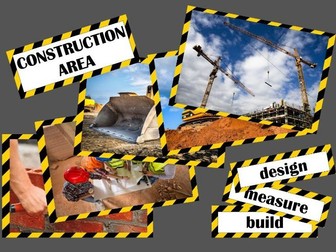
Create an engaging and inspiring construction area with this EYFS Construction Area Display Pack. This resource includes clear, child-friendly photos of key construction equipment and machinery such as excavators and cranes, designed to spark curiosity, imaginative play and meaningful talk.
Carefully chosen vocabulary cards introduce words such as design, build and construct, helping to develop early language skills and support role play, mark making and collaborative play. Ideal for continuous provision, this resource encourages children to explore how things are made while building confidence with new words linked to real-world experiences.
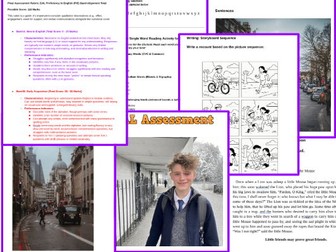
Use this assessment tool to establish a baseline and track the progress of EAL / ESL Learners with this Comprehensive Assessment Pack. Are you looking for a robust and reliable way to assess newly arrived English as an Additional Language (EAL) students in your setting? This meticulously designed EAL Assessment Pack, aligned with the widely recognized Proficiency in English (PiE) scale, provides everything you need to accurately assess proficiency across all key language skills.
This all-in-one resource covers the four core language skills:
Writing Assessment
Alphabet Recognition & Formation: A clear task to assess a student’s ability to write the alphabet in lowercase.
Vocabulary from Picture: An engaging activity where students list visible items from a detailed street scene.
Sentence Construction: Tasks for writing general sentences about a picture and sentences using specific openers.
Storyboard Recount: A visual sequence of six panels prompts students to write a coherent narrative, assessing their ability to recount events logically.
Reading Assessment
Alphabet Reading: Assess recognition of lowercase letters.
Graded Single Word Reading: From CVC words to more challenging multi-syllable words, this activity assesses decoding and recognition.
Fluency & Comprehension: A classic fable, “The Lion and the Mouse,” is provided for reading aloud, followed by differentiated comprehension questions ranging from simple recall to extended inference and opinion.
Speaking & Listening Assessment
Differentiated Questions: A carefully structured set of 15 questions, progressing from basic personal information (e.g., “What is your name?”) to more challenging hypothetical and reasoning questions (e.g., “Imagine you could travel anywhere…”). These questions are designed to encourage communication and investigate proficiency across tiers.
Why Choose the EAL / ESL Assessment Pack?
PiE Scale Alignment: Directly linked to the UK’s influential Proficiency in English (PiE) scale (Bands A-E).
Comprehensive Coverage: Assesses writing, speaking, listening, and reading elements in one convenient pack.
Graded Activities: Tasks are designed to progressively challenge students, suitable for various proficiency levels from “New to English” to “Developing Competence” and beyond.
Clear Mark Schemes & Rubrics: Includes detailed mark schemes for each section and a final comprehensive rubric to interpret overall scores against PiE bands.
Formative & Summative Use: Ideal for informing teaching and providing targeted support, as well as tracking progress.
Empower your EAL learners on their journey with accurate and insightful assessment!
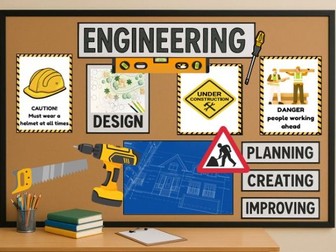
Create an engaging construction-themed learning area with this bright and versatile classroom display pack! Perfect for Early Years, KS.1, SEN, or STEM-focused classrooms, this resource helps transform your space into an exciting construction and role-play zone.
This printable P.D.F includes a range of clear safety signs, themed posters, tool cut-outs, and blueprint-style visuals to support imaginative play, communication, and topic learning.
What is Included:
Construction Safety Signs (Caution, Danger, Keep Out, etc.)
Tool Cut-Outs for display and role-play
Blueprint-Style Posters
Construction-Themed Visuals & Labels
Print-and-Go P.D.F Format
Perfect For:
Construction role-play areas
STEM & D.T topics
Continuous provision
Early Years & Primary classrooms
SEN and visual support
Classroom door or bulletin board displays
Transform your students’ creativity with the SCAMPER Visual Arts Resource, a powerful tool designed to inspire fresh ideas and innovative approaches to art projects. Perfect for secondary and IB Art classrooms, this resource introduces the SCAMPER framework—Substitute, Combine, Adapt, Modify, Put to Another Use, Eliminate, Rearrange/Reduce—to guide students in brainstorming, experimenting, and refining their artwork.
Packed with practical examples and prompts, the SCAMPER resource encourages students to explore new materials, techniques, and perspectives. It supports critical thinking, problem-solving, and artistic development, making it an invaluable tool for teachers seeking to engage students and elevate their creative potential.
Key Features:
Student-Friendly Prompts: Clear and accessible questions to encourage creative exploration.
Examples for Application: Practical ideas for brainstorming, experimentation, and peer feedback.
Flexible Use: Suitable for individual projects, group work, or feedback sessions.
Curriculum Alignment: Perfectly complements GCSE, IGCSE, and IB Visual Arts standards.
Digital and Printable: Ready for use in both online and classroom settings.
Ideal For:
Teachers looking to inspire creativity and originality in student artwork.
Art students needing structured guidance for developing and refining their ideas.
Peer feedback sessions to encourage collaboration and constructive critique.
Empower your students to think outside the box and create with confidence using the SCAMPER Visual Arts Resource!
Download today and watch their creativity soar.
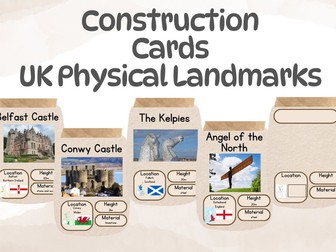
Prompts to use in the construction area that prompt children of different physical landmarks across the United Kingdom.
Each landmark includes:
title
photo
location (country located on UK map and relevant flag)
height in meters
material it is built from
Location links to geography objectives focusing on the UK, Height links to year 1 maths curriculum and materials link to the materials taught in the year 1 curriculum.
22 landmarks include:
London Eye, St. Paul’s Cathedral, Buckingham Palace, Big Ben, Cardiff Castle, Edinburgh Castle, Titanic Museum
There is a blank page to that children can complete or be used to create your own.
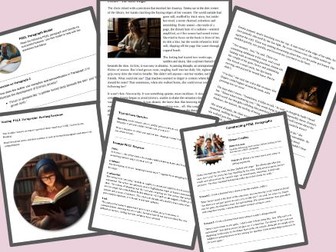
These booklets support GCSE, English Language teachers in delivering sessions on how to write PEEL paragraphs for the GCSE, English Language Exam: Fiction. It can be used for all English Language exam boards. There are two booklets - content detailed below.
*Responding to Conflict in GCSE, Fictional Texts *
This booklet provides GCSE English Language teachers with a structured resource for teaching students how to analyze and respond to conflict in fictional texts. Through carefully crafted short extracts, students are introduced to the PEEL (Point, Evidence, Explanation, Link) method, enabling them to develop clear, focused, and detailed responses to exam-style questions.
The booklet includes:
Three short fictional extracts showcasing different types of conflict: sibling arguments, teacher-student confrontations, and relationship disagreements.
Exam-style questions designed to guide students in identifying and analyzing language techniques.
Model PEEL responses for each extract, providing clear examples of how to structure answers effectively.
Extension exercises encouraging deeper engagement with themes of conflict, tension, and emotional dynamics.
This resource is perfect for teachers looking to improve students’ ability to interpret language, explore character relationships, and construct coherent analytical paragraphs.
Exploring Psychological Narratives with PEEL
This booklet focuses on developing students’ analytical writing skills through psychological narratives. Designed to engage students with complex emotional and mental themes, it includes extracts and exercises aligned with GCSE English Language exam criteria.
Additional Resource! A further reading response unit has been added. It includes and extract from My Antonia by Willa Cather, a quotation activity and a model paragraph. Further worksheets to develop deeper analysis are provided.
Key features include:
Short, rich extracts that explore anxiety, unease, and suspense, giving students an opportunity to analyze subtle language techniques.
Exam-style comprehension questions targeting skills such as interpreting metaphor, personification, and sensory imagery.
A model PEEL paragraph for each extract, showcasing how to structure responses to achieve higher marks.
Step-by-step guidance on writing effective topic sentences, selecting precise evidence, and linking ideas back to the question.
This booklet provides GCSE English Language teachers with a versatile tool to challenge students’ critical thinking and help them refine their analytical writing!
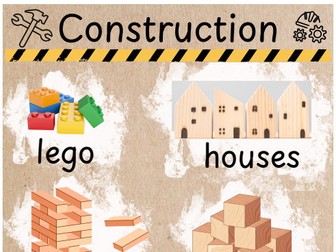
Visual poster, ideal for a reminder about what to expect to see in the construction area. Teachers and support staff can also use for prompting questions or to model the language used in the area.
Adopting the latest technology can be daunting for teams. But machine learning and artificial intelligence are helping make job sites more efficient and saving money in the process. AI solutions that have made an impact in other industries are beginning to emerge in the construction industry.
Robotics, AI, and the Internet of Things can reduce building costs by up to 20%. There are companies that are starting to offer self-driving construction machinery to perform repetitive tasks more efficiently than their human counterparts, such as pouring concrete, bricklaying, welding, and demolition.
Construction companies are starting to use AI and machine learning to better plan for distribution of labour and machinery across jobs.
The Adventure of Carcosa Guardian the AI Construction Anime, explores the beauty of Artificial Intelligent Construction Tool. In course of the story line, Carcosa girl, summons a Magical pen that will ask you to provide a side of the desire 2-D shape to sketch. You can enter any number between 50 and 150, due to the typical dimension configuration attribute in scratch programming; when the side of the Square to sketch is required from the user. Just follow the Mathemagic girl instruction and follow through the game; thereby, navigating through your Geometrical Dream World with the assistance of the Carcosa Guardian the Construction Genie Anime
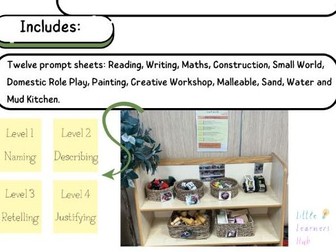
These Blank level questioning prompts are strategically designed to support adult-child interactions in all areas of provision during play. Tailored to children’s communication levels, they encourage appropriate and meaningful conversations, fostering language development and engagement. They are a versatile and beautifully created resource for all early years classrooms!
**This is a set of three prompt sheets which can be placed at adult level in the area of provision. Other prompt sheets are available **
Key features:
Differentiated Questions:
Each sheet provides questions suited to the developmental level of the child - based on research by Blank, Rose and Berlin (1978) - and the area in which they are playing.
Versatile Use:
Ideal for student teachers, temporary staff, and full-time practitioners, ensuring consistency in language-rich interactions.
Classroom and Home:
Perfect for classroom use, but can also be shared with parents to encourage similar interactions at home.
By integrating these sheets, educators can maintain a language-focused environment while ensuring that everyone - regardless of their familiarity with the children - can contribute to their development. They are a valuable tool for teachers looking to improve communication and play-based learning.
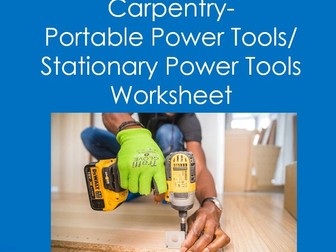
This 40 term worksheet will help your Carpentry students to learn about portable and stationery power tools. Terms include: jigsaw, router, pneumatic, laminate, table saw, staplers, magazine, nailers, and other relevant terms.
Ideal for a career and technical Carpentry or related course and can be used as a classwork assignment, assessment, or review. Can also be used with other Carpentry worksheets. Word bank and answer key provided.
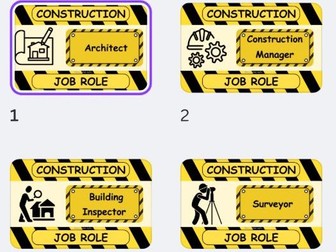
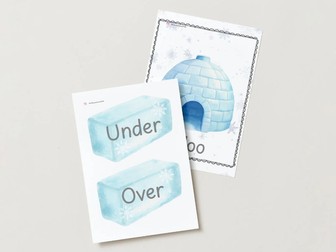
Construction project job role cards to attach to lanyards. Encourages collaborative learning, listening, turn taking, roles and responsibilities and more. Ideal for all primary years and could be used as part of continuous provision in EYFS, for small group play or interventions.
Print as A5 but scale down to 100 when printing for it to be the right size to add to a lanyard.
This resource is a list of common carpentry and building handtools. The first worksheet lists the tool, has a description of what the tool is used for and has a picture. The second sheet is an activity for students to complete by filling in the description area.
This is useful for apprentices or those working in the construction industry that are new to NZ (worker from overseas) that need to get up to speed with names for tools and equipment within the industry
Construction Challenge Cards
Made using duplo and wooden bricks.
i.e. Can you make a dinosaur? Can you make a castle? Can you make a repeating pattern?
Over 22 pages related to hand tools/ in the DT workshop environment.
Each page contains a different tool, description and image.
This resource is fully customisable and can be used as a teaching and learning resource and or a display.
Compatible with BTEC Construction. Specifically module 1 ‘Producing a timber product’ , criteria 1.1.
A full set of revision cards for the Educas Construction & the Built Environment specification (2025).
Includes 97 slides of questions and answers for pupils to use as a revision tool.
I have included both a PDF and a PP version (please open in slides to match fonts).
To support literacy across the curriculum and obviously Science in particular here, these sentence construction frames are extremely useful in a number of different contexts. Students find this quite a challenge but do engage with this in an extremely positive manner. A good opportunity for collaborative work.
They can be edited for differentiation purposes, with significant challenge for the most able and also access for the weakest/SEND.
They have been used very successfully as starters, plenaries, end of topic summaries, revision tools, homework and also extensions and they can be adapted for any topic across the entire curriculum from Yr7 to Yr13.
I have attached a number of examples with associated powerpoints to have up on the board as the students attempt the task, including.....
Limestone
Hydrocarbons, Fractional Distillation and Cracking
Radiation
Respiratory and Circulatory System
The Atom, Reacting Masses and Rates of Reaction
Transformers and Power
A major strand of science and technology studies in recent decades has related to the social construction of technology (SCOT) movement, whose adherents maintain that technological systems are determined just as much by social forces as by technological ones. Taking this SCOT notion as a starting point, and putting a focus on the user, this paper looks at some examples of the educational use of software tools that exploit the functionality of the software in ways far removed from the original design.
Construct the shapes Deputy Crimes needs for the tools he wants to aid his survival as well as cutting a couple of things in half using only a ruler and a protractor.