Factors, Multiples and PrimesQuick View
Magictrickster

Factors, Multiples and Primes

(0)
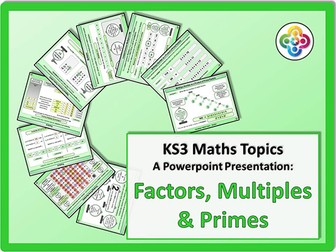
Factors, Multiples and Primes for KS3 This individual powerpoint presentation is from the KS3 Maths Topics Series. It contains 54 slides (Plus a title and end slide), so there are lots of examples. This is an ideal resource which you will enjoy using to explain Facotrs, Multiples and Primes to your classes for years to come. The powerpoint explains: Prime Numbers & Finding Prime Numbers Factors Common Factor Highest Common Factor Multiples Common Multiple Lowest Common Multiple Writing a Number as a Product of Prime Factors
Factors, Multiples, Primes into Venn DiagramsQuick View
ceejaypee

Factors, Multiples, Primes into Venn Diagrams

(0)
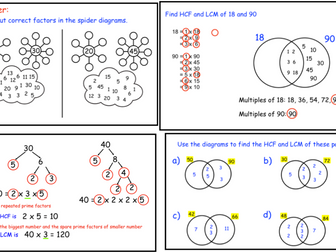
A lesson to remind students how to classify types of number ideal for Ks3 or Ks4 Foundation GCSE. See my Free "Bingo" resource for an ideal starter or plenary depending on the group. The worksheets allows students to do a bit of fun shading, and likewise also introduces Venn Diagrams which have been added into the GCSE curriculum.
Factors, Multiples and PrimesQuick View
deselby

Factors, Multiples and Primes

(160)
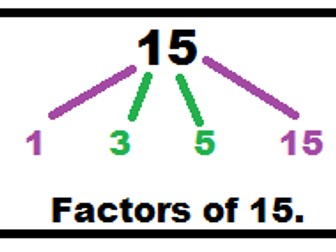
A lesson on discovering what factors, multiples and primes are. Hopefully follows a fairly logical process, with a quite difficult activity to end on.
Factors, Multiples and Prime numbersQuick View
beachman0274

Factors, Multiples and Prime numbers

(7)
All explained on the one page. This simple activity, whilst it may take some explaining to lower ability students because of the directions, can become quite a colourful way to learn these three important topics.
Prime Factors, Prime Factorisation, HCF/LCM (ppt)Quick View
A_Gualda

Prime Factors, Prime Factorisation, HCF/LCM (ppt)

(0)
2/3 Lessons. Objectives: Be able to write a number as a product of its prime factors. Be able to construct a tree diagram to find the prime factors of a number. Be able to calculate the HCF and LCM of two numbers using Venn diagrams. Be able to find the HCF and LCM of two numbers when given the prime factorisation of each numbers. Includes: Lesson starters; Worked examples; Practise questions; Plenary questions.
Factors, Multiples, Primes, Squares and Cubes - Year 6Quick View
Online_Teaching_Resources

Factors, Multiples, Primes, Squares and Cubes - Year 6

(1)
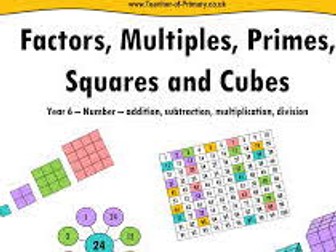
Factors, Multiples, Primes, Squares and Cubes - Year 6 This Year 6 maths teaching resource includes a PowerPoint and differentiated worksheets for independent learning, to guide your class through identifying factors and multiples of numbers. It will help the children understand how to solve problems involving factors, multiples, primes and square/cube numbers in context, along with deepening their understanding of the four operations, as they will need to use a range of skills including multiplication and division. They will learn to represent factors and multiples in a variety of ways, including pictorial representations. The worksheets contain varied fluency, reasoning and problem solving to reinforce and consolidate the children’s learning. The resource contains five lessons, which support the White Rose Small Steps guidance, and are designed to support a mastery approach to teaching maths. Content includes: Lesson 1: Common factors with 1 accompanying worksheet and answers Lesson 2: Common multiples with 1 accompanying worksheet and answers Lesson 3: Prime numbers with 1 accompanying worksheet and answers lesson 4: Square and cube numbers with 1 accompanying worksheet and answers Lesson 5: Consolidation of skills learned so far with challenge cards ‘Factors, Multiples, Primes, Squares and Cubes - Year 6’ is completely editable giving teachers the freedom to adapt the resource to suit their individual teaching needs. Not quite what you’re looking for? Click below to see similar resources: Multiples - Year 6 Prime Numbers - Year 6 Square and Cube Numbers - Year 6 Factors, Multiples, Primes, Squares and Cubes Challenge Cards - Year 6 Factors, Multiples, Primes, Squares and Cubes Challenge Cards - Year 6 The Four Operations - Year 6 Factors - Year 6 Multiplication - Year 6
Multiples, Factors and Prime NumbersQuick View
TenTors

Multiples, Factors and Prime Numbers

(1)
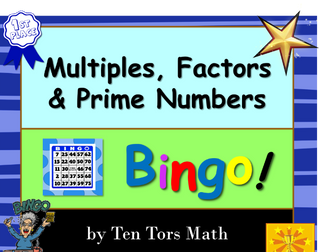
Multiples, Factors and Prime Numbers Bingo! game A bingo game on finding multiples, factors and prime numbers. Comes complete with printable unique bingo cards for up to 36 students. Alternatively there is a no print option where students draw their own 3 by 3 grid and choose nine numbers from the board. If the answer to a slide is their number they cross it off. The first student to cross off all nine numbers calls out bingo! Usually there is a small prize for the winner. Why use bingo in your lessons? Math can and should be enjoyable. A bingo game turns math into an exciting experience that the kids will love. Bingo will engage your students, fully involving them in an activity for 20 to 30 minutes. Bingo is a great way to consolidate and answer questions on a recently taught topic or to get students to refresh their understanding of an earlier topic without them complaining that they’ve seen it before!
Factors, Multiples and Prime assessmentQuick View
Edustem1

Factors, Multiples and Prime assessment

(1)
A powerpoint presentation perfect for starters and assessment for Numeracy! It is perfect to use as a plenary as well to check students understanding of the topic. It has multiple choices where only one answer is correct from (A, B, C and D). Perfect as a whiteboard activity for assessment during observational and Ofsted lessons. You can also use this Red, Green, Amber and White activity where students put up their planners to assess students learning. Following topics are assessed: Factors, Multiples, Prime factors, Prime Numbers, Divisors and Highest common factor Please leave a review for this resource :) Let me know if it helps you in your lessons.
Prime Numbers - Year 5Quick View
Online_Teaching_Resources

Prime Numbers - Year 5

(0)
Prime Numbers - Year 5 In this maths teaching resource, pupils are introduced to prime numbers as per the requirements of the Year 5 maths programme of study (Number - multiplication and division). It has been created following the White Rose Small Steps guidance for - Autumn - Block 3 - Multiplication and division A. Content includes: An animated PowerPoint lesson Activities to support the teaching of these objectives and three accompanying worksheets 1 further worksheet with answers ‘Prime Numbers - Year 5’ can be edited so teachers are able to adapt the resource to suit their individual teaching requirements. Not quite what you’re looking for? Click below to see similar resources: Cube Numbers - Year 5 Common Factors Activity - Year 5 Square Numbers - Year 5 Multiplying by 10, 100 and 1000 - Year 5 Identifying Factors - Year 5 Multiples of 10, 100 and 1000 - Year 5 Identifying Multiples - Year 5 Factors Activities - Year 5 Dividing by 10, 100 and 1000 - Year 5 Common Multiples Activity - Year 5 Year 5 Multiplication and Division Bundle 1
Factors, Multiples and Prime numbers lesson pptQuick View
jessicapavlou

Factors, Multiples and Prime numbers lesson ppt

(1)
Full lesson PowerPoint on Factors, Multiples & Prime Lesson includes modeling, collaborative slides where targeted questioning can be used and independent working slides. Lesson plan: Introduction Understanding and identifying factors - I try / We try / You try Quick Q’s - AFL Linking to prime numbers Understanding and identifying prime numbers Quick Q’s - AFL Understanding and identifying multiples - I try / We try / You try Mixed AFL questions on all three topics
Factors and multiples, prime factorizationQuick View
sino2536

Factors and multiples, prime factorization

(0)
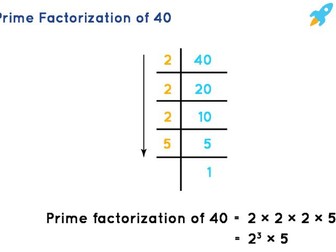
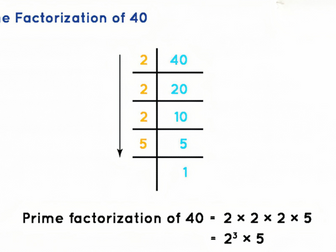
• Factors are numbers that divide evenly into another number. • Prime numbers have only two factors: 1 and themselves. • Prime factorization is a way to break down a number into its prime factors. Note : Course include (Questions and Answers + Activities)
Factors and multiples, prime factorizationQuick View
sino2536

Factors and multiples, prime factorization

(0)
• Factors are smaller numbers that divide evenly into a larger number. • Prime numbers have only two factors: 1 and themselves. • Prime factorization is a way to break down a number into its prime factors by multiplying them together.
Prime Factor Trees - Factoring WorksheetsQuick View
atlasart

Prime Factor Trees - Factoring Worksheets

(0)
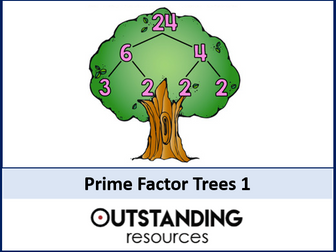
Prime Factor Trees - Factoring Worksheets You’ll get 5 worksheets that you can use for short assessments, morning work or warm up exercises. Students will be able to easily practice prime factors while having fun! It’ll be a useful resource during your class that will boost your teaching efficiency! Thank you for stopping by! You can contact me with questions about this product. Thank you for all reviews, ratings and comments you leave on my profile!
Factors, Multiples and Primes WeekQuick View
Raphella

Factors, Multiples and Primes Week

(0)
A series of 4/5 lessons all based around factors, multiples and prime numbers. Aimed at the year 5 curriculum (new) Cold and hot tasks for assessment included, along with all resources and powerpoints. Leave feedback please
Factors, Multiples and Primes WorksheetQuick View
jcoulter62

Factors, Multiples and Primes Worksheet

(0)
A resource which is an extension activity on the topic of factors, multiples and primes which is designed to stretch more gifted students. This worksheet in particular aims to test pupils reasoning abilities and explain their responses coherently.