Pearsons BTEC Level 3 Sport National Extended Certificate in Sport. 2016.
D: Examine Training Methods for Different Components of Fitness
34 documents. PowerPoints, Handouts and Worksheets.
Covers the following:
D1 - Components of Fitness to be Trained
D1.1 - Skill Related
D2 - Training Methods for Physical Fitness Related Components
D2.1 - Aerobic Endurance
D2.2 - Muscular Strength
D2.3 - Muscular Endurance
D2.4 - Core Stability
D2.5 - Flexibility
D2.6 - Speed
D3 - Training Methods for Skill Related Fitness components
D3.1 - D3.5 - Agility, Balance, Coordination, Reaction Time, Power
I have recently re-planned the entire AQA GCSE PE Course- and now offer new and further improved versions of my resources! The resources have been planned based on years of experience to ensure all students in the class can be successful within GCSE PE. This unit includes lessons on Fitness components, Fitness tests and Health and Fitness.
All resources have bee planned inline with the specification and examiner reports. In addition, lessons make specific reference to the assessment objectives so that students are able to develop their exam technique responses with high levels of literacy in line with mark scheme requirements.
This huge bundle of resources include; 4 lesson powerpoints and accompanying booklets, homework tasks, exam practice work sheets and scaffolded class resources. If you purchase this bundle you will not only cut down on hours of planning- but you will also have everything you need to ensure that your students receive the best outcomes possible!
3/4 lessons worth of content over 2 powerpoints all based on the training methods related to the components of fitness. The lessons explore the different training methods and exercises that can be used to improve the components of fitness for Health and Skill related components. Small tasks built into the lessons to apply the FITT principle to the components and the methods. Can be applied to any Sport or Public Service course as well as any Fitness modules.
Pearsons BTEC Level 3 Sport National Extended Certificate in Sport. 2016.
A step by step PowerPoint on how to answer Q6.
Guided time spent on question included.
Example answers per slide also included to help show what needs to be written by student.
Broken down into FITT, SMARTER, SPORVAIR, Periodisation and Equipment.
I have planned all resources using examiner reports and assessment objectives inline with the specification. The resources have been used with multiple cohorts and are proven in supporting students to be successful. All of my resources, provide modelled and scaffolded examples of exam technique to support you building children’s confidence in the classroom.
This unit includes lessons on Physical training ; Principles and Methods/Types of training . This resource pack includes:
Lesson 1 - Physical Training : Powerpoint of Specificity, Progressive overload and FITT , student workbooklet for classwork & exam technique
Lesson 2 - Physical Training : Powerpoint on Tedium and Reversibility. Also an I DO, WE DO, YOU DO - exam technique model for extended answer questions
Lesson 3 & Lesson 4 - Methods of training: Powerpoint, student workbooklet for classwork and exam technique.
Lessons make specific reference to the assessment objectives so that students are able to develop their exam technique responses with high levels of literacy in line with mark scheme requirements.
If you purchase this bundle you will not only cut down on hours of planning- but you will also have everything you need to ensure that your students receive the best outcomes possible!
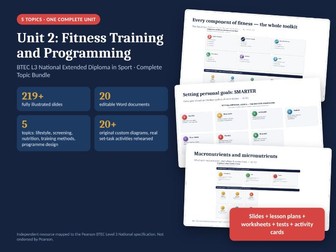
A complete, ready-to-teach bundle covering all five topics of Unit 2:
Fitness Training and Programming for Health, Sport and Well-being for the
BTEC Level 3 National Extended Diploma in Sport — Lifestyle Factors,
Screening Processes, Programme-Related Nutritional Needs, Training Methods
and Training Programme Design.
Every topic is built to the same standard: a fully illustrated slide deck
with original custom diagrams, plus a complete Word document pack —
lesson plans, worksheets with answers, set-task practice with a full mark
scheme, and printable activity cards with a learner tracker.
Unit 2 is assessed by ONE supervised set task worth 60 marks, and this
bundle is built directly around it — every topic finishes with a practice
exercise using the exact command word and mark weighting of a real
Activity from the set task (DESCRIBE, EXPLAIN, PROVIDE, JUSTIFY, DESIGN),
so students walk into the assessment having already rehearsed exactly what
it will ask of them.
WHAT’S INCLUDED (5 topics × 5 files = 25 resources)
For each of the 5 topics you get:
• A fully illustrated slide deck (38–62 slides) with original custom
diagrams on almost every slide, not just bullet points
• Detailed lesson plans for 3–5 lessons of 90+ minutes, timed and
student-centred, with recap and AfL built in
• Worksheets with a full answer key
• Set-task practice mapped to the real Pearson Activity and mark scheme
for that topic
• Printable activity cards plus a learner “I can” tracker against every
assessment criterion
Across the bundle that’s 219+ slides and 20 fully editable Word documents,
all mapped to the Pearson BTEC Level 3 National specification for Unit 2.
A bonus Examiner Insight and Question Guide is also included, summarising
common weaknesses from real examiner reports and how each topic addresses
them.
WHY TEACHERS LIKE THIS PACK
• Saves hours of planning — everything is ready to teach from lesson one
• Diagrams do the explaining — body risk maps, health monitoring tests,
macro/micronutrient panels, heart rate training zones, the FITT and
additional principles of training, and periodisation are all shown
visually, which works far better for 16–18 year olds than text-heavy
slides
• Consistent structure across all 5 topics makes it easy for students to
know what to expect and for you to track progress against every AC
• Every lesson has a retrieval check, an exit ticket and a “ready for your
set task” recap slide — assessment is built in throughout, not bolted
on at the end
• Topic E (Training Programme Design) rehearses the two biggest-value
activities in the whole set task — DESIGN and JUSTIFY a training
programme, worth 20 of the 60 marks combined
• Fully editable — every slide and document can be adapted to your own
group, timings or exam board wording
This resource contains the following:
12 x printable circuit training station cards
1 x printable circuit training worksheet
PDF files in the download so print the cards and get them laminated. I have used the circuit with Year 7 - 11 by adapting the amount of time working at each station.
On the worksheet the amount of time at each station is left blank so that you can adapt it each lesson.
These resources are designed to support CIE IGCSE PE students complete the Weight Training for Fitness practical component of the course.
Resources include:
Powerpoint Presentation outlining the fundamental principles of Weight Training and how to design a 6-week training programme.
An accompanying workbook to complete to enable students to have a record of key information including:
Fundamentals of weight training
Principles of training
Programme design
Advanced weight training methods
Practical filming/assessment guidance and FAQs
Useful links
Six-Week Training Programme Log/Record with weekly reflections
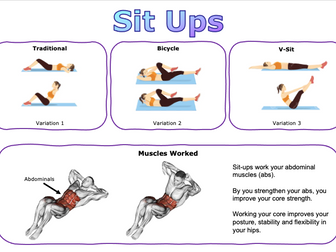
17 bodyweight exercise stations to be used for circiuts.
Each circuit consists of 3 variations of the exercise as well as indicate which muscles are being worked.
These are a set of explanations on how to perform each of the fitness tests with pictures, all national averages for GCSE age students and an equipment list.
I used these in my fitness testing lessons to put on the wall and in student recording books so they could perform and investigate the tests independently in the lesson.
I have also including the recording sheet we use to record students results for each test.
Please review with your email and I can send you a normative table list for all sports that students can use for coursework or assessing fitness tests.
This thoroughly planned lesson focuses on unt 3.1.3 - Physical training - Methods of training. The lesson includes a 18 slide PowerPoint presentation, student workbook, ‘diamond 9’ matching activity and a storyboard/learning mat, a long answer exam question structuring activity, which enables students to apply their knowledge and understanding in preparation for writing a long answer exam question response.
This can be used for teaching the topic for the first time or for revision purposes, can be taught practically or within a classroom. The lesson and resources can also be adapted to teach at KS3 as a bridging activity before starting the course, or within KS3 practical fitness lessons.
This is part of the Paper 1 module in line with the new AQA GCSE PE 9-1 course, first taught September 2016. This can be taught in 1-2 lessons.
For the topic there is all content required, inline with the spec. It includes differentiated learning activities through; discussion tasks, higher order questioning and exam questions are also included to test the student’s knowledge and understanding. The exam questions relate to the AO1, AO2 and AO3 assessment objectives.
Designed for students studying the GCSE PE 2016 specification, a detailed Powerpoint for the topic area. Contains learn it, apply it and practice it sections. Exam style questions at the end of the topic.
Designed to suit all learning needs this extensive and differentiated detailed resource bundle contains all pupils will need to know regarding different types of fitness testing, the methods of training, setting SMART goals and also the principles of training. Easily adaptable to suit all exam boards this bundle includes:
- Lesson by lesson PowerPoint presentation
- Pupil worksheets
- Differentiated activities
- End of unit tests with mark schemes
- Teacher guides/answer booklets
A new resource for the new EDEXCEL specification for GCSE PE. This resource has a presentation covering all the training methods for the course and a 3 task worksheet.
BTEC Sport Fitness Testing and Training PowerPoint for use in the mandatory Unit 1. Introduction to the unit alongside assignment briefs and assessment criteria details.
This worksheet is also available with my set of 12 circuit training cards but produced here for free PDF download.
Worksheet for use in secondary circuit training lessons. I have used it with Yr 7-11 by changing the working time at each station.


 Quick View