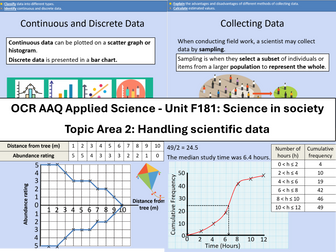
Resources include a relevant starter, an explanation of the difference between qualitative, quantitative, discrete and continuous data and a card sort activity.
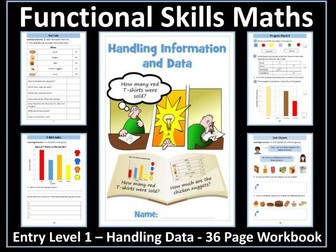
This resource has been designed for students working towards Functional Skills Maths qualifications at Entry Level 1 (Edexcel-Pearson, NCFE, City and Guilds, AQA, Highfield Qualifications, NOCN, Open Awards). It contains an age-appropriate, 36-page workbook on handling information and data.
This resource will help pupils to achieve these outcomes:
read numerical information from lists
sort and classify objects using a single criterion
read and draw simple charts and diagrams including a tally chart, block
diagram/graph
The 35-page workbook contains 10 information pages, 24 worksheets, 2 progress checks and a certificate of achievement. It is available in PDF and an editable PowerPoint version. It can be used for classwork, homework, revision or as an independent learning pack.
Please note, the watermark on the preview images is not present on the resource itself.
If you buy this resource and are pleased with your purchase, I would be grateful if you could leave a review. In return, you can have a free resource up to the value of your purchased resource. Just email inspireandeducate@aol.co.uk with your user name, the resource you have reviewed and the resource you would like for free.
You may also be interested in:
Entry Level 1 - Handling Data - 100+ Slide PowerPoint Lesson
The editable PowerPoint lesson explains how to extract information from lists,
sort and classify objects, read and draw simple charts and diagrams including a tally chart and block graph. It provides many opportunities for pupils to apply this knowledge and practise their data handling skills. It also contains several links to videos on data handling and example exam questions. It is ideal for introducing this component of the specification and for revision purposes.
Save money and buy both resources at a discounted rate:
Entry Level 1 - Handling Data - PowerPoint and Workbook
Level 1 - Numbers and The Number System Bundle
Level 1 - Measures, Shape, Space Bundle
Level 1 - Handling Information and Data Bundle
Entry Level 3 Bundle
Entry Level 2 Bundle
Entry Level 1 Bundle
Entry Level English Resources
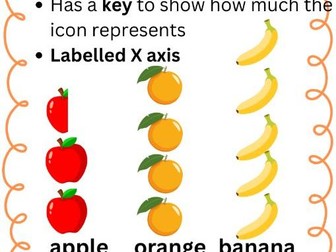
This resource includes tally charts to be completed, making pictograms and interpreting data from pictograms and tables, involving counting in 1, 2s, 5s and 10s. These activities will supplement maths schemes and focus on the objectives of the year 2 maths curriculum - statistics.
This resource has been designed for Entry Level 3 students working towards Functional Skills Maths qualifications at Level 1 (Edexcel-Pearson, NCFE, City and Guilds, AQA, Highfield Qualifications, NOCN, Open Awards). It contains 6 workbooks and 6 PowerPoint lessons on handling information and data.
These resources will help pupils to achieve these outcomes:
represent discrete data in tables, diagrams and charts including pie charts, bar charts and line graphs
group discrete data and represent grouped data graphically
find the mean and range of a set of quantities
understand probability on a scale from 0 (impossible) to 1 (certain) and use
probabilities to compare the likelihood of events
use equally likely outcomes to calculate the probability of a simple event and to express it as a fraction in its simplest form
The bundle includes six workbooks and six PowerPoint lessons:
Workbooks
The 25+ page workbooks contain explanation pages, worksheets,progress checks and certificates of achievement. They are provided in PDF and editable PowerPoint versions. They can be used for classwork, homework, revision or as an independent learning pack.
PowerPoint Lesson
The PowerPoint lessons clearly explain the skills and knowledge needed for the handling information and data component of the Level 1 specification. Many opportunities are provided within the PowerPoints for students to reinforce and consolidate their knowledge and to practise their skills in handling data.
All the PowerPoints contain video links to the various components of data handling and representation and to example exam questions. They are ideal for introducing the various components of the handling information and data specification and for revision purposes.
If you buy this resource and are pleased with your purchase I would be grateful if you could leave a review. In return, you can have a free resource up to the value of your purchased resource. Email inspireandeducate@aol.co.uk with your user name, the resource you have reviewed and the resource you would like for free.
You may also be interested in:
Level 1 - Numbers and The Number System Bundle
Level 1 - Measures, Shape, Space Bundle
Level 1 - Handling Information and Data Bundle
Entry Level 3 Maths Bundle
Entry Level 2 maths Bundle
Entry Level 1 Maths Bundle
Entry Level English Resources
This is a small collection of key words related to data handling. They are designed as a display tool. Remember if laminating to use matt laminates for wall displays to avoid reflection problems.
Key words: range, mean, true value, average, real difference.
A collection of worksheets and activities in a range of styles. Some activities are pair work/ lead to class discussion. Includes a wordseach. Also a handling data Project - which is the fittest form.
This resource is available for less Skittles Data Handling Investigation: Count, Sort, and Create a Bar Chart or for free downloads (including this resource) sign up at Alphabet Learning
What’s included?
This download includes seven A4, portrait orientation pdf sheets.
Both Colour and Black & White versions of the 3 main activity sheets (6 pages).
1 Sheet of Printable Paper Skittles (for cutting and sorting/counting).
What’s it for?
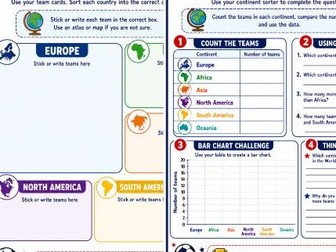
This three-step investigation uses Skittles to teach learners to become data experts by:
Sorting and Counting the coloured Skittles (data collection).
Organising and Recording the data onto a clear, simple bar chart.
Analysing the results by answering questions about the data.
Once this activity is complete your learners may be allowed to eat their Skittles as a reward, alternatively paper Skittles are provided.
Who’s it for?
This resource has been designed for early years children, pupils in years one and two as well as older students needing additional learning support.
Resource Details
The activity is structured for individual learners, using one ‘portion’ of Skittles (real or paper).
Page 1 (Data Collection): Learners sort Skittles into 5 colour groups (red, orange, yellow, green, purple) and record the totals for each group.
Page 2 (Data Organising): The recorded totals are then transferred onto a simple, clear bar chart.
Capacity Note: The bar chart can accommodate up to 16 Skittles of any single colour group.
Page 3 (Data Analysis): Learners answer questions based on the bar chart, covering concepts like most/least, difference, odd/even, and ‘the same’.
All colour-names are printed clearly at the top of page 3 so that learners don’t need to think about colour-word spellings.
Important message
Any issues with this resource please let us know - we are happy to make changes.
REMEMBER…
FREE downloads (including this resource!) available - Sign up for instant free credits to use at Alphabet Learning
New online service NOW AVAILABLE where this resource is available for less Data Handling ‘Traffic Survey’ Activity OR for FREE downloads (including this resource) sign up at… Alphabet Learning
What’s included?
This download includes x2 A4, portrait, pdf sheets.
Who’s it for?
This resource has been designed for early years children, pupils in years one and two as well as older students needing additional learning support.
What’s it for?
This is a meaningful, hands-on activity for data handling. It helps children count and record different traffic types (up to seven), and teaches them to organise this data into a block diagram. An empty space is included allowing you to customise the traffic items.
Resource Details
There are x2 stages to this activity, going out (always with an adult!) to count vehicles for an agreed amount of time and transferring the information collected onto a block diagram.
Page 1
Learners will practice counting different types of vehicles and pedestrians they observe from a safe distance (always with adult supervision!) The record sheet includes:
cars
vans
buses
trucks
bicycles
motorbikes
pedestrians
plus an extra space to add another type of traffic/vehicle
Page 2
Use the information from your “traffic survey” to complete this simple, clear block diagram. Simply colour the correct number of boxes for each type of vehicle. For any group with more than x12 vehicles, colour up to the “12+” line to show a large number.
Important message
Any issues with this resource please let us know - we are happy to make changes.
REMEMBER…
New online service NOW AVAILABLE with FREE downloads (including this resource!) Sign up for instant free credits to use at… Alphabet Learning
This Winter Olympics Medal Tables Maths resource is a fun and engaging way to teach data handling skills in KS2 using real-world Olympic data. Pupils practise reading and interpreting medal tables, calculating totals, comparing values, and answering reasoning questions. The resource then develops graph skills by guiding children to create and interpret bar charts, before extending learning with a pie chart activity focused on fractions, proportion, and data interpretation.
What’s included:
●Medal table reading and calculation questions
●Reasoning and comparison problems
●Bar chart drawing and interpretation tasks
●Pie chart extension with fractions and reasoning
●Answer sheet included
Perfect for:
◆Upper KS2 maths lessons
◆Data handling and statistics units
◆Cross-curricular links with sport or the Olympics
◆Independent work, guided practice, or homework
Clear layout, accessible questions, and a motivating Olympic theme make this an ideal resource for consolidating and extending data handling skills.
This document is a revision booklet I put together for my students over the years. It contains worked examples and notes describing how certain problems are solved.
A mixed bundle of resources which can be used as starters/ homeworks and to make the handling data units in years 7/8 a little richer. Includes a suggested handling data project resources and probability worksheets.
This 9 page booklet is designed to help students and parents when with mathematical questions within their class and homework be it in Maths, Science, Geography, etc.. Topics Include:
Tables
Bar Graphs
Line Graphs
Scatter Graphs
Pie Charts
Averages