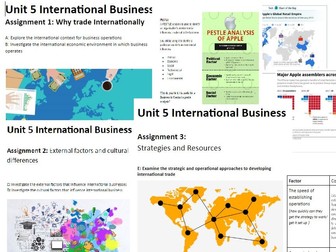
BTEC Business Unit 5 (International Business) - 5 Powerpoints, representing the WHOLE UNIT
Every Learning Aim comprehensively covered and all materials written by an experienced teacher and BTEC Moderator.
PowerPoints contain all the materials that your students will need and include activities, questions and videos to review and reinforce knowledge.
One third discount on cost of buying individual PowerPoints.
Want individual Learning Aims or elements within them? Search for the individual Elements that you require.
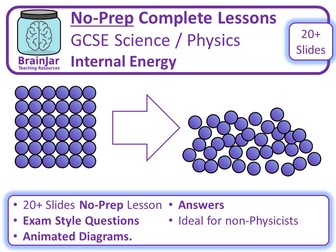
Complete No-Prep lesson with exam questions, tasks and answers on Internal Energy for AQA GCSE (9-1) Science / Physics. This lesson covers all of AQA GCSE Physics 4.3.2.1 / Combined Science 6.3.2.1
As a Secondary Science teacher and Deputy Headteacher for many years I make high quality no-prep lessons so busy teachers can teach outstanding lessons without spending hours planning. This high quality lesson includes explanations, different types of in-lesson assessment (all with answers) and unique exam questions.
My lessons are ideal for non-Physicists - as a Biologist who retrained as a Physics teacher I know how to take learners on a journey that builds up their understanding step by step, while still going into a lot of depth. The preview video shows a representative sample of slides from the resource so that you get a good idea of what it includes before you buy.
What’s Included:
• Starter / Do Now Activity
• Explanation slides in “chunked” sections with animated diagrams.
• Multiple questions in different question styles and difficulties - no need for worksheets. Each “chunked” explanation section typically includes a set of “learning check / quick questions” followed by a set of in-depth questions on the learning from that “chunk” of the lesson. All questions have answers.
• Exam-style questions on the whole lesson at the end of the lesson- these are unique, based on real exam questions but not just copied from exam boards.
• Answers for all questions
• All easily editable to adapt to your teaching or to use in existing lessons.
• Slightly humorous, at points, if you like that sort of thing.
Learning objectives:
Define Internal Energy.
Explain why heating a substance increases its internal energy.
Explain why heating a substance until it changes state increases its internal energy.
Written for AQA GCSE Science and Physics but likely to be applicable to other exam specifications.
Please leave a rating / review and all other feedback gratefully received!
This bundle includes Lessons for all topics in IGCSE/GCSE Business studies. Theme 1; Business activity and influences on business. Includes Lesson power points, resources, multiple choice quizzes, AfL throughout, printable resources, case studies and much more!! All tasks are differentiated and very student-led. Additional planning will not be required.
1.1 Business objectives
1.2 Types of organisations
1.3 Classification of businesses
1.4 Decisions on location
1.5 Business and the international economy
1.6 Government objectives and policies
1.7 External factors
1.8 What makes a business successful?
End of Topic examination questions for Theme 1 can be found here: https://www.tes.com/teaching-resource/resource-12971664
They are FREE! :D
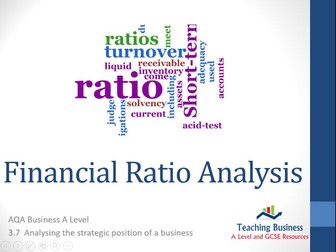
A new range of materials aimed at supporting teachers of the AQA A Level in Business. This presentation is designed to cover the topic of financial ratio analysis and has been adapted to meet the specific requirements of the AQA specification. The presentation considers the basic purpose of financial ratios. It then examines the key ratios of ROCE, Gearing, Payables and Receivable Days, Current Ratio and Inventory Turnover considering each of their strengths and weaknesses and providing suggestions as to how each could be improved. The pack concludes with a critical analysis of ratios and assesses their weaknesses. The pack contains the Quick Fire Five knowledge questions, several practice calculation questions, a short objective test and an essay question all complete with suggested answers. This pack also includes a FREE copy of the student revision notes for this section of the course.
This bundle includes Lessons for all topics in IGCSE/GCSE Business studies. Theme 2; People in Business. Includes Lesson power points, resources, multiple choice quizzes, AfL throughout, printable resources, case studies and much more!! All tasks are differentiated and very student-led. Additional planning will not be required. All lessons are observation ready guaranteed to impress.
Includes 2.1 Internal and External communication to 2.5 Organisational structure and employees.
Topic examiantion questions for Theme 2 can be found here: https://www.tes.com/teaching-resource/resource-13116854
They are FREE to download! :D
Business 0450 IGCSE Business &the international economy 6.3
Topics
Business & the international economy
Globalization
Barriers of trade
Factors to attract MNCs
Impact of MNCs on host country
Updated for 2026 Cambridge syllabus
Play in slideshow & full screen
Complete lesson
Interactive
Educational
Real business examples
Covers all subject content material
Activities
Solutions to activities
Videos
Past paper questions
Solutions to past paper questions
I put a lot of work into these slides
Updated & improved every year
Based on several years of teaching experience
My students love the slides!
BTEC National Business Level 3 Unit 5: International Business- Assignment 1, 2 +3 Student Booklets
**BTEC National Business Level 3 Unit 5: International Business- Assignment 1 Student Booklet
**
67 PAGE BOOKLET
Student booklet covering all aspects of the unit/ specification and assignment brief
Coursework tasks broken down in to individual easy to follow tasks
case studies and news articles deepen student knowledge and understanding
Higher order questioning used throughout
Differentiation through Extension exercises/ questions
Keywords and Terminology
**BTEC National Business Level 3 Unit 5: International Business- Assignment 2 Student Booklet
**
43 PAGE BOOKLET
Student booklet covering all aspects of the unit/ specification and assignment brief
Coursework tasks broken down in to individual easy to follow tasks
case studies and news articles deepen student knowledge and understanding
Higher order questioning used throughout
Differentiation through Extension exercises/ questions
Keywords and Terminology
**
BTEC National Business Level 3 Unit 5: International Business- Assignment 3 Student Booklet**
**
44 PAGE BOOKLET
Student booklet covering all aspects of the unit/ specification and assignment brief
Coursework tasks broken down in to individual easy to follow tasks
case studies and news articles deepen student knowledge and understanding
Higher order questioning used throughout
Differentiation through Extension exercises/ questions
Keywords and Terminology
All PPT slides and worksheets for Unit 1: Business and markets
AND
Unit 2: Managing operations, Human resources and Finance
With past paper exam questions integrated
A fully comprehensive unit for unit 5 international business.
All lessons complete to meet all learning aims and requirements for assignments. Additional distinction focus lessons to push students for high marks.
Globalisation and International Business is a lecture which is covered during International Business Module for bachelor/master level students.
LECTURE OVERVIEW
Globalization has become a major socioeconomic force and topic of debate in the twenty-first century. Chapter One examines the forces that are driving this phenomenon, as well as the often-passionate criticisms of the process. It reviews the objectives that firms pursue when they engage in international business activities and describes the various modes of entry that may be used. It also notes the terminology that has come into existence as new types of organizations have evolved. The chapter concludes with a discussion of the ways in which international business differs from domestic business.
Lecture Learning Objectives:
• Define globalization and international business and show how they affect each other
• Grasp why companies engage in international business and why international business growth has accelerated
• Discuss globalization’s future and the major criticisms of it
• Illustrate the different ways in which a company can accomplish its global objectives
• Recognize the need to apply social science disciplines to understanding the differences between international and domestic business
In this file you will find:
1 Globalization and International Business Lecture Power Point Presentation
1 Guide file how to conduct Lecture
1 Test Bank with 100 different questions and full answer to them with the descriptions and explanations
3 Interesting Exercises
8 Interesting Discussion Questions and answers to them
1 additional reading file about the lecture topic in order to enhance Lecturer/Teacher/Student knowledge
1 folder with useful pictures
Once you will purchase this resource please leave a comment!
Course Description
This 16-lesson course, Introduction to International Business, provides students with a comprehensive understanding of how firms operate, compete, and collaborate in the global business environment. It explores the strategic, cultural, institutional, and ethical dimensions that shape international management decisions in an increasingly complex world.
Students will learn how multinational enterprises (MNEs), small and medium-sized firms, and emerging-market challengers expand across borders through foreign direct investment (FDI), alliances, and innovation networks. The course examines how cultural differences influence marketing, human resource management, and leadership, and how global organisations balance profitability with corporate responsibility, sustainability, and ethical governance.
The course aims to:
Develop an in-depth understanding of the strategic, organisational, and institutional factors influencing international business operations.
Equip students with analytical tools to assess market entry options, cross-border partnerships, and global value chains.
Foster awareness of cultural diversity and its implications for communication, leadership, and marketing.
Encourage responsible and ethical thinking aligned with global sustainability goals (ESG, SDGs).
Strengthen critical, reflective, and practical skills essential for future global managers and entrepreneurs.
The course has 16 lessons divided into FOUR blocks, including
Block 1: Global Strategy & Structure – Internationalisation theories, FDI, global R&D, alliances, and competitive strategy.
Block 2: Cultural, Marketing & HR Dimensions – Cross-cultural management, international marketing, product innovation, and global talent development.
Block 3: Global Trade, Finance & Supply Chain – Institutions, trade agreements, logistics, and sustainable supply chains.
Block 4: Ethics, Governance & Sustainability – CSR, ESG frameworks, and the future of responsible globalisation.
Assessment includes:
• Mid-Term Group Project (40%) – Market entry and strategy presentation.
• Final Exam (60%) – Integrative analysis of strategy, culture, trade, and ethics.
The materials included are extremely rich and integrated, including complete PowerPoints, detailed lesson plans, previews and reviews, weekly tests, reading materials, case studies, and video links, exercises, and group activities. And there are two major assessments (mid-term group project and final exam).
Target Audience
This course is designed for a wide range of learners — from secondary and post-secondary students to higher education and professional training. Its flexible structure and resource-rich content make it equally valuable for teachers seeking ready-to-use materials, institutions developing IB curricula, and individuals interested in global business literacy.
Course Description
This 16-lesson course, Introduction to International Business, provides students with a comprehensive understanding of how firms operate, compete, and collaborate in the global business environment. It explores the strategic, cultural, institutional, and ethical dimensions that shape international management decisions in an increasingly complex world.
Students will learn how multinational enterprises (MNEs), small and medium-sized firms, and emerging-market challengers expand across borders through foreign direct investment (FDI), alliances, and innovation networks. The course examines how cultural differences influence marketing, human resource management, and leadership, and how global organisations balance profitability with corporate responsibility, sustainability, and ethical governance.
The course aims to:
Develop an in-depth understanding of the strategic, organisational, and institutional factors influencing international business operations.
Equip students with analytical tools to assess market entry options, cross-border partnerships, and global value chains.
Foster awareness of cultural diversity and its implications for communication, leadership, and marketing.
Encourage responsible and ethical thinking aligned with global sustainability goals (ESG, SDGs).
Strengthen critical, reflective, and practical skills essential for future global managers and entrepreneurs.
The course has 16 lessons divided into FOUR blocks, including
Block 1: Global Strategy & Structure – Internationalisation theories, FDI, global R&D, alliances, and competitive strategy.
Block 2: Cultural, Marketing & HR Dimensions – Cross-cultural management, international marketing, product innovation, and global talent development.
Block 3: Global Trade, Finance & Supply Chain – Institutions, trade agreements, logistics, and sustainable supply chains.
Block 4: Ethics, Governance & Sustainability – CSR, ESG frameworks, and the future of responsible globalisation.
Assessment includes:
• Mid-Term Group Project (40%) – Market entry and strategy presentation.
• Final Exam (60%) – Integrative analysis of strategy, culture, trade, and ethics.
The materials included are extremely rich and integrated, including complete PowerPoints, detailed lesson plans, previews and reviews, weekly tests, reading materials, case studies, and video links, exercises, and group activities. And there are two major assessments (mid-term group project and final exam).
Target Audience
This course is designed for a wide range of learners — from secondary and post-secondary students to higher education and professional training. Its flexible structure and resource-rich content make it equally valuable for teachers seeking ready-to-use materials, institutions developing IB curricula, and individuals interested in global business literacy.
Btec level 3 unit 5 ; International business - This contains power point lessons and worksheets for the first part of this module
Woudl also be useful for any students looking at international business
NB this was written while the debate over Brexit was still happening and before covid- so you may need to adapt the ‘Brexit debate part’
6 full power point lessons
power point on currency
intro to aim C
worksheets and handouts
Lesson content and other resources for lesson on PESTLE - specifically adapted to the international business market. (Some content may have been adapted from other sources).
A new series of resources aimed at assisting teachers with the delivery of the Edexcel A Level Business specification. This resource specifically looks at topic 4.1.2 International Trade and Business Growth. It considers the issues of imports and exports; specialisation and competitiveness and the key issue of Foreign Direct Investment (FDI). The slides contain several activities with suggested answers including the Quick Fire Five and a 10 mark practice question. The clear and well-presented nature of the slides are aimed at helping students to understand the topics with each topic analysed to provide a balanced assessment of the theory.
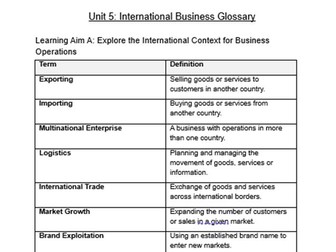
BTEC Business - Unit 5: International Business
(Learning Aims A–E)
A professionally formatted glossary covering all key terms from Unit 5 of the BTEC National Level 3 Business course. This resource breaks down the content by learning aim, making it easy for students to revise and understand important terminology.
What’s included:
Clear, student-friendly definitions of essential terms
Structured by learning aim for easy navigation
Suitable for printing or digital use.
Ideal for students folders for this unit.
Perfect for:
Supporting classwork and homework
Independent revision
Coursework preparation
Internal Business Growth (Lesson 19) - GCSE Business
Unit 1: Business Activity
PowerPoint to deliver a lesson relating to business growth
This layout includes the following:
Including:
Starter recap questions
Internal (organic) growth
Including selling more of current products in
existing markets, looking for new markets,
launching new products, increasing advertising,
promotion and investment
Students should write down any text that is in red.


 Quick View