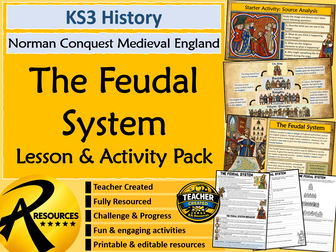
The Feudal System - Norman ConquestQuick View
RAResources

The Feudal System - Norman Conquest

(0)
**Once purchased, you will receive everything needed to teach students about William I’s use of the Feudal System in Medieval England. ** This high quality resource includes the following: A4 Worksheet 1: A fact sheet about the Feudal System for students to use while competing their tasks. A4 Worksheet 2: A worksheet to help students follow up from their main task of creating a Feudal System diagram. The questions on the sheet are explanation based but still provide structure for all students to use. Main Power Point Presentation Slide 1 - Title Slide - To explain how the Feudal System helped William control England after 1066. Slide 2: Starter Task 1 - Two medieval illustrations of society - what can students learn from them about how William kept control? Slide 3/4: Starter Task 2 - A brief introduction to the idea of a hierarchy. Students think about and design their own school’s hierarchy before focusing on the purpose of it. Slides 5-9: An overview of the Feudal System with clear, bold images and small chunks of writing. Slide 10: My own version of the Feudal System diagram Slide 11: Main Task activity - Students taken through step by step to create their own diagram of the Feudal System. Slide 12: Two printable Feudal System blank diagrams if needed Slide 13: A optional role play set of cards for students to read out in class or groups of 4. Slide 14: Mini Learning Review - students have to place four linked images in the correct order Slide 15: Learning Review - Students need to write their own definition of the Feudal System from what they have learned in the lesson. Slide 16-18: Key term match up activity with one slide being a printable version to give students. Slide 19: A challenge question - Would the Feudal System work in today’s society? All images used in this lesson are in the public domain and are therefore copyright free at the time of publishing. Images which require attribution have been attributed in the notes section of each slide where the image appears. If you feel any errors have been made, please contact me at raschoolresources@gmail.com in the first instance to resolve any issues. My lessons are completed using PowerPoint and designed on widescreen formatting. Thank you. This resource is for personal use only and for copyright reasons should not be copied/amended for commercial use.
Domesday Book - Norman ConquestQuick View
RAResources

Domesday Book - Norman Conquest

(0)
**This lesson examines William’s use of the Domesday Book as a method to take further control of England. ** As with all of my resources, everything you need for the teaching of this topic is included and so there is no need for additional text books or resources. With this purchase you will receive: Worksheet 1: An A4 fact sheet all about the Domesday Book Worksheet 2: A student task sheet including various levels of questions. Main PowerPoint Presentation: Slide 1: Title slide – To explain the role of the Domesday Book during the Norman Conquest of England Slide 2: A Think and discuss task about the methods the UK government today uses to collect information about its people Slide 3: A fill in the missing term activity based on William’s actions during the Norman Conquest so far – answers revealed Slide 4: An illustration of a scene of the Domesday survey – students given inference based questions from it Slide 5: Background information about the Domesday survey Slide 6: Background information about the Domesday survey questions Slide 7: An alterative online research task about the Domesday Book data today and UK Census Slide 8: A short clip from BBC Teach about the Domesday Book Slide 9: How to structure an answer to a question about the importance of the Domesday Book Slide 10: A creative writing optional task Slide 11: Learning Review – 10 questions from the lesson Slide 12: Learning Review – answers revealed to the 10 questions All images used in this lesson are in the public domain and are therefore copyright free at the time of publishing. Images which require attribution have been attributed in the notes section of each slide where the image appears. If you feel any errors have been made, please contact me at raschoolresources@gmail.com in the first instance to resolve any issues. My lessons are completed using PowerPoint and designed on widescreen formatting. Thank you. This resource is for personal use only and for copyright reasons should not be copied/amended for commercial use.
Norman Castles - Norman ConquestQuick View
PilgrimHistory

Norman Castles - Norman Conquest

(1)
This lesson further explores the theme of William the Conqueror’s control and tightening grip on England as rebellion and opposition dominate his early years. Students will study William’s castle building program, from the Motte and Bailey through to stone keep castles and analyse their strengths and weaknesses. They will question why the Normans placed their reliance on these eye sores and how their features gave them control and defence against a hostile population. Furthermore they will evaluate how much control he was able to exert over the population using a control ‘o’ meter. Finally there is an interactive question and answer session with an Anglo-Saxon castle builder at the time who has some interesting things to say about his compliance in all of it. This lesson is therefore designed to be fun, challenging and engaging. The lesson is enquiry based with a key question using a lightbulb posed at the start of the lesson and revisited at the end using a rate ‘o’ meter to show the progress of learning. The resource is differentiated and gives suggested teaching strategies. It comes in PowerPoint format which can be amended and changed to suit.
Medieval Towns - Norman EnglandQuick View
PilgrimHistory

Medieval Towns - Norman England

(1)
This lesson has two aims; to discover if medieval towns were dangerous places to live and to question how dirty and unhygienic they actually were. Students learn how Medieval towns grew up through Charters and Guilds and how shops and their names and surnames became intertwined. An exercise tests their ability to interpret shop signs. They analyse a number of statements about the dangers facing townsfolk and evidence this on a road map (or dirt track) using danger symbols and accompanying road signs. The second part of the lesson focuses on the filth and dirt of Medieval towns and questions how much the local authorities did. Students evaluate how hygienic towns were, colour coding thermometers and rating each step taken by the local authorities (or not as the case may be). This lesson is therefore designed to be interactive, fun, challenging and engaging and could be used over two lessons. The lesson is enquiry based with a key question using a lightbulb posed at the start of the lesson and revisited at the end using a rate ‘o’ meter to show the progress of learning. The resource is differentiated and gives suggested teaching strategies. It comes in PowerPoint format which can be amended and changed to suit.
Doom Paintings - Norman EnglandQuick View
PilgrimHistory

Doom Paintings - Norman England

(0)
The aim of this lesson is to judge how powerful Doom Paintings were in Medieval and Norman England. Students will be posed questions to answer, such as why was the Church so important in medieval society and why did people find it so hard to ignore its messages of doom and gloom? Students will learn how Doom paintings were a powerful propaganda tool in the Church’s message over its illiterate masses. Students will examine various paintings and video footage to give an in-depth analysis of their messages. They will then be required to transport themselves into the medieval era and create an extended written piece to express the impact these Medieval Doom paintings were having on their way of life. There is a peer assessment activity to complete and success criteria to help them if required. The lesson is enquiry based with a key question using a lightbulb posed at the start of the lesson and revisited at the end using a rate ‘o’ meter to show the progress of learning. The resource comes in PowerPoint format if there is a wish to adapt and change. I have also included suggested teaching strategies to deliver the lesson and there are differentiated materials included.
Anglo Saxons and NormansQuick View
mossa

Anglo Saxons and Normans

(0)
Lesson 1 -Introduction to Anglo Saxons and Normans in England- 1060-1087 For Edexcel specification GCSE but can be used for any exam board Includes: detailed topic check list/ learning journey Key vocabulary Activity looking at artefacts and what can be learned from them Card sort activity to introduce Anglo Saxon society and the different key words thegn etc. Detailed powerpoint. Variety of tasks
Norman MacCaig Scottish Text - Aunt JuliaQuick View
Katcustard

Norman MacCaig Scottish Text - Aunt Julia

(2)
These resources are designed to help pupils study and prepare for the National Five Scottish Text. These resources focus on the poem Aunt Julia. It includes a copy of the poem Resources included: PPT to take them through annotation Annotated poem Revision Tasks Scottish Text Practice including PPT MS for peer/self-assessment
The Normans: Life in a Norman VillageQuick View
markthegeographer

The Normans: Life in a Norman Village

(1)
GCSE Anglo Saxon and Norman England 1060-87 for the new specification 2016. In this lesson we look at the medieval manor system. We start with a simple retrieval practice starter. We then introduce the Norman village by giving an overview of how it works. The pupils answer questions from an info strip. We then look at the types of houses found in the village and what the medieval manor was. The pupils describe the typical village house and manor. We then look at the peasants year and day with the pupils answer questions and recording potential hardships. We also briefly look at Wharram Percy as an example village. We finish with a source question. Hope this saves you some valuable planning time! https://www.tes.com/teaching-resources/shop/markthegeographer
The Norman Church - GCSE History Anglo-Saxon and Norman EnglandQuick View
Overhumanity

The Norman Church - GCSE History Anglo-Saxon and Norman England

(0)
This lesson explores the changes to the church after the Norman invasion, looking at the differences between Stigand and Lanfranc. It includes a starter, a video, a Venn diagram task and a written task. It works well for GCSE and KS3. Please note - The Pearson textbook - Edexcel GCSE (9-1) History Anglo-Saxon and Norman England, c1060–88 is used to add extra information in this lesson. If you use a different textbook, you will need to alter the page numbers on the slides accordingly. Thanks, enjoy!
NormansQuick View
TeacherCentral

Normans

18 Resources
Topic: Norman conquest and control Lesson 1 FREE: https://www.tes.com/teaching-resource/resource-12724583 KS3 SoW This SoW is designed in detail and is both differentiated and engaging, and allows you to move pupils through content efficiently. As a result, lessons can take around two periods to deliver and are sequenced to flow through this period of time comprehensively. Made to the highest standard and constructed using current research, both dual coding and retrieval practices are at the heart of this unit. A colour scheme also runs throughout to ease both your delivery and students comprehension. An outline of the SoW can be viewed below: Norman conquest and control Death of Edward the Confessor Stamford Bridge Battle of Hastings Hastings - evaluating factors Bayeux Tapestry Harrying of the North Castles Feudal System Domesday Survey Methods of control - evaluation Methods of control - writing The legal system Language Norman Christmas Assessment Any question please do feel free to get in contact: teachercentralltd@gmail.com Best FREE Resources (Teacher Central) https://www.tes.com/teaching-resource/britain-losing-and-gaining-an-empire-12973075 https://www.tes.com/teaching-resource/financial-literacy-12898983 https://www.tes.com/teaching-resource/romeo-and-juliet-12908635 https://www.tes.com/teaching-resource/shakespeare-12908634 https://www.tes.com/teaching-resource/macbeth-gcse-12863697 https://www.tes.com/teaching-resource/animal-farm-free-sow-12942163 (FREE SoW) https://www.tes.com/teaching-resource/slavery-sow-12843084 (FREE SoW) https://www.tes.com/teaching-resource/russia-1917-91-from-lenin-to-yeltsin-12834552 https://www.tes.com/teaching-resources/shop/TeacherCentral?sortBy=lowestPrice&p=5 I hope you find this SoW useful. If you have, I have created a series of resources. You can check them out here. https://www.tes.com/teaching-resources/shop/TeacherCentral
Domesday Book  - Norman ConquestQuick View
thomas_corner

Domesday Book - Norman Conquest

(0)
Discover an engaging KS3 lesson that brings the Domesday Survey to life, exploring its key features and uncovering the aims of William the Conqueror. The lesson contextualises William’s economic problems after the conquest, the aims and creation of the Domesday survey. There are video links to support students engagement and help them to visualise the creation of the Domesday survey. There is an opportunity to model source analysis followed by multiple sources where students can practice this skill. The lesson revolves around the key enquiry question ‘What were the key features of the Domesday book?’ with the lesson ending in a PEE paragraph as a formative knowledge test. The lesson comes in PowerPoint format, feel free to adapt the lesson to suit your needs best!
AQA Norman England - Historic Environment 2026 Pevensey CastleQuick View
Rhurst2012

AQA Norman England - Historic Environment 2026 Pevensey Castle

(0)
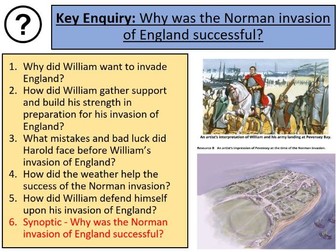
Complete set of lessons and resource for the Norman England 2026 Historic Environment - Pevensey Castle. The lessons have been designed around the factor of ‘cause and consequence’: However, these could be easily adapted if you believe the concept will be different. E.g. Q4: The reason for the success of the Norman invasion was… We teach these lessons stand alone before the control section so have already taught 1066. Lesson 1: Why did William want to invade England? Lesson 2: How did William gather support and build his strength in preparation for his invasion of England? Lesson 3: What mistakes and bad luck did Harold face before William’s invasion of England? Lesson 4: How did the weather help the success of the Norman invasion? Lesson 5: How did William defend himself upon his invasion of England? Lesson 6: Synoptic - Why was the Norman invasion of England successful? Resource Booklet Knowledge Organiser Sheet Each lesson starts with a retrieval grid which can be easily populated with questions from your topics. Disclaimer - This resource set was done using the AQA resource booklet. There is actually limited information on Pevensey as a castle and is very different to the last time this site was used.
Anglo-Saxon & Norman England GCSE History Exam Technique Presentation - EdexcelQuick View
RAResources

Anglo-Saxon & Norman England GCSE History Exam Technique Presentation - Edexcel

(1)
UPDATED & READY FOR THE 2025 exams! This resource takes into account the latest amendments to Edexcel GCSE History question paper formatting, timing and question types. This 15-slide presentation takes students on a step-by-step guide through the Paper 2 British Depth Study exam for Anglo-Saxon & Norman England and provides them with: Example questions Question walkthroughs Advice about exam technique Mark scheme reminders Model answers All past exam question topics (2016-2023) Slide 1: Introduction title slide Slide 2: An overview of the Anglo-Saxon & Norman England question types Slide 3-5: An outline of the ‘Describe one feature of [2 x 2]’ question type. Slide 6-8: An outline of the ‘Explain why [12]’ question type Slide 9-11: An outline of the ‘How far do you agree [16]’ question type. Slide 12-15: All past paper question topics from 2016 Samples to 2023. Buyers of this resource have often used it as part of a walkthrough for their students before the exam, as an introduction to the topic or as a way to remind students of the exam techniques as they practice their skills. Please be aware that any images used in this resource are copyright free. Others which require attribution have been attributed in the notes section of each slide. If you feel any errors have been made with this, please email me in the first instance at raschoolresources@gmail.com
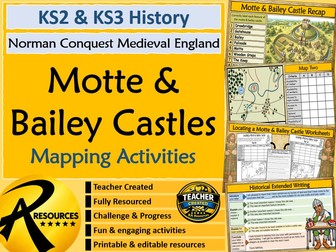
Motte & Bailey Castles - Location & Features  Medieval Norman ConquestQuick View
RAResources

Motte & Bailey Castles - Location & Features Medieval Norman Conquest

(1)
In this lesson, students will use their geography and history skills to identify and explain the best location for a motte and bailey castle, using a variety of map based options and set criteria. Worksheet 1: An A4 worksheet including the two tables that students need to fill out in order to score the best site for their motte and bailey castle Worksheet 2: An A4 worksheet which allows students to structure and write a report about their choice of the best site for a motte and bailey castle PowerPoint: Slide 1: Title slide - To evaluate the most suitable location for a motte and bailey castle Slide 2: Learning Recap 1 - Students are shown an illustration of a motte and bailey castle and have to identify the numbered features on it. Slide 3-4: Alternative Learning Recap - Students are given a diagram of a motte and bailey castle and have to label the different features of it. Slide 5: Animated and illustrated background information about William’s use of motte and bailey castles Slide 6-7: An outline of the main task Slides 8-9: Slides showing the first map which students have to analyse. A table is also included for the teacher to collect student scores. Slides 10-11: Slides showing the second more focussed map which students have to analyse. A table is also included for the teacher to collect student scores. Slide 12: A sheet to help students write their report about their chosen castle to William. Sentence starters given with an opportunity for higher ability students to adapt and develop their own ideas. Slide 13: Challenge Task - Students encouraged to create their own map Slides 14-15: The original map designs (in case you wanted to adapt them in any way) Slide 16: Printable motte and bailey diagrams for the starter task All images used in this lesson are in the public domain and are therefore copyright free at the time of publishing. Images which require attribution have been attributed in the notes section of each slide where the image appears. If you feel any errors have been made, please contact me at raschoolresources@gmail.com in the first instance to resolve any issues. My lessons are completed using PowerPoint and designed on widescreen formatting. Thank you. This resource is for personal use only and for copyright reasons should not be copied/amended for commercial use.
Anglo-Saxon & Norman England Revision Resources Pack - GCSE History EdexcelQuick View
RAResources

Anglo-Saxon & Norman England Revision Resources Pack - GCSE History Edexcel

(0)
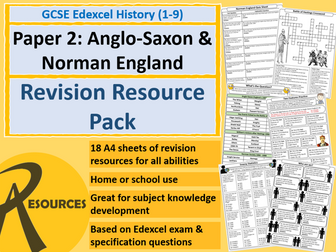
This resource pack includes a wide range of revision activities on A4 which can be used by students in the classroom or at home. The revision pack includes the following activities: Activity 1: A blank timeline covering all of the main eras in the study which students can add key dates to. Activity 2: Anglo-Saxon key individuals match up activity Activity 3: ‘Who are we?’ - Students guess the group by their description. Activity 4: Anglo-Saxon & Norman Key Event Research Sheet Activity 5: William I’s Actions Diagram Fill Activity 6: Anglo-Saxon England Glossary Fill Activity 7: Norman England Glossary Fill (x2 sheets) Activity 8: Statistics Multiple Choice Quiz Activity 9: ‘Use your brain to explain’ activity to help prepare for 12 and 16 mark questions. Activity 10: Two Features Practice Questions Activity 11: ‘What’s the Question’ Activity Activity 12: Battle of Hastings Crossword Activity 13: Anglo-Saxon Quiz Sheet Activity 14: 1066 Quiz Sheet Activity 15: William I’s Control of England Quiz Sheet Activity 16: Norman England Quiz Sheet Where possible, answers have been provided either in the notes section of each slide. Further Anglo-Saxon and Norman England revision resources can be found at: Anglo-Saxon & Norman Timeline:https://www.tes.com/teaching-resource/resource-12825103 Anglo-Saxon & Norman Fact Sheets:https://www.tes.com/teaching-resource/resource-12225783 Please note that all images (clipart/vector/illustrations/photographs) are in the public domain and are therefore classed as Creative Commons 1.0 unless otherwise attributed in the notes section of each slide. If you believe there are any errors, please email me directly in the first instance to resolve the issue.
AQA NORMAN ENGLAND 1066-1100 LESSON 18 TOWN LIFEQuick View
04August00

AQA NORMAN ENGLAND 1066-1100 LESSON 18 TOWN LIFE

(0)
PART TWO: LIFE UNDER THE NORMANS Lesson Eighteen: Town life Key Learning Objectives: To explore the development of towns Topics Covered: How did towns develop under William’s rule? What were guilds? Did town life improve under William? PowerPoint and Student Workbooklet Variety of Activities Activate Challenge Activities Application of Knowledge - Explain Exam Skills Retrieval Activities Review Activities All Lessons Have a PowerPoint and Student Workbooklet Provided and Work In Conjunction with AQA GCSE Approved Oxford Textbook.
The Norman Conquest: weekly homeworkQuick View
alepitirra

The Norman Conquest: weekly homework

(0)
Looking for homework that students actually want to complete? This resource offers 8 engaging and varied homework tasks designed to deepen students’ understanding of the Norman Conquest while encouraging creativity, independence, and historical thinking beyond the classroom. This set is designed to support a Norman Conquest unit and works particularly well as a menu of choice or as structured homework across several lessons. The tasks encourage pupils to revisit key knowledge while applying it in different formats, helping knowledge stick and giving students the chance to shine in different ways. Across the homework tasks, students will consolidate their understanding of the Norman invasion and its consequences, including castles, the feudal system, the Domesday Book, Norman control, and daily life after 1066. Activities range from creative model-making and shield design, to written explanations, fact files, decision-making tasks and knowledge recall, ensuring accessibility for all learners while still providing challenge. The variety of tasks allows students to demonstrate learning in different ways, whether through extended writing, visual work, research, or structured responses. This makes the resource ideal for mixed-ability classes, early KS3, or as an end-of-unit consolidation pack. Clear instructions on each slide mean students can work independently, while outcomes are easy to assess. The resource is fully prepared as a slideshow, making it easy to set, display, or upload. It can be used as weekly homework, enrichment tasks, or a take-home project across the unit. If you are happy with your resource, PLEASE LEAVE US A REVIEW – it really helps my shop grow and lets me keep creating high-quality lessons for you. If you encounter any issues, please email me at alepitirra@hotmail.it and I’ll do my best to solve them. Best regards, Alessio
The Norman Conquest - RevisionQuick View
alepitirra

The Norman Conquest - Revision

(0)
Looking for a clear, effective way to revise the Norman Conquest without losing student engagement? This revision lesson offers six well-structured tasks designed to help students confidently revisit the key knowledge and skills required for understanding the Norman Conquest of 1066. The lesson is ideal as an end-of-unit revision session, a pre-assessment recap, or a structured consolidation lesson. It supports students in recalling core facts before applying their knowledge through a range of accessible but challenging activities. Across the six tasks, students revise the Battle of Hastings, William’s problems after 1066, Norman methods of control, castles, the Feudal System and the Domesday Book. Tasks are carefully sequenced to move from retrieval and comprehension to explanation and structured written responses, allowing students to strengthen both subject knowledge and historical writing skills. As with the rest of the unit, the lesson follows a consistent modelled structure, ensuring students always understand what they are doing and why. Tasks are differentiated by difficulty, allowing the lesson to be easily adapted for mixed-ability classes. Written tasks reflect the GCSE writing framework, making this lesson particularly useful for developing exam confidence. If you are happy with your resource, PLEASE LEAVE A REVIEW – it really helps my shop grow and lets me keep creating high-quality lessons for you. If you encounter any issues, please email me at alepitirra@hotmail.it and I’ll do my best to solve them. Best regards, Alessio
Normans in IrelandQuick View
alana852

Normans in Ireland

(4)
Powerpoint explaining why the Normans came to Ireland. Includes activity where students can construct their own mnemonics.