Sonnet 116 by Shakespeare - Complete Lesson + Study GuideQuick View
Scrbbly

Sonnet 116 by Shakespeare - Complete Lesson + Study Guide

(1)
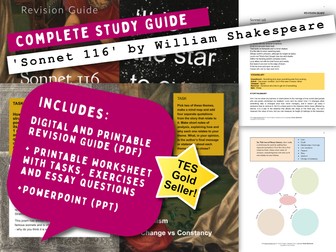
A full lesson + study guide for the poem ‘Sonnet 116’ by William Shakespeare - perfect for classroom teaching or independent revision. Suitable for KS3, GCSE, iGCSE + beyond! . Includes: 10-page digital pdf 10-page printable pdf 7-slide powerpoint 8-page worksheet . CONTENTS: VOCABULARY STORY / SUMMARY SPEAKER / VOICE ATTITUDES LANGUAGE FEATURES STRUCTURE / FORM CONTEXT THEMES TASKS + EXERCISES POSSIBLE ESSAY QUESTIONS . Teaching or studying the Edexcel IGCSE Literature course? Take a look at our EDEXCEL IGCSE POETRY BUNDLE here. . Want to know more about how our resources work? Download a FREE STUDY GUIDE to see whether the bundle is right for you: Blessing - Imtiaz Dharker … If you buy this resource and find it useful, we’d be very grateful if you could leave an honest review - to say thank you, we’re happy to give you a second resource completely free of charge. Just drop us an email at admin@scrbbly.com with your TES name, the name of the resource you reviewed, and which one you’d like for free. We’ll email it over to you within 24 hours. … View our SHOP for other literature and language resources.
'Sonnet 116' by William Shakespeare (1 Lesson Plan)Quick View
MrsRumsey

'Sonnet 116' by William Shakespeare (1 Lesson Plan)

(0)
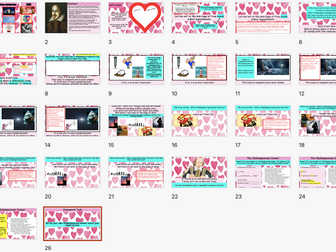
A 26-slide lesson plan that guides students’ analysis of the poem ‘Sonnet 116’ by William Shakespeare. This can be used as part of the IGCSE Edexcel English Literature course. Topics covered: Context Allusion to ceremony of marriage Language Analysis Use of Imagery Personification of love and death Structure of the Shakespearean Sonnet Homework Task
Exploring Shakespeare's 'Sonnet 130'Quick View
jodyleighwinter

Exploring Shakespeare's 'Sonnet 130'

(0)
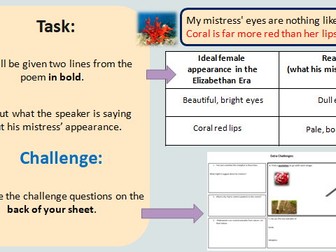
A lesson exploring ideas about appearance, reality and the presentation of women in Shakespeare’s ‘Sonnet 130’. Prompts discussion about ‘reality’ and ‘appearence’, weaving in ideas about social media. Students work individually to interpret different given lines in the poem (worksheet including challenge questions), and then class collaboratively discuss, explore and feedback their interpretations. Lesson also includes a creative writing task.
Sonnet 130: ShakespeareQuick View
MrGradgrind

Sonnet 130: Shakespeare

(0)
This 32-slide lesson explores William Shakespeare’s ‘Sonnet 130’. The lesson considers what we might expect typical love poetry to entail and how Shakespeare subverts our expectations. Students are prompted to question stereotypical depictions of romance and romantic imagery, and to think about how Shakespeare plays with the sonnet form itself. Questions, discussion points, and tasks are featured throughout, including an analytical ‘mini-essay’ in response to a question. The lesson ends with a creative writing (poetry) task that could be set in class or as a homework activity. This lesson is ideal for KS3. A copy of the poem (with glossary) is included. Files are included as PDFs to retain aesthetics.
'Sonnet 116' Lesson and AnalysisQuick View
MissREnglish

'Sonnet 116' Lesson and Analysis

(0)
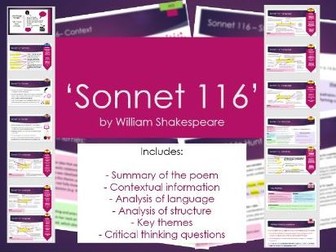
A lesson covering ‘Sonnet 116’ by William Shakespeare. This is one of the poems from the AQA A-Level Literature ‘Love Through the Ages’ Poetry anthology. The PowerPoint includes: A summary of the poem Contextual information Analysis of language Analysis of structure Key themes Critical thinking questions
SONNETS BY SHAKESPEAREQuick View
Raphella

SONNETS BY SHAKESPEARE

4 Resources
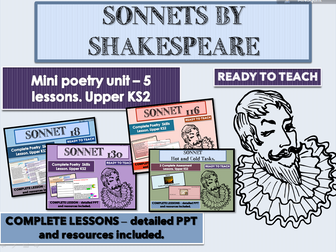
A MINI UNIT OF 5 LESSONS, BASED AROUND THE SONNETS OF SHAKESPEARE. WRITTEN FOR UPPER KS2 (YEAR 6 ) BUT FULLY DIFFERENTIATED, SO EASILY ADAPTED. EACH LESSON INCLUDES A DETAILED PPT AND ALL RESOURCES.
Poetry - Shakespeare - Sonnet 130 (My Mistress' Eyes) - 3 detailed lessonsQuick View
tuttifootie

Poetry - Shakespeare - Sonnet 130 (My Mistress' Eyes) - 3 detailed lessons

(1)
Introducing Shakespeare's poetry for the first time? These three interesting, rigorous lessons provide a great 'way in' for teenagers. Lesson 1 scaffolds how to go about understanding the poem, leaving students ready to interpret the poem creatively. Lesson 2 asks students to determine for themselves what makes a sonnet. It will be a valuable resource for teachers looking to teach or recap rhyme, metre, and structure. Lesson 3 uses a great TED talk by Akala, a very well-informed British rapper, where he demonstrates similarities between iambic pentameter and rap. Students then have a go at making their own (humorous) version of the poem using a cloze version of the poem. Everything you need for a successful lesson is present, including pre-starters to capture attention, starters to kick-start inquiry, teaching points, independent or group work, and reflective plenaries. The worksheets link to the presentations. All resources are easily editable if you wish to make them your own. See this lesson to get an idea of what our resources are like: https://www.tes.com/teaching-resource/poetry-performing-poetry-touch-by-lewin-1st-lesson-free-11141731 If you like this lesson, please visit our shop to see more.
Shakespeare's Sonnets KS3Quick View
NICKY_S_96

Shakespeare's Sonnets KS3

(0)
Looking at Shakespeare and his sonnets (an introduction). Particularly looks at Sonnet 18 and 130. Looks at iambic pentameter and pathetic fallacy. Information on Shakespearian context. Two version of PP, one for M-HA y8 the other used with LA Y8 (nurture group).
Shakespeare's SonnetsQuick View
Havs

Shakespeare's Sonnets

(0)
This is a series of 4-5 lessons that explore 3 of Shakespeare's sonnets (1 for homework) as a way to introduce Y7 to analysis for Shakespeare in a light hearted and quirky way. The scheme starts with a comparison between Shakespeare and Justin Beiber lyrics as way to explore the commonalties in language of love. It then progresses to analysing sonnets 116 and 104. The lessons finish with students working in groups to create their own sonnets, using images and words as challenge stimulus. The resource also includes a homework investigation that can be done as a lesson or as a project to then be presented in a Shakespeare market place as another lesson led by the students.
Shakespeares Sonnet AnalysisQuick View
mrsbray2765

Shakespeares Sonnet Analysis

(1)
This Powerpoint introduces Sonnets 27 & 130 by Shakespeare to students. I use this for Years 7-9. It is a great introduction into the language of Shakespeare. It encourages students to translate the poems into modern day English and also consider the form and style of the sonnets. It also provides an opportunity to discuss poetic techniques such as sensory language.
Shakespeare Sonnet 130 TestQuick View
KimberlyDana

Shakespeare Sonnet 130 Test

(0)
Teaching Shakespeare’s Sonnet 130? Assess your students’ comprehension level and access higher order thinking skills with the Sonnet 130 Close Reading Test (10 Pages/Text Included). Questions include multiple choice, short answers, and a rigorous five-paragraph essay on the thematic message. This product is Common Core aligned, all-inclusive, and super sub friendly - keep them learning even when you’re not there! Answer key included. Close reading is a high yield strategy that ensures maximum literary benefits and proficiency as seen in increased test scores.
Shakespeare's Sonnets - Literature Study (Sonnet 18; Sonnet 130)Quick View
mathompson91

Shakespeare's Sonnets - Literature Study (Sonnet 18; Sonnet 130)

(0)
This unit teaches pupils about the Shakespearean sonnet form. Pupils learn the conventions of the sonnet and are exposed to Shakespeare’s language through Sonnet 18. Pupils then learn how Shakespeare subverts and pokes fun at these conventions through Sonnet 130. Pupils work on skills including: understanding difficult language understanding historical context textual analyis evaluation Pupils work towards a timed critical essay. This unit of work would be suitable for the critical essay section of the National 5 English exam. Links to Quizlet cards and Blooket provided within.
Sonnet 18 by William Shakespeare - Full Lesson Activities - CIE Poetry iGCSE 2026Quick View
shauneelius

Sonnet 18 by William Shakespeare - Full Lesson Activities - CIE Poetry iGCSE 2026

(0)
In this 19-slide PowerPoint, you will find: objective and starter, creative writing task to stimulate ideas connected to the poem, reorganise the poem activity, drama task to facilitate first reading, first impression comprehension questions with an extension, form and structure analysis, multiple interpretation ideas (romantic love vs personal tribute to Hamnet), poetic technique analysis, line-by-line analysis, line-by-line homework questions, essay ideas with four PEE model paragraphs, essay plan. Works best as a PP but you can convert to PDF or Google Slides. Hope it’s useful for your students.
Sonnet 116 by William ShakespeareQuick View
jdgardner

Sonnet 116 by William Shakespeare

(0)
This fully-resourced and engaging lesson is designed for students preparing for the Edexcel IGCSE English Literature (4ET1) Poetry Anthology. Focused on Shakespeare’s Sonnet 116, the resource enables students to explore how the poet presents ideas about love through structure, imagery, and language, while supporting them in building strong exam-style analytical responses. Lesson Features and Content: Engaging Starters: Interactive quizzes and reflective questions (e.g. How do you know when you’re in love?) prompt personal engagement with the poem’s core theme. Accessible Introduction to Form: A student-friendly guide to the sonnet form — including an entertaining breakdown of rhyme scheme, structure (octave, sestet, volta), and Shakespeare’s variation on the traditional Petrarchan form. Contextual Vocabulary Support: Key vocabulary (e.g. impediments, tempests, sickle, bark) is pre-taught and reinforced to support confident reading and annotation. Modern Translation Matching Task: A worksheet is provided for students to match Shakespeare’s language to a modern translation. Quotation ‘Exploding’ Task: Students select key quotations and ‘explode’ their meanings through guided scaffolded notes — supporting precise exploration of imagery and authorial intent. Model Analytical Paragraph Frame: Includes a PETAL paragraph scaffold with sentence starters and prompts, encouraging students to write clear, well-structured responses about how Shakespeare presents love. Challenge and Extension: students consider whether Shakespeare’s view of love remains relevant today — encouraging personal responses and critical thinking.
Shakespeare's Sonnets Part TwoQuick View
mrsbray2765

Shakespeare's Sonnets Part Two

(0)
An analysis of Shakespeare’s Sonnets 18 & 116. These slides provide the opportunity for students to translate Shakespeare into modern day English. I use these between Years 7-9 as find them a good introduction into Shakespeare’s language. They also allow conversation for use of personification and poetic form.