Bright, clear and child-friendly display posters to support the teaching of punctuation in Key Stage 2. This resource includes individual posters for a wide range of punctuation marks:
Full stops
Commas
Finger spaces
Dashes
Question marks
Brackets
Apostrophes
Ellipses
Semi-colons
Colons
Inverted commas
Exclamation marks
Hyphens
Capital letters
Perfect for English working walls, grammar displays or punctuation reference points during writing lessons. The simple design makes each poster easy for pupils to see and use as a visual reminder when drafting and editing their writing.
These posters can be used for:
Displaying on classroom walls
Adding to table toolkits for writing support
Revising punctuation in grammar lessons
Encouraging independence in written work
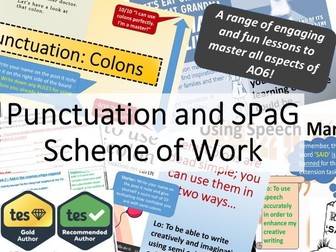
Complete Punctuation and SPaG scheme of work for Key Stage 3 and GCSE. It’s time to win the battle against poor grammar and punctuation once and for all!
Complete unit of work which will allow your students to master advanced punctuation as well as engage with a range of exciting creative writing tasks. If you are anything like me, explicit teaching/reminding of how to properly apply punctuation is ESSENTIAL for all ability ranges, especially with the new specification GCSE placing so much emphasis on AO6.
These lessons are certainly geared more towards KS3 and KS4 students. Powerpoints are light hearted and fun, with plenty of images/colour and silly jokes to keep your students engaged and entertained. I’ve found these lessons serve as an excellent ‘crash course’ in punctuation either at the beginning of the academic year or in the run up to the GCSE exams. Below is a list of contents:
Commas (£2 if purchased on its own) -
Commas powerpoint lessons
Commas in a list worksheet
Commas in a complex sentences worksheet
Colons (£2 if purchased on its own) -
Colon powerpoint lessons
Mastering colons worksheet
Semi-Colons (£2 if purchased on its own)-
Semi-colon lesson powerpoints
Semi-colon worksheets (x2)
Semi-colon writing success criteria worksheet
Speech- (£2 if purchased on its own)
Speech powerpoint lessons
Speech worksheet
Speech mixed practice worksheet
Writing success criteria worksheet
Editing and proof reading - (£3 if purchased on its own)
Editing and proof reading mini scheme powerpoint (nearly 50 slides)
Editing and proof reading worksheets (£2 if purchased separately)
A wide range of proof reading worksheets that you can use to consolidate and improve your student’s SPaG and proof reading abilities after you have finished the unit of work.
This unit would suit a range of abilities as there is lots of scope for stretch and challenge, with ambitious success criteria and extension tasks built in throughout. Scaffolding and differentiation options are built in where appropriate.
Fully resourced and ready to roll, minimal adaptation or tweaking required.
This is obviously a SPaG/Punctuation scheme of work, but it is equally focused on creative/descriptive writing too. Much of the content is therefore ideal for teaching general creative writing skills or preparing for the fiction writing task on the new specification (9-1) GCSE English Language exam.
Grab a bargain compared to buying these resources separately.
Two engaging lesson on varying sentence structures and using punctuation for effect. Includes a range of activities and detailed worksheets that really encourage pupils to see the merit of more varied structural choices, as well as emphasises the significance of technical accuracy. Worked extremely well and had high impact on my own classes.
Suitable for both KS3 and KS4.
Year 6 teachers, are you tired of drilling practice papers? Ditch the photocopier and bring grammar revision to life with The Unfair Game: Punctuation Edition a thrilling, high-energy way to prepare for Year 6 Grammar SATs Paper 1.
This brand-new edition focuses on punctuation, ensuring your students have opportunities to practise the punctuation skills needed at KS2, including:
• Full stops, commas and question marks
• Exclamation marks
• Apostrophes for possession and contraction
• Inverted commas
• Commas in lists and to clarify meaning
• Colons, semi-colons and dashes
• Hyphens
Questions are SATs-style, inspired by the 2023 and 2024 papers, so your students are revising exactly what they need in an engaging, strategic format.
Why Choose The Unfair Game?
Unpredictable Point Values: Each question has a hidden score – but will it be positive or negative? Players only find out after answering!
High-Stakes Strategy: Answer correctly, then make a tough call – keep the points or pass them on? You must decide before knowing the value!
Full Engagement: With fast-paced, competitive gameplay, this is SATs revision disguised as fun! Your class will be buzzing with excitement as they strategise, collaborate, and apply their grammar knowledge.
Perfect for SATs Prep: Say goodbye to revision fatigue! The Unfair Game keeps students motivated, focused and actively learning key grammar concepts right up to SATs week.
If you are ready to liven up your SATs grammar revision, choose The Unfair Game: Punctuation Edition. It makes SPAG practice engaging, exciting and – most importantly – unfair!
Download now and let the games begin!
I'm using this as a reminder to pupils (and I am embarrassed to say which year they are in!) but I thought it could be useful to others.
A ppt for recapping how to use some punctuation in a sentence correctly, looking specifically at questions and statements, capital letters, and apostrophes (with omission only, not possession - that will come in another ppt later).
This resource contains a quiz/revision resource on KS2 SATS English - spelling punctuation and grammar. It can be used as a quiz or as a revision resource.
The quiz can be administered in a variety of ways - to individuals or teams. The answers can be found by clicking on the question image on the bottom right-hand corner of each slide. Answers can be given either as you go through the quiz or at the end. An answer sheet is included to record answers.
The quiz includes SATS style questions on:
grammatical terms, word/classes - nouns, verbs, adjectives, coordinating and subjunctive conjunctions, pronouns possessive, relative, adverbs, adverbials, prepositions, determiners, subject and object, verb tenses, modal verbs, present and past progressive,passive and active, clauses - main, fronted adverbials, subordinate, relational, punctuation - full stops, commas in lists, commas to clarify meaning, question marks, exclamation marks, inverted commas, apostrophes, colons, semi-colons, capital letters, hyphens, direct speech, brackets, determiners, articles - definite and indefinite, function of sentences - declarative, interrogative, imperative and exclamatory sentences (statement, question, command, exclamation), vocabulary -synonyms and antonyms, prefixes and suffixes, spelling - homophones and plurals.
Please note, the watermark on the preview images is not present on the resource itself.
You may also be interested in:
Key Stage 2 SPaG SATS Set of 66 SATS Style Questions
This resource contains a set of 66 SATS style questions on grammatical terms and word classes. The resource includes questions on the following:
Nouns
Verbs
Adjectives
Conjunctions
Pronouns
Possessive Pronouns
Relative Pronouns
Adverbs
Prepositions
Determiners
Subject and Object
Thinking of publishing your own resources or already an author and want to improve your resources and sales? Check out this step-by-step guide:
How to Become a Successful TES Author: Step-by-Step Guide
This resource gives pupils 7 rules for punctuating dialogue in a simple and easy to follow Power Point. It also includes 12 practice questions with answers.
Used as a stand alone lesson, this gives pupils the chance to practice their punctuation dialogue skills. It can be used to teach younger learners 7 - 11 but it can also serve as a practice for older pupils 11 - 14.
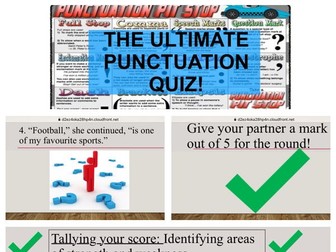
Here is the ultimate SPaG/punctuation quiz! Let’s face it, teaching SPaG can be dry, this quiz is just one way of making it a little more fun and adding a competitive element to it too.
* Rounds comprise of either 5 or 10 questions
* A single round can be completed as a starter, or the whole quiz can take at least a lesson
* Answers are provided at the end of each round and can be peer assessed
* Students must get all aspects of the question right to gain marks for that particular question (for example, all commas must be in the correct place on a comma question to gain a single mark). However, the test can be made easier by giving a mark for each punctuation mark in the correct place.
* If you wish, you can use this as a baseline assessment and revisit the test again to check progress at the end of a SPaG or writing unit.
Rounds as follows:
Round 1 – Brackets (out of 10)
Round 2 – ? ! or . (out of 10)
Round 3 – Speech marks (out of 5)
Round 4 – Semicolons (out of 5)
Round 5 – Colons (out of 5)
Round 6 – Commas (out of 10)
Round 7 – Mixed 1 (out of 5)
Round 8 – Mixed 2 (out of 5
Round 9 – Mixed 3 (out of 5)
The quiz is reasonably challenging, and is therefore geared more towards KS3 and GCSE English level. However, it could also work with really bright KS2 students. Ideal activity as a standalone lesson or as part of a programme of GCSE revision for the new 9-1 Language spec, which places huge emphasis on this aspect of writing. I guess it would also make an ideal whole school literacy drive resource during tutor time!
Ready to roll, Enjoy!
Sentence Punctuation Practice - Years 3 and 4 Punctuation
This lower KS2 teaching resource is an end of unit assessment following completion of our sentence punctuation lessons: Capital letters and Full Stops, Question Marks and Exclamation Marks.
What’s included:
An animated PowerPoint teaching resource quickly recapping capital letters, full stops, question marks and exclamation marks
Activities to assess understanding with an accompanying worksheet
The resource is fully editable, allowing teachers to adapt content to suit their class, pace and teaching style. It is ideal for lower KS2 grammar, punctuation and SPaG lessons, intervention work, revision or home learning.
Click the images above to preview Sentence Punctuation Practice - Years 3 and 4 Punctuation in more detail.
Not quite what you’re looking for? Click below for similar Year 3 and 4 punctuation resources:
Question Marks - Years 3 and 4 FREE Punctuation Resource
Commas for Writing Lists - Years 3 and 4
Using Commas to Separate Subordinate Clauses - Years 3 and 4
Using Commas After Fronted Adverbials - Years 3 and 4
Using Commas Practice - Years 3 and 4
Apostrophes for Contractions - Years 3 and 4
Apostrophes for Singular Possession - Years 3 and 4
Apostrophes for Plural Possession - Years 3 and 4
Using Apostrophes Practice - Years 3 and 4
Punctuating Direct Speech - Years 3 and 4
Introducing Paragraphs - Years 3 and 4
Using Headings and Subheadings - Years 3 and 4
Capital Letters and Full Stops - Years 3 and 4
Exclamation Marks - Years 3 and 4
This powerpoint dedicates each slide to a different area of the punctuation and grammar SATs test. It is highly useful when revising the concepts the children must know for the test in an engaging way. All slides followed by an answer slide!
The powerpoint covers:
Phrases (adverbial, prepositional & noun)
Prepositions
Co-ordinating and subordinating conjunctions
Main & subordinate clauses
Relative clauses
Modal verbs
Determiners
Prefixes and suffixes
Root words
Subject-verb agreement
Pronouns
Active & passive voice
Synonyms & antonyms
Progressive tense
Perfect tense
Word classes
Hyphens
Colons, semi-colons and dashes
Apostrophe for contraction and possession
This bundle includes six PowerPoint lessons on punctuation - parenthesis (commas, dashes, brackets), commas to clarify meaning, colons, semicolons, hyphens and the ellipsis.
All the PowerPoints clearly explain the functions of each punctuation mark and how they are used. Many opportunities are provided within the PowerPoints for pupils to identify when they should be used and to place them correctly in writing.
All the PowerPoints contain links to short videos that also explain and give example of how they are used.
PowerPoint presentation which helps students understand different punctuation marks and when to use them.
This is a visual presentation that can be printed and used as classroom display/posters.
There are two short activities for students to complete at the end of the presentation.
Punctuation marks addressed:
Full stops
Capital letters
Commas
Apostrophes
Colon
Semi-colon
Question Marks
Exclamation Marks
Hope you enjoy :)
Punctuation: This punctuation cootie catcher bundle is a great way for students to have fun while they practice working with commas, apostrophes, and quotation marks.
All these cootie catchers sell individually for $5.65; as a bundle they are 20% off, for $4.50!
This punctuation bundle contains each of the following products:
1. Apostrophes
2. Commas
3. Quotation Marks
Brighten up your literacy corner with this fun, aesthetic punctuation bunting! Perfect for KS2 classrooms, this display resource turns punctuation marks into a visually engaging feature, helping students remember key punctuation while adding a pop of color to your walls. Easy to print, cut, and hang, it’s a simple way to make literacy displays both educational and eye-catching.
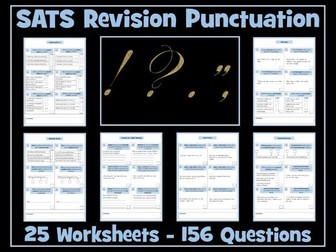
This resource contains a set of 156 SATS style questions (25 pages) on all aspects of punctuation. It is an ideal SATS practice resource and also a useful assessment tool to identify what pupils have achieved and what they need to work on in punctuation. A pupil assessment sheet is also included. The resource includes questions on the following:
Capital Letters
Full Stops
Question Mark
Exclamation Mark
Commas in Lists
Commas after Fronted Adverbials
Commas to Clarify Meaning
Colons
Semi-Colons
Apostrophes for Possession
Apostrophes for Contraction
Hyphens
Single Dash
Ellipsis
Inverted Commas
Brackets
You may also be interested in:
Key Stage 2 SATS Grammar Questions- Grammatical Terms and Word Classes - 11 Worksheets - 66 Questions
Key Stage 2 100 Question SPaG SATS Revision PowerPoint Quiz
This resource contains a quiz/revision resource on KS2 SATS English - spelling punctuation and grammar. The questions are in SATS style and include questions on grammatical terms, word/classes, combining words, punctuation and spelling.
More SATS English Resources
Thinking of publishing your own resources or already an author and want to improve your resources and sales? Check out this step-by-step guide:
How to Become a Successful TES Author: Step-by-Step Guide