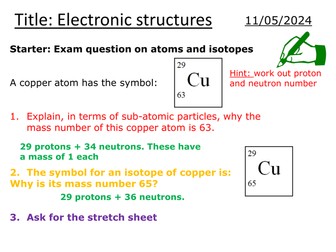
An introduction into electronic structure. Whole lesson including all activities, the electronic structure of the first 20 elements is a modified activity from a different author (griffad 1972) - Thank you. This lesson was taught to a high ability KS3 group, but can be modified for GCSE groups
Introduction to atomic structure, designed for teaching Atomic Structure in the IB Diploma Programme, but is useful for any KS4 or KS5 course. There is a little exercise at the end of the KS4 bit to practice working out number or protons, electrons and neutrons in different atoms and ions. There is a different one including isotopes. It might be necessary to remove ions from this table if not discussed yet.
Following that is more higher-level stuff on atomic orbitals, the Aufbau principle, etc.
I updated this in November 2016 to reflect the changes to the IB syllabus, but there are some bits missing, notably mass spectra, calculations for electron transitions and some more detail on ionization energies.
2 worksheets on electron configuration. 1 explains the atom and how electrons are arranged, the next requires students to draw electron configuration diagrams for the first 20 elements.
Designed for BTEC Level 2 Applied Science atomic structure assignment.
This is for low ability GCSE.
Following the AQA trilogy spec.
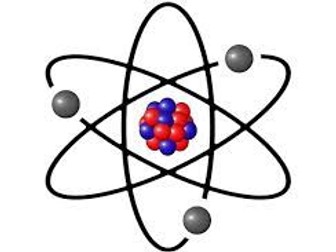
This covers the structure of the atom, how to calculate protons, neutrons and electrons and why atoms have no charge.
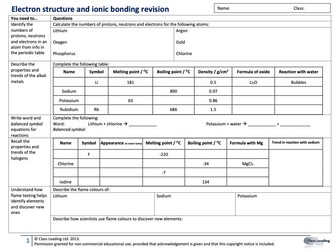
Student Booklet that students complete as they progress through the topic. Covers electron structure, ion formation, ionic bonding, covalent bonding and structures.
Includes full lesson with starter, plenary, timings and AFL. Look at the periodic table, subatomic particles, and electronic configuration. Use the PDFs to produce electron configuration whiteboards for immediate feedback from the whole class. Use the simple periodic tables and pupils can look up their own data for quickfire assessments.
periodic table, electron shells, energy levels, assessment
This lesson was written as a revision lesson for AQA-C1-1-Fundamental ideas. But can be used for any lesson on atomic structure.This is an independent task that breaks down atomic structure and electron diagrams into short tasks for the students. Also contains a starter and plenary to show student progress.
Lesson introducing electronic configuration and electron shell diagrams. Also relates outer electrons to groups in Periodic table. Now updated with paired electrons (better as a result!) thanks for feedback.
This is a worksheet I've assembled and used with classes in BTEC and GCSE.
I've added two image from google image search which helped me explain the overflowing effect when drawing electrons (the class imagined a fountain filling up for the first time).
I hope they help! This specifically was my evidence for BTEC 'Assignment 1.3 P3 Describe the atomic structures of elements 1-20, found in the periodic table'.
Pupils without any previous learning in the subject are introduced to basic electronics.
Pupils are taught the skills required to make simple electronic circuitry and will engage in the design of a complete electronic product for a target customer group.
Skills such as soldering, circuit assembly, circuit design and component choice are introduced.
Lesson resources for the ‘Electron Structure’ unit (OCR Chemistry A) which includes:
Energy Levels (Shells & Sub-Shells) and orbitals.
Electronic configurations
All PowerPoints start with a short quiz to help gauge understanding at the start and most tasks are differentiated by choice.
Keywords: structure, bonding, electron, energy levels, shells, orbitals, rings, periodic table, patterns.
Notes: This is a revision summary sheet that has questions about structure and bonding relating to electron arrangements and ion formation.
Please note that this resource was originally designed for unit C4 of OCR 21st Century Science, but is applicable to other specifications.
It includes an answer sheet.
An editable premium version is available at: https://www.tes.com/teaching-resource/-13142395
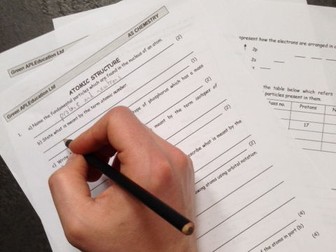
A double-sided worksheet and fully complete answer sheet which covers atomic structure. The answer sheet contains the worked answers and a mark scheme, making it useful to set as an assessment task or as a piece of marked homework.
The worksheet is based on UK curriculum content, but it may be useful for other country’s curriculum, around age 16 to 18 year old students.
Other premium resources are also available which cover atomic structure for post-16 students including this collection of A level worksheets and fully complete answer sheets and mark schemes:
https://www.tes.com/teaching-resource/chemistry-a-level-atomic-structure-collection-11106431
Powerpoint presentation covering atoms, atomic structure, electron configuration, elements, molecules, compounds, balanced equations, conservation of mass.
Everything in chapter 1 of chemistry in AQA Science A textbook, but focussed on the specification.
A full differentiated lesson based on the new AQA (C1.8) SOW but can be used for others. The lesson employs several activities to scaffold students towards writing/drawing electron structures for the first 20 elements of the periodic table. All answers are included in the slides and timers are used to promote pace. Hope it saves you some time.
If you like this resource please visit my shop for more: https://www.tes.com/teaching-resources/shop/matt_nick1in
Table filling activity requiring students to determine the mass number, atomic number, and the number of protons, neutrons and electrons in different atoms/ions.
This lesson is designed for the NEW AQA Trilogy Chemistry GCSE, particularly the ‘Electronic Structure’ SoW
Presentation contains:
• Lesson objective
• Success criteria
• Information slides
• Challenge activities
• Demonstrate understanding tasks
• Lesson resources (aimed at a mixed ability class covering content 1-8)
It is available as a digital worksheet and its resources are designed to meet the needs of a mixed ability class
If you require more assistance, please contact me at-
ChemLabs1000@gmail.com
My year 9s and my year 11s love this challenge.
The idea behind it is that the pupils will really get to grips with the protons, neutrons and electrons of each element so they can correctly answer questions about ions, bonding and electronic configuration. This is coming in earlier in the new Edexcel specification!
I give pupils 3 minutes for this activity. If it cannot be done in that time, they haven't grasped it yet! They do it as a starter or a plenary, and all begin at the same time. It works well as a mini test where they race against each other (or even you) to be the first one to finish with them all correct. They can even mark each others!
When they finish one challenge (95% correct or more) they move on to the next one. I use school rewards for when they advance and I have also included a certificate that I have given to the ones who complete all 3. This can obviously be modified to reflect you and your class.
Don't forget to leave a review!
This PowerPoint covers all of the content from the (draft) NEW 2016 AQA syllabus for Chemistry topic 1 - Atomic Structure and the Periodic Table. It includes: the structure of the atom, elements, compounds, balancing equations, naming compounds, mixtures, filtration, evaporation, distillation, chromatography, the development of atomic structure theory, Rutherford scattering, mass and atomic number, isotopes, electron structure, the periodic table, how the periodic table has developed, properties of metals, the noble gases, the alkali metals, reactivity and properties of alkali metals, the halogens, reactivity and properties of the halogens, properties of the transition metals.