This resource introduces learners to basic equations. It then progresses to solving equations which involve mulitplication of a variable e.g. 2x = 20 so x = 10.
It then progresses to solving two step equations by using the balancing strategy.
For each topic covered the Powerpoint has a few quick questions and links to games that can be played on an IWB with learners.
A three level differentiated activity to practise algebraic substitution which includes practice of negative numbers and BIDMAS. Suitable for Y6 and above.
Editable Word document and PDF document.
Answers are included on second page.
These worksheets are linked to the Key Stage 2 curriculum and provide a range of differentiated algebra questions.
These worksheets are also available individually for £2 each. Make a saving! Buy this bundle of three worksheets for £2.50!
Carefully crafted teaching presentation with everything you need to teach this small step of White Rose Maths Year 6 Spring Block 3 Algebra Unit. This presentation follows the mastery approach of concrete, pictorial and abstract, whilst implementing all aspects of Rosenshine’s principles of instruction.
This presentation contains:
*A warm-up to start the children’s thinking with AfL and metacognition style questions.
*Guided practice through each new concept, providing models of strategies and worked examples.
*Independent practice through differentiated varied fluency, reasoning, and problem-solving questions.
*Plus, a greater depth extension activity to fully show students’ understanding.
*Answer sheets for teacher or students’ self/peer assessment
*Student refection page to discuss the lesson’s objectives and their individual next steps.
The complete Year 6 Spring Block 3 Algebra Unit can be found here.
-This product is not affiliated with nor endorsed by White Rose Maths-
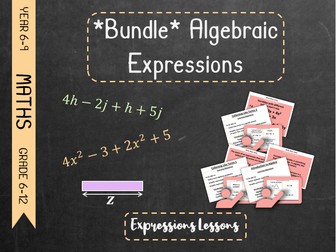
This growing bundle is a series of lessons on algebraic expressions. The bundle currently/will include:
Introduction to Algebra
Collecting Like Terms 1 (variables power of 1)
Collecting Like Terms 2 (variables power other than 1)
Collecting Like Terms 3 (variables multiplied together)
Multiplying Variables
Dividing Variables
Expanding Brackets 1 (variable inside bracket)
Expanding Brackets 2 (variable outside bracket)
Substitution
Writing Expressions
Using Formula
Writing Formula
ALGEBRA. Getting into Algebra. 2. Creating Algebraic Equations to Solve. One Step.
20 Questions with Animated Step-by-Step Solutions.
Questions cover addition, subtraction, multiplication and division.
The resource is intended as an introduction to algebraic thinking.
Each question has…
The question with work-pad (for print or board)
An animated step-by-step walk-through
Nothing elaborate - just a worksheet based on fairly typical 11+ algebra questions.
I put it together just for a bit of extra practice for my pupils - algebra isn't exactly a favourite topic!
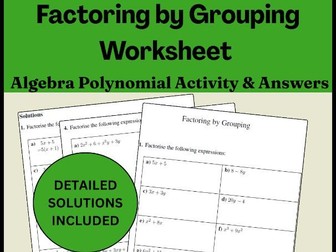
A worksheet on factorising algebraic expressions using the method of grouping.
The first exercise is on factoring algebraic expressions by taking the highest common factor of their terms and the remaining exercises are on factoring by grouping. Detailed solutions are included.
Are you looking for a comprehensive, no-prep algebra booklet to help your students master factorising polynomials? This 10-page resource features 40 structured practice questions ranging from basic Greatest Common Factor (GCF) to advanced factorising by grouping and expression evaluation, complete with a full step-by-step master answer key.
Save hours of planning time with this complete Factorising by Grouping and GCF Practice Booklet! Tailored specifically for Secondary Mathematics students across Key Stage 3, Key Stage 4, and GCSE preparation, this multi-page resource systematically guides learners through the core methods of polynomial factorisation.
Whether you need a reliable homework assignment, an independent revision guide, targeted exam preparation, or a quick emergency cover lesson, this print-and-go resource has you covered.
What is Included in this Booklet?
• Page 1: GCF Introduction – 12 foundational questions focusing on factorising out the Greatest Common Factor from linear and quadratic expressions.
• Page 2: Binomial GCF Grouping – 10 problems that transition students into recognizing binomial common factors, including tricky sign-switching questions.
• Pages 3 & 4: Four-Term Polynomial Grouping – 18 intermediate to advanced expressions where students group terms to factorise completely.
• Page 5: Evaluating Factored Expressions – 6 higher-order thinking extension questions where students must first factorise the expression and then substitute given values to solve.
• Pages 6–10: Full Master Solutions – Every single page features a matching, completely worked-out solution sheet to make marking a breeze or allow for student self-assessment.
Perfect For:
• KS3 Extension, KS4 Core, and GCSE Mathematics classes
• Remedial math groups and targeted intervention
• Homework tasks, weekly quizzes, or structured classwork
• Independent study and exam revision packs
Topic Keywords Covered:
Factorising by grouping, greatest common factor (GCF), algebraic expressions, factorising polynomials, quadratic brackets, algebra expansion, GCSE Maths revision.
Ready to become math detectives as we dive into the exciting world of function machines! These amazing mathematical tools will help you discover patterns, solve puzzles, and see how algebra comes alive through step-by-step transformations.
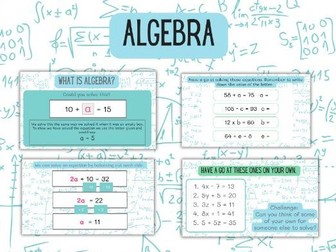
This resource covers one step and two step equations (with balancing). It includes lots of examples for learners to try before progressing on.
It also has 3 differentiated worksheets which provide consolidation and challenge for all learners.
This is a detailed resource that I use as a Workbook for my students
It is 52 pages long and over 7300 words, There are 312 practise questions and just over 60 Detailed worked examples of GCSE style questions and can easily cover a good chunk of the GCSE Maths 9-1 Exam paper material
The End of topic questions can also be used as weekly assessments to test pupils understanding or as homeworks through the year.
The topics covered are all under the Algebra section and Number section from the GCSE Maths 9-1 curriculum (Mainly Edexcel and AQA but still applies for all other main exam boards)
Any solutions can be provided, please email me at AJMathsT@Gmail.com
Topics covered:
‘Simplifying Algebraic Expressions’
‘Expanding and Factorising’
‘Solving Equations and Inequalities’
‘Indices’
‘Solving Quadratic equations’
‘Simultaneous Equations’
‘Functions’
‘Simplifying Algebraic Fractions’
‘Completing the Square’
‘Expanding Triple Brackets’
‘Fractions’
‘Percentages’
‘Rounding and approximation’
‘Error Intervals’
‘Surds’
‘Sequences’
‘Standard Form’
‘Recurring Decimals’
‘Repeated Counting’
PowerPoint and Slides lesson involving an introduction to algebra and algebraic notation including writing expressions from diagrams.
Please read preview before purchase
This algebra worksheet helps children to practise substituting, writing algebraic expressions and solve equations in algebra. It is suitable for children in Year 5, Year 6 and Year 7.
It would also make a really great homework activity.
Very basic filling in the gaps exercise to introduce the concept of algebra and solving equations to low ability KS3 students or high ability KS2 students.
A set of fun Easter-themed shape algebra worksheets, differentiated three ways, with answers.
Pupils use algebra to crack the code to find the value of the different Easter objects, such as the Easter bunny, Easter egg and Easter basket.
Three differentiated worksheets are provided for this fun Easter maths activity:
• Bronze: simple additions and subtractions
• Silver: additions, subtractions, multiplications and divisions; multi-step problem solving
• Gold: more complex problem solving involving multiple steps; square numbers and cubes included
Each worksheet contains an answer sheets showing the completed Easter worksheet.
Each document comes as a PDF.
You may also like:
Valentine-themed
✦ Valentine’s Day Maths Bundle Differentiated
✦ Valentine’s Coordinate Picture Worksheets Differentiated With Answers
✦ Valentine’s Fractions Pixel Art Differentiated Maths Worksheets
Halloween-themed
✦ Halloween Maths BUNDLE - Differentiated Worksheets
✦ Halloween Coordinate Picture Differentiated Worksheets with Answers
✦ Halloween Fraction Word Problem Sheets Differentiated with Answers
✦ Halloween Shape Algebra Differentiated Sheets with Answers
Christmas-themed
✦ Christmas Maths Bundle - Differentiated Worksheets
✦ Christmas Coordinate Pictures Differentiated Worksheets
✦ Christmas Shape Algebra Worksheets – Differentiated
✦ Christmas Fraction Word Problem Differentiated Worksheets with Answers
Other maths resources
✦ Rounding Code Cracker Worksheets
✦ Division Word Problems With Rounding Differentiated Sheets
✦ Negative Numbers Differentiated Worksheets
Visit Helen-Teach’s shop for more resources.
This lesson allows students to apply and use their algebraic thinking through the lens of cryptography, where students problem solve to crack the code and unlock a vault - perfect to help your students master algebraic expressions through clear explanations, thought-provoking challenges, and engaging activities!
Knowledge and Skills Covered:
Knowledge:
I know that a variable is a letter or symbol used to represent a value that can change or is currently unknown. In this lesson, we use variables to build our own secret security keys.
I know the difference between an expression and an equation. In this lesson, we create expressions for our codes and turn them into equations when we set them equal to a specific vault output.
I know that an inverse operation is the opposite action that can be used to isolate a variable. In this lesson, we must use the inverse of three separate steps to successfully crack a vault and find the starting input.
Skills:
I can translate a word problem into a formal algebraic expression or equation. In this lesson, we turn written security instructions into mathematical formulas.
I can substitute numerical values into a formula to find a solution. In this lesson, we test our security codes with different numbers to make sure they work before locking the vault.
I can solve two-step equations (and beyond) by balancing both sides. In this lesson, we use the balance method to solve complex equations that have multiple operations.
What’s Included?
Your download includes everything you need for a successful lesson:
Unit Overview Notes: Outlines the knowledge, skills, and pre-requisites for the entire unit. This lesson is part of a 6 lesson unit, exploring ‘Can we use symbols and patterns to predict the unknown?’
Detailed Lesson Walkthrough/Notes: Includes a step-by-step guide with guiding questions and key discussion points.
Guiding Questions: Great opportunities for AfL throughout your lesson, designed to help your students draw on their previous learning and make purposeful connections.
Lesson Slides: Engaging slides to guide your lesson.
Lesson Activities: Includes accessible, low-floor high ceiling activities that all students can access through adaptive teaching, leading to improved confidence. There are also opportunities embedded in the lesson for further challenge to extend learners further and outlined strategies to enable learners.
Exit Ticket: A purposeful closing task which allows students to demonstrate their understanding, skills and knowledge - a great opportunity for AfL.
This download provides both the Editable PPT Version and the PDF Version.
Terms of Use: This product should only be used by the teacher who purchased it. This product is not to be shared with other teachers.
Was this resource helpful? Please leave a rating to help improve future Mindful Maths resources.
Carefully crafted teaching presentation with everything you need to teach this small step of White Rose Maths Year 6 Spring Block 3 Algebra Unit. This presentation follows the mastery approach of concrete, pictorial and abstract, whilst implementing all aspects of Rosenshine’s principles of instruction.
This presentation contains:
*A warm-up to start the children’s thinking with AfL and metacognition style questions.
*Guided practice through each new concept, providing models of strategies and worked examples.
*Independent practice through differentiated varied fluency, reasoning, and problem-solving questions.
*Plus, a greater depth extension activity to fully show students’ understanding.
*Answer sheets for teacher or students’ self/peer assessment
*Student refection page to discuss the lesson’s objectives and their individual next steps.
The complete Year 6 Spring Block 3 Algebra Unit can be found here.
-This product is not affiliated with nor endorsed by White Rose Maths-
Introduction to Algebra- Writing Expressions PowerPoint Lesson KS2-KS3
27 slides fully editable PowerPoint lesson on introducing pupils to the use of letters and writing expressions.
This lesson includes real life scenarios/ visuals to help pupils understand the concept of using letters as an unknown value.
Lots of worked examples and practice questions for pupils (including all solutions).


 Quick View