Genetic Modification - Bacteria, Genetic Engineering, GMOs and EthicsQuick View
sciencesloth

Genetic Modification - Bacteria, Genetic Engineering, GMOs and Ethics

(1)
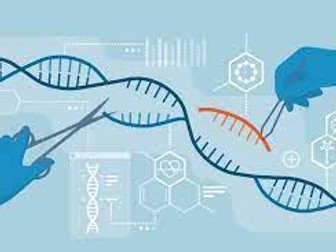
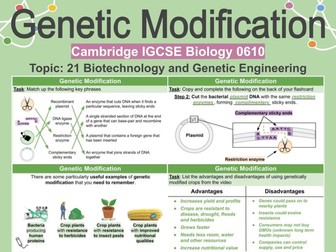
✓ Engaging presentation ✓ Worksheet with flashcards ✓ Lots of short AFL tasks ✓ Exam question examples This lesson on Genetic Modification is designed for KS4 Science students enrolled in the CIE Cambridge IGCSE Biology 0610 (2023-25) course. This is the first lesson in the topic 21 Biotechnology and Genetic Modification. This lesson covers the syllabus points from both 21.1 and 21.3 (as these went together quite nicely). The lesson recaps previous learning from other linked topics to ensure students have a strong foundation before diving into the material. It also includes concise and easy-to-understand information and a variety of quick assessment for learning tasks to help students solidify their understanding of the topic. There is a strong emphasis on answering exam questions, with examples and the mark scheme included in the presentation. Objectives: 21.1 Biotechnology and genetic modification State that bacteria are useful in biotechnology and genetic modification due to their rapid reproduction rate and their ability to make complex molecules Discuss why bacteria are useful in biotechnology and genetic modification, limited to: (a) few ethical concerns over their manipulation and growth (b) the presence of plasmids 21.3 Genetic modification Describe genetic modification as changing the genetic material of an organism by removing, changing or inserting individual genes Outline the process of genetic modification using bacterial production of a human protein as an example, limited to: (a) isolation of the DNA making up a human gene using restriction enzymes, forming sticky ends (b) cutting of bacterial plasmid DNA with the same restriction enzymes, forming complementary sticky ends © insertion of human DNA into bacterial plasmid DNA using DNA ligase to form a recombinant plasmid (d) insertion of recombinant plasmids into bacteria (specific details are not required) (e) multiplication of bacteria containing recombinant plasmids (f) expression in bacteria of the human gene to make the human protein Outline examples of genetic modification: (a) the insertion of human genes into bacteria to produce human proteins (b) the insertion of genes into crop plants to confer resistance to herbicides © the insertion of genes into crop plants to confer resistance to insect pests (d) the insertion of genes into crop plants to improve nutritional qualities Discuss the advantages and disadvantages of genetically modifying crops, including soya, maize and rice This lesson would also be adaptable for all GCSE students (whether AQA, Edexcel, OCR) and great for KS3 Science or as a GCSE revision resource.
GMO's and ethicsQuick View
zuba102

GMO's and ethics

(4)
Power point used for teaching GMO's (topic 8, Edexcel but may be useful for other board). I also used some exam questions, but I cannot upload these due to copyright.
GMO or Organic food?Quick View
mrgeographyuk

GMO or Organic food?

(1)
This lessons investigates the positives and negatives of both GM and organic food looking at a BBC article and a video as source material. The lesson begins with a fun quiz of ‘guess the fruit/veg’ - all before they were selectively grown. The lesson finishes with students deciding if we should be eating organic of GM food.
Crossword and keyword definitions list: GMOs / genetic modificationQuick View
j_oconnor

Crossword and keyword definitions list: GMOs / genetic modification

(0)
A detailed crossword on genetic modification with answer key on the back and comprehensive list of keywords and definitions for the topic. Word format so can be edited, lots of questions, so makes a good assessment for learning or homework activity. Made for the Edexcel IGCSE biology syllabus, but suitable for any GCSE syllabus.
Genetically Modified Organism (GMO) debate. Bioethics.Quick View
geofurry

Genetically Modified Organism (GMO) debate. Bioethics.

(0)
Structure your pupil’s arguing muscles with this pre-researched debate on Genetically Modified Organisms. I collected common arguments for both sides so all you have to do is give one list to half your pupils and the other list to the other half. 30 minute class activity.
Genetic Engeneering (IGCSE, MYP, DP, and A level) .....................GMOQuick View
seemakhokher

Genetic Engeneering (IGCSE, MYP, DP, and A level) .....................GMO

(0)
If you use this resource please add your reflection, how to improve? What is missing part! Starter Main lesson Class room activity Plenary ( I used someone else idea for plenary because I like it) Print these slides off in colour and spread them around the room, students can then collect information from the sheet about the different genetically engineered organisms. I think this is a good activity to illustrate the wide variety of ways that organisms can be genetically engineered. Videos (you tube resource) Home work ASSESSMENT Task Thank you. Regards, Seema
Business Ethics | Worksheet on GMO OMG DocumentaryQuick View
twoteachers002

Business Ethics | Worksheet on GMO OMG Documentary

(0)
This worksheet is based on the Amazon Prime documentary GMO OMG It investigates the involvement of food giant Monsanto and their questionable practices. How do GMOs affect our children, the health of our planet, and our freedom of choice? And perhaps the ultimate question, which Seifert tests himself: is it even possible to reject the food system currently in place, or have we lost something we can’t gain back? These and other questions take Seifert on a journey from his family’s table to Haiti, Paris, Norway, and the lobby of agra-giant Monsanto, from which he is unceremoniously ejected. Along the way we gain insight into a question that is of growing concern to citizens the world over: what’s on your plate?
SB4 Science Assessment - Darwin's Theory, Classification, Evolution, GMOs in Farming.Quick View
ollie765

SB4 Science Assessment - Darwin's Theory, Classification, Evolution, GMOs in Farming.

(0)
This assessment is based around the topics covered in the Pearson Edexcel GCSE Science SB4 unit, though can be used as an assessment to test knowledge around 'Darwin's Theory, Classification, Evolution, Genetic Engineering/GMOs in Farming and Fertilisers/Biological Controls' without use of the book. Please note that the resource is paid as it took some time to produce and is not available for editing and redistribution without permission. Thank you!
B2.6 Genetic Engineering Year 11 Edexcel BiologyQuick View
MEst

B2.6 Genetic Engineering Year 11 Edexcel Biology

(0)
Lesson plan (presentation) with activities to achieve the following learning objectives: 1) Describe the process of genetic engineering 2) Describe case studies of GMOs (e.g. golden rice and insulin) 3) Explain the ethical considerations of GMOs
Organic or GM?Quick View
mrgeographyuk

Organic or GM?

(0)
A look at organic vs GMO where facts are presented hopefully free from bias and then students get to make up their own minds and present them.
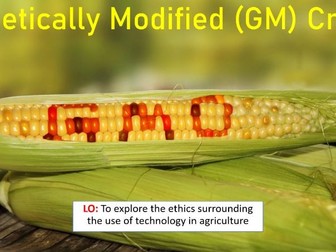
Genetically Modified (GM) Crops (Global Perspectives)Quick View
carlzammit1

Genetically Modified (GM) Crops (Global Perspectives)

(0)
Lessons 5&6/7 on the unit of food ethics designed for Global Perspectives Written Paper (AS Level) Introduces students to the debate of GMOs, activity to define what they are, there is a source analysis question and infographic, videos and a news article supplements learning activities and looks at the case study of GMO usage in Kenya. There are also past paper questions (based on Cambridge AS Level Syllabus) and a mark scheme, together with articles
CB4e 9-1 - The advantages and disadvantages of genetic modificationQuick View
ScienceMastery

CB4e 9-1 - The advantages and disadvantages of genetic modification

(1)
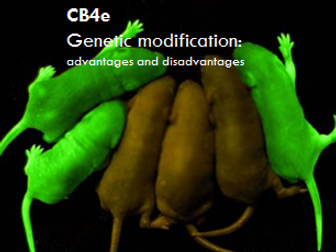
The lesson starts by a summary activity of GMO before the student watch two clips of the pros and cons of GMO. The lesson evolves into a carousel style information gathering task which encourages independence and curiosity. The understanding is assessed via a hinge point question that directs the students to a differentiated worksheet. The lesson is concluded with an exam question.
AL Biology: Gene Technology FULL UNITQuick View
PerisB

AL Biology: Gene Technology FULL UNIT

(1)
Everything you need to deliver the unit of gene technology for A level Biology (82 slides) It follows Cambridge syllabus (9700) but it is easily adaptable to others. The topic is divided in 5 parts: Genetic engineering: introduction to the topic. Tools for Gene technology: restriction enzymes, DNA ligase, promoters, vectors, markers, electrophoresis and PCR explained. Bioinformatics and the need to deal with the information. Genetic technology and medicine: proteins for medicinal uses and genetic screening. Gene therapy: studying the case of cystic fibrosis Gene technology and agriculture: GMOs crops and animals and social implications. There are two extra power points: Power point with activities for revision using past papers. Power point with revision using videos. Check the slides’ notes as some of them have background information, links or suggestions for activities. All pictures have been sourced from the creative commons website. Please, DM me if you have any doubt. Constructive feedback would be much appreciated.
AgricultureQuick View
mrgeographyuk

Agriculture

6 Resources
These 6 lessons are most appropriate for GCSE classes and include key terminology, locations of agriculture, improving farming techniques, the Green Revolution and organic vs GMO opinion based lesson after investigating evidence.
KS3 Genetic ModificationQuick View
ejscienceresources

KS3 Genetic Modification

(0)
KS3 lesson on Genetic modification, looking at what it is, some examples and then discussion on what the problems could potentially be with GMOs. Lesson includes video, discussion, questions and activity where students need to create a cartoon strip on how GMO are created. If you would like to use an alternative activity, you could get students researching and writing a newspaper article on GM crops and the advantages and disadvantages. This would however, require a second lesson with access to computers/GM research. Please leave a review and check out my other resources. Thanks
CB4 - learning outcome sheet, exit ticket tracker, assessment and 10 lessonsQuick View
ScienceMastery

CB4 - learning outcome sheet, exit ticket tracker, assessment and 10 lessons

11 Resources
This bundle is made up of good to outstanding lessons with in-built AFL and differentiation. CB4 is an Edexcel topic focusing on evolution and genetic modification. Admin - learning outcome sheet Lesson 0 - entry test Lesson 1 - natural selection Lesson 2 - bacterial antibiotic resistance Lesson 3 - human evolution Lesson 4 - classification Lesson 5 - selective breeding Lesson 6 - revision of topics covered in the SOW Lesson 7 - CB4d continuation - GMO Lesson 8 - Advantages and disadvantages of GMO Lesson 9 - Exit test and revision
iGCSE Biology: B21 Biotechnology and Genetic modification (Cambridge)Quick View
Amenghis

iGCSE Biology: B21 Biotechnology and Genetic modification (Cambridge)

(0)
Full resources bundle made up of 4 lessons which you can use to teach topic 21 (iGCSE Cambridge). Each lesson contains starter tasks, regular assessment questions with answers, all key information and student friendly diagrams. The following lessons are included: Genetic engineering pt 1 and 2 (process of genetic modification and GMO crops). Biotechnology pt 1 and 2 (uses of microorganisms in processes and fermenters). Student checklist