Shakespeare Booklet: Exploring Shakespeare's World (KS3)Quick View
laurajholder

Shakespeare Booklet: Exploring Shakespeare's World (KS3)

(8)
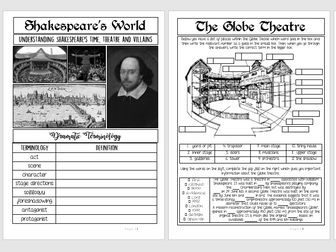
This is an extremely dense 12 page booklet with easily an entire scheme of work. This has been created to give year 7 an introduction to Shakespeare: to understand his life, works, times, theatre and to grasp how a script works. There are two pages which focus on Shakespeare’s villains (Don John and Iago) but in reality this is to simply expose students to Shakespeare’s life and characters rather than to complete in depth analysis of a plot and character. Although this was created with year 7 in mind it would fill a gap at any level of Key Stage 3 if students’ knowledge of Elizabethan England is lacking. Both the editable Word document and .pdf are provided - please note the word document may not appear like the booklet pdf because of font use and formatting. This booklet is also available as part of a Shakespeare bundle with two other KS3 booklets covering Shakespeare heroes and the idea of tragic heroes and Shakespeare’s relationships. The booklet is as follows: 1 - front cover and basic dramatic terminology glossary 2 - William Shakespeare information with space to create a fact file 3 - Shakespeare’s works - basic information, followed by a task to understand the difference between comedies, tragedies and histories then sorting key plays into each type 4+5 - a double page spread with a timeline across Elizabethan and Jacobean England. At the top students can create a timeline of historical events and then plot Shakespeare’s life underneath (perhaps using page 2) 6 - Elizabethan entertainment - 4 boxes for students to complete information about bear baiting, bull baiting, cock fighting and the theatre - I have attached the factfile made to accompany this lesson. 7- The Globe Theatre - A label the Globe picture followed by a gap fill about its history (in image) 8- Understanding a script - the first scene of Macbeth is used to explain the layout of a script, followed by a gap underneath for students to make their own mini script using a similar layout and features. 9- Stage directions- a list of common Shakespeare stage directions with definitions for students to match followed by some complex stage directions to "translate" 10 - An explanation of the character and his motives, an extract from the play (1.3) and a series of questions which track students through the extract. 11 - An explanation of the character and his motives,an extract from 1.1 alongside a modern translation followed by a series of questions. 12- a common words glossary where students should independently record new words learnt.
ShakespeareQuick View
EnglishGCSEcouk

Shakespeare

(7)
Shakespeare introduction! A fully differentiated and resourced lesson that introduces students to William Shakespeare’s, the world he lived in and explores the genres he wrote in as well. A great way to introduce any unit of work on Shakespeare that covers context but also specific elements of different genres of Shakespeare’s plays. Check out our English Shop for loads more free and inexpensive KS3, KS4, KS5, Literacy and whole school resources. AQA English Language Paper 1 and Paper 2 Knowledge Organisers AQA English Language Paper 1 Section A package AQA English Language Paper 1 Sections A and B package AQA English Language Paper 1 package AQA English Language Paper 2 Question 5 package AQA English Language Paper 1 Question 5 package AQA English Language Paper 2 Section A package AQA English Language and English Literature revision package An Inspector Calls whole scheme package An Inspector Calls revision package Macbeth whole scheme package Macbeth revision package A Christmas Carol whole scheme package A Christmas Carol revision package Jekyll and Hyde whole scheme package Jekyll and Hyde revision package Romeo and Juliet whole scheme package Power and Conflict poetry comparing poems package Power and Conflict poetry whole scheme package Love and Relationships poetry whole scheme package Unseen Poetry whole scheme package
SHAKESPEARE’S VILLAINS - A COMPLETE KS3 SOWQuick View
btmmadstuff

SHAKESPEARE’S VILLAINS - A COMPLETE KS3 SOW

(0)
An entire SOW which consists of 20 PPT LESSONS, RESOURCES, a MEDIUM-TERM PLAN and a KNOWLEDGE ORGANISER based on VILLAINS in SHAKESPEARE. Lessons include: Context, Society, Women, Religion and Beliefs, Theatre, Shakespearian Language (Cliches, Insults), Genres, Themes, ‘The Seven Ages of Man’, Protagonist, Antagonist, Tragic Hero which leads into some of Shakespeare’s well-known plays and their VILLAINS: ‘Romeo and Juliet’ (Tybalt), ‘Macbeth’ (Macbeth, Lady Macbeth, The Witches), ‘Hamlet’ (Claudius), ‘The Tempest’ (Caliban) leading up to a Reading Assessment based on an Evaluation of Lady Macbeth (Model PEEZA Paragraph, New Vocabulary, Sentence Starters, Planning Sheet etc). A fantastic SOW for Year 7’s and lower-ability Year 8’s and Year 9’s.
KS3 Shakespeare Year 7 Unit – Shakespeare and Elizabethan England (20 Full Lessons)Quick View
11001584

KS3 Shakespeare Year 7 Unit – Shakespeare and Elizabethan England (20 Full Lessons)

17 Resources
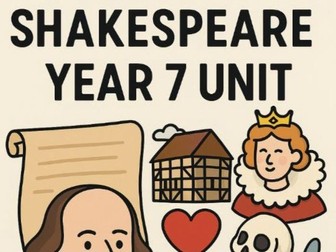
KS3 Shakespeare Year 7 Unit – Shakespeare and Elizabethan England (20 Full Lessons) A fresh, student-friendly introduction to Shakespeare – building contextual knowledge, analytical skills, and creative confidence from the very start of KS3. This unique 20-lesson bundle takes a bold and engaging approach to teaching Shakespeare to Year 7 students. Rather than starting with a full play, this unit immerses learners in the world Shakespeare lived and wrote in, gradually building the knowledge, vocabulary and interpretive skills they’ll need for successful GCSE study. Through structured, accessible lessons, students explore: Life in Elizabethan England and Shakespeare’s theatre Universal themes like love, power, betrayal and ambition Key dramatic techniques such as soliloquies, irony, and comic relief Creative responses including short stories, soliloquy writing and poetry Extracts from Romeo and Juliet, Macbeth, and Shakespearean sonnets Every lesson follows a consistent format with: ✔️ A guiding Key Question ✔️ Vocabulary development tasks ✔️ A Focus Zone activity (analytical, creative, or performance-based) ✔️ Final reflection tasks ✔️ Supportive scaffolds and SEN-friendly structure throughout This scheme doesn’t just study Shakespeare – it helps students understand why he matters, how he wrote, and why his stories still resonate. Ideal for laying contextual and conceptual foundations in Year 7 and setting students up with confidence for KS4.
William Shakespeare | Introduction ActivitiesQuick View
TheNiftyNinja

William Shakespeare | Introduction Activities

(1)
Students will begin the lesson by creating a mind map of what they already know about William Shakespeare. They will then play a memory game using images associated with William Shakespeare and his work. After watching a video based on his life, students will make their own notes to use for a collage. They will collaborate with one another to share facts about William Shakespeare which will have them excited and engaged as they walk around the classroom to learn different facts from one another. They will work in groups to collate their facts to add to the collage. Includes: Animated PowerPoint presentation of 6 slides Printable facts on Shakespeare ✧ ✧ ✧ ✧ ✧ ✧ ✧ ✧ ✧ ✧ ✧ ✧ ✧ ✧ ✧ ✧ ✧ ✧ ✧ ✧ ✧ ✧ ✧ ✧ ✧ ✧ ✧ ✧ ✧ ✧ ✧ ✧ ✧ ✧ Kindly leave feedback for this product. We’d love to hear from you! ©The Nifty Ninja
Romeo and Juliet Mega Quiz - William ShakespeareQuick View
RavenResources

Romeo and Juliet Mega Quiz - William Shakespeare

(0)
A varied 1 hour to 1 hour 30 minute end of unit quiz or a good way to start revising Romeo and Juliet by William Shakespeare. Eight rounds with 75 questions appropriate for secondary school and college students (key stage 4 and 5, 11 to 18 year olds). Appropriate for teams or individuals (more fun with teams). Eight different rounds with a total of 75 questions (most with ten questions and an anagram round with five). The quiz will take between an hour and 1 hour 30 minutes to complete. A response sheet is included with a teacher’s sheet that includes all the answers. Round One: Character Anagrams Round Two: Context Multiple Choice Round Three: Who says what? Round Four: Word Meanings Round Five: What happens when? Round Six: Literary Techniques Round Seven: Who am I? Round Eight: Complete the Quotation Tie breakers Students work through a highly visual PowerPoint answering questions in each round. The animations in the PowerPoint allow you to create interest and allow students time to answer questions. Examples of the Character Anagrams, Who says what?, Word Meanings, What happens when, Literary Techniques, Who am I? and Complete the Quotation are included to make instructions clear and accessible. The What says what?, Word Meanings, Literary Techniques and Complete the Quotation have an electronic voice readings. Either turn on your speakers, or not, depending on your preference. Once the quiz has been completed, students mark the answers of the other teams and work through the questions that can create further discussion. Questions are appropriate to a secondary school and college aged student. Please note: Romeo and Juliet has two possible spelling of Friar Laurence/Lawerence. The quiz has adopted the spelling Friar Lawrence but the text of the slide can be changed to Friar Laurence, if that is your preference for your students. The eight rounds of questions last for between 50 minutes and 1 hour (depending on how much time you give students to answer the questions). You can also give students longer to complete the questions. For example, the Who am I? clues could be left on the board to allow students to discuss possibilities in groups. The other questions in the quiz can be moved through at a brisk pace. Working through the answers takes between 15 and 20 minutes. You can slow the progress down or speed it up depending on your group or lessons. Whole quiz time: 1 hour to 1 hour 30 minutes. The PowerPoint can be edited and adapted allowing you to change any questions to suit your students. Try out the free end of term quiz. Also Available: FREE Romeo and Juliet Task Cards.
Shakespeare's Macbeth: key quotations for GCSEQuick View
mishymashy

Shakespeare's Macbeth: key quotations for GCSE

(8)
A revision resource for GCSE students to help them memorise key quotations from Macbeth. A 5 page document, colour-coded according to character. Accompanying brief analysis of each quotation: stylistic features, key themes, similar scenes. Easily adaptable for differentiation.
An Introduction to Shakespeare- KS3Quick View
mmjordan12

An Introduction to Shakespeare- KS3

5 Resources
Highly challenging and fully resourced 5 lesson introductory unit to Shakespeare. All lessons contain 18-20 PowerPoint slides with a variety of tasks, formative assessment opportunities, analysis of key play extracts, scaffolding and modelling. Topic 1- Context and introduction Topic 2- Comedies (AMND) Topic 3- Tragedies (King Lear) Topic 4- Histories (Richard III) Topic 5- Shakespeare’s Leading Ladies (Lady Macbeth) Bundle deal- typically £2.50 per lesson (saving over 50%)!
MACBETH Quotes GCSE REVISION Poster SHAKESPEAREQuick View
Facetious

MACBETH Quotes GCSE REVISION Poster SHAKESPEARE

(2)
This is from a series of posters I made for revision of the characters in Macbeth. They each display quotes that would be useful to revise for the GCSE exam. This one features Macbeth. I printed some out in A4 for my students but they look pretty good in A3 as eye-catching wall displays. Similarly, you could reduce them to A5 and provide them as revision booklets. I will be uploading Lady Macbeth, Banquo, King Duncan, Macduff and The Witches so please look for those if you wish to have the complete set. Other sets available or coming soon: Frankenstein; Blood Brothers; An Inspector Calls; Romeo and Juliet. Please get in touch if there is a series of characters and quotes which you would like me to make. As long as it will sell on here, I am happy to put the time in to making them.
Shakespeare - The Globe Theatre ContextQuick View
EnglishGCSEcouk

Shakespeare - The Globe Theatre Context

(3)
We explore Shakespeare’s The Globe Theatre and think about its layout, its structure, the different sections of the audience and the experience of visiting the theatre during the Elizabethan period. Students use their new knowledge and understanding to write their own diary entries from the viewpoint of a member of the Elizabethan audience. An excellent lesson for studying all Shakespeare texts and a great way of engaging students with historical and social context. Query or question? Get in touch at info@englishgcse.co.uk
ShakespeareQuick View
TeacherCentral

Shakespeare

(0)
L1: Who was Shakespeare? Romeo and Juliet FREE - Lesson Two: Bundle Sow: https://www.tes.com/teaching-resource/romeo-and-juliet-12908632 This SoW is designed in detail and is both differentiated and engaging, and allows you to move pupils through content efficiently. Made to the highest standard and constructed using current research, both dual coding and retrieval practices are at the heart of this unit. A colour scheme also runs throughout to ease both your delivery and students comprehension. SoW: Can the World Ever Become Fully Developed? L1: Who was Shakespeare? L2: How is Romeo and Juliet Set Up By the Prologue? L3: Why is Act 1 Scene 1 Significant? L4: How Does Romeo’s Emotions Evolve Upon Meeting Juliet? L5: Why Does the Capulet Party Advance the Story? L6: How Do Romeo and Juliet Display Their Attraction to Each Other? L7: How Romeo and Juliet Present Themselves to Each in the Balcony Scene? L8: What is the Significance of Friar Laurence? L9: Why is the Nurse Included in Romeo and Juliet? L10: How Do Mercutio and Tybalt Change the Direction of the Story? L11: How Does the Story Develop After Tybalt’s Murder? L12: How Does the Presence of Paris Complicate the Story? L13: What are the Strengths and Weaknesses of Fairer Lawrence’s Plan? L14: How does Friar Lawrence’s Plan Start to Go Wrong? L15: How does this Story of Romeo and Juliet End? If you leave a review of any of our resources, you can claim any **FREE ** single resource from our ever growing library. Simply message the above email, which is monitored daily. teachercentralltd@gmail.com
Shakespeare Escape RoomQuick View
EnglishGCSEcouk

Shakespeare Escape Room

(0)
Escape Shakespeare’s Globe Theatre! We’ve put together this detailed English lesson that introduces or re-introduces language, structure, stagecraft and genre. Students work in groups to escape The Globe Theatre and have to solve numerous puzzles and activities in order to get out. Using an adventure story theme, this is a brilliant introduction lesson for studying William Shakespeare or first lesson back for all English students whether KS3 or KS4. It is also perfect for the end of term or end of year. Check out our English Shop for loads more free and inexpensive KS3, KS4, KS5, Literacy and whole school resources. AQA English Language Paper 1 and Paper 2 Knowledge Organisers AQA English Language Paper 1 Section A package AQA English Language Paper 1 Sections A and B package AQA English Language Paper 1 package AQA English Language Paper 2 Question 5 package AQA English Language Paper 1 Question 5 package AQA English Language Paper 2 Section A package AQA English Language and English Literature revision package An Inspector Calls whole scheme package An Inspector Calls revision package Macbeth whole scheme package Macbeth revision package A Christmas Carol whole scheme package A Christmas Carol revision package Jekyll and Hyde whole scheme package Jekyll and Hyde revision package Romeo and Juliet whole scheme package Power and Conflict poetry comparing poems package Power and Conflict poetry whole scheme package Love and Relationships poetry whole scheme package Unseen Poetry whole scheme package
Julius Caesar - William Shakespeare - Big Bundle!Quick View
TandLGuru

Julius Caesar - William Shakespeare - Big Bundle!

9 Resources
THIS BUNDLE CONTAINS ALL OF THE JULIUS CAESAR LESSONS, IN ADDITION TO THE COMPREHENSION ACTIVITY BOOKLET, AND THE JULIUS CAESAR KNOWLEDGE ORGANISER! This engaging, varied, and informative scheme of learning is designed to help students gain understanding, assessment skills, and key interpretations of William Shakespeare’s ‘Julius Caesar.’ Made up of a wide-range of interesting and exciting lessons, students should complete this scheme having gathered vital skills in: interpreting the significant meanings of the play, understanding the writer’s ideas within the play, analysing key characters, settings, and themes, and understanding Shakespeare’s language devices. Included is: Julius Caesar Knowledge Organiser Julius Caesar Comprehension Bundle …and the lessons… -Understanding Historical Context; -Act 1 Scene 1 - The Play Opening; -Act 1 Scene 2 - The Feast of Lupercal; -Act 3 Scene 1 - The Assassination Scene; -Act 3 Scene 2 - Mark Antony’s Speech; -Act 4 Scene 3 - The Ghost of Caesar; -Act 5 Scene 5 - Brutus: The Tragic Hero. Stimulating, visual, and easily adaptable, these lessons provide suggested learning objectives and outcomes for students of a wide-range of abilities - The vast majority of tasks are differentiated to allow for different abilities and needs in your classroom. Each lesson loosely follows this logical learning journey to ensure that students learn in bite-size steps: Engaging Defining/ Understanding Identifying/Remembering Analysing/ Creating Peer or self evaluating. All of the lessons are interactive, employ a variety of different teaching and learning methods and styles, and are visually-engaging. Resources, worksheets, and lesson plans are all provided.
Sonnet 130: ShakespeareQuick View
MrGradgrind

Sonnet 130: Shakespeare

(0)
This 32-slide lesson explores William Shakespeare’s ‘Sonnet 130’. The lesson considers what we might expect typical love poetry to entail and how Shakespeare subverts our expectations. Students are prompted to question stereotypical depictions of romance and romantic imagery, and to think about how Shakespeare plays with the sonnet form itself. Questions, discussion points, and tasks are featured throughout, including an analytical ‘mini-essay’ in response to a question. The lesson ends with a creative writing (poetry) task that could be set in class or as a homework activity. This lesson is ideal for KS3. A copy of the poem (with glossary) is included. Files are included as PDFs to retain aesthetics.
Assorted Shakespeare Knowledge OrganisersQuick View
n7-deadpool

Assorted Shakespeare Knowledge Organisers

(0)
2 page knowledge organisers for: Romeo and Juliet Macbeth Merchant of Venice Julius Caesar Twelfth Night Much Ado About Nothing A Midsummer Night’s Dream The Tempest Each KO has one page with a simplified plot summary (key scenes on a timeline), a character list and dual coding key theme images. There is also a blank page for key quotations for pupils to fill in themselves as the play is studied - this page can be printed as often as needed depending on how many key quotations you feel pupils need.
A Midsummer Night's Dream by William ShakespeareQuick View
TesEnglish

A Midsummer Night's Dream by William Shakespeare

(5)
A teaching resource for those studying A Midsummer Night's Dream by William Shakespeare. It includes printable worksheets directing and analysing Act 3, Scene 2 - the quarrel. It was designed for Year 9 but can be adapted for other age ranges and levels.