Time Detectives: An Interactive LessonQuick View
Sp-teacher

Time Detectives: An Interactive Lesson

(0)
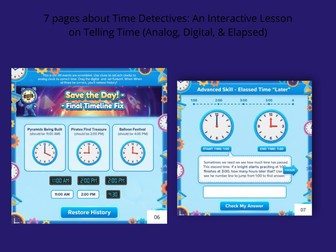
Engage your students in a thrilling time-travel adventure with Time Detectives, an interactive PDF or digital resource designed to master the essential skill of telling time! The Timeline is broken, and only your students—the newly appointed Time Agents—can fix it by learning the secret code: T.I.M.E… This comprehensive lesson covers analog and digital time-telling up to the half-hour and introduces the concept of elapsed time. The engaging, mission-based structure motivates students as they work to restore history!. Key Features and Learning Objectives: Analog Clock Mastery (Tools of the Trade): Students learn to identify the hour and minute hands, and read times to the hour (“o’clock”) and half-hour (“half past”). Digital Clock Decoding: Introduces the digital clock format and teaches students how to recognize the hour and minutes before and after the colon. Time Matching Missions: Includes matching exercises to connect analog and digital representations of time (e.g., matching a clock showing 5:00 to the digital time 5:00). Final Timeline Fix: A capstone activity where students must set analog clocks to specific times (e.g., 11:00 AM, 2:00 PM, 4:00 PM) to “restore history”. Introduction to Elapsed Time (Advanced Skill): Students use a number line model to calculate the duration of an event (e.g., from 1:00 to 3:00). Interactive/Printable Activities: Designed to allow students to drag labels, move hands, type in times, and log their findings in a “Mission Log” and “Time Traveler’s Diary”. Mission Complete & Certificate: Ends with a celebration, declaring the student an Official Time Keeper and includes a space for a personalized certificate. Perfect for 2nd and 3rd-grade students, remote learning, math centers, or as a fun homework assignment!
Time Detectives BundleQuick View
peterfogarty

Time Detectives Bundle

10 Resources
Here are history teaching resources from different times and places. Encourage your students to become real time detectives today!
Time Detectives Make a Time Capsule KS1Quick View
lbrowne

Time Detectives Make a Time Capsule KS1

(0)
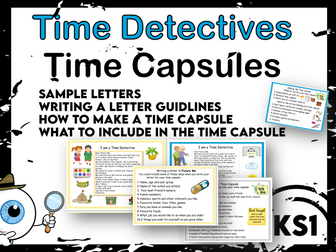
These resources link to your topic on History, Time Detectives, Ourselves and Literacy. Sheets 1 and 2 are examples of letters written by children to include in their time capsules. Children can use these to stimulate their own letter writing. Sheet 3 is a guide for children writing their letters to Future Me! There are 10 ideas of what could be included in the letters. Sheet 4 gives a list of ideas of what children might put into their time capsules. Sheet 5 gives some ideas for children to consider when making their time capsules and decorating them.
VICTORIAN CRIME & THE RISE OF THE DETECTIVE - IDEAL AS INTRO TO SHERLOCK HOLMES KS3Quick View
mrsoskins

VICTORIAN CRIME & THE RISE OF THE DETECTIVE - IDEAL AS INTRO TO SHERLOCK HOLMES KS3

(0)
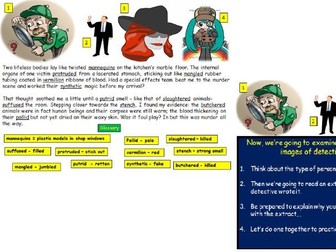
2 X LESSONS Students will look at Victorian society and the rise in crime rates that triggered the rise of the police force. They are then introduced to Jack the Ripper and encouraged to think how the context of the time actually enabled Jack the Ripper to commit his crimes so successfully / why the police were unable to catch him. Plenary tasks asks why detective fiction may have been popular at this time. Students look at the history of detective fiction, beginning with Poe / Murders at the Rue de Morgue. A focus on the character of the detective and detective conventions, testing knowledge by applying knowledge of conventions to extracts from The Sherlock Holmes Tale ‘The Adventure of the Sussex Vampire.’ Then, students look at images of Holmes study (Sherlock Holmes museum) and deduce ideas about his character. Lesson ends with fun observational skills competition where students spot the hidden animals in the pictures.
Math Detective TimeQuick View
mathinik

Math Detective Time

(1)
It’s a good activity for Primary 3, 4 and 5 students who would like to play detectives. This is an exercise for the students to spot errors and how they can right the mistakes.
KS2 Vikings Clothing and Possessions Time Detectives Complete Lesson PackQuick View
TheFutureTeacherFoundation

KS2 Vikings Clothing and Possessions Time Detectives Complete Lesson Pack

(0)
This fun yet challenging, cross-curricula lesson has elements of: computing, history and writing, all built into a lesson centred around independent learning. Children will complete a series of engaging tasks including labelling a graphic of a Viking with researched information on clothing and possessions, learning what a person from that time may have owned and building their understanding of life was really like in the time period. They then complete 3 written activities and an extension activity based upon that knowledge they have gained. Activities include framing historically-valid questions, critical thinking and drawing comparisons: all aspects of the new 2014 curriculum. The activities are designed to elicit a deeper level of thought and understanding of the era. Can be taught as two separate hour long lessons but better over one longer session, contains starter and plenary, made for KS2 but accessible to higher ability KS1 and lower ability KS3
Time Detectives Treasure Hunt KS1Quick View
lbrowne

Time Detectives Treasure Hunt KS1

(0)
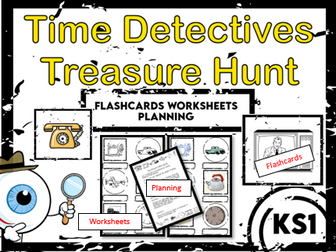
A set of resources for your topic on Time Detectives linked to History and Literacy. The resource includes a planning sheet with learning objectives and 3 activity ideas. There are flashcards in colour and black and white showing 12 artefacts. These can be hidden indoors or outdoors for a treasure hunt. You may want to laminate if using outdoors or reusing resources for displays or for future classes. There are 2 worksheets each showing 6 artefacts. These are in colour and black and white. Use the worksheets on their own for children to label the objects or as a recording tool. Children mark off the objects they find on the treasure hunt and then label them. Activities: Treasure Hunt Research in groups and presentation Chronological timelines
Time Detectives 12 Task Cards KS1Quick View
lbrowne

Time Detectives 12 Task Cards KS1

(0)
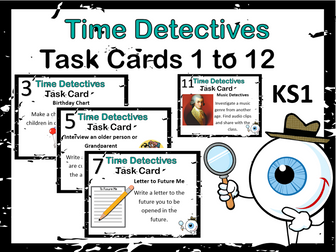
12 cross curricular task cards for children to choose from or work through connected to their topic on Time Detectives, History or Time. Each of the task cards can be worked on in pairs, individually or in groups. Examples are: Write a letter to the Future You. Listen to a famous speech such as the moon landing. Make a timeline or time capsule. Interview a grandparent. Link this resource with others in this set including a Bundle of Resources on Time Detectives. The final page has 2 Time Detective pictures that children could use for their topic book covers or add to your weekly timetable or displays. Cut and laminate the resources for durability and reuse. Useful too, for homework tasks.
Time Detectives Planning and Activities KS1Quick View
lbrowne

Time Detectives Planning and Activities KS1

(0)
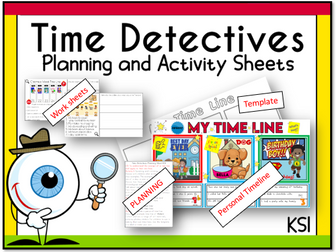
A lesson resource or unit of work when introducing the topic of Time Detectives or timelines to young children. There is a planning sheet included with learning objectives and activity ideas. There are 2 worksheets included where children can familiarize themselves with the idea of using information and answering questions. There is a template timeline sheet that children can use to make a simple personal timeline. There is a colour timeline completed by ‘Robert’ to share with your class to give them some ideas for when they make their own.
Time Detectives Resource Bundle KS1Quick View
lbrowne

Time Detectives Resource Bundle KS1

4 Resources
A bundle of resources on the theme of Time Detectives for KS1 children and suitable for SEND pupils. Linked to History, Mathematics (number and time) and Literacy. A collection of stimulating ideas, flashcards, worksheets and planning to enhance your topic. The resources include pictures and symbols. Boardmaker licenced.
Detecting ANIONSQuick View
GJHeducation

Detecting ANIONS

(0)
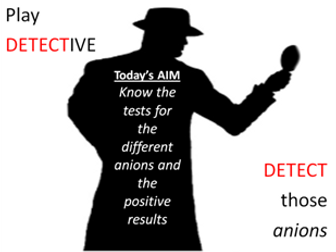
An engaging and practical based lesson presentation (24 slides) which challenges the students to carry out a range of practical tasks to learn the identification tests and positive results for the anions. The lesson begins by challenging the students to use their prior knowledge of chemical formulae to name two sets of ions. Students will be reminded of the definition of a cation so they can use this to write an accurate one for the anions. The rest of the lesson looks at the different tests and time is taken to explain the details behind each of them. Progress checks have been written into the lesson at regular intervals to allow the students to check their understanding. A set homework has also been included. This lesson has been written for GCSE students.
Plant Disease Detection and Defences  (Triple) - GCSE Biology WorksheetsQuick View
cal-w11

Plant Disease Detection and Defences (Triple) - GCSE Biology Worksheets

(0)
This resource contains two worksheets that can be used in class or as homework to enable your students to practice what they have learnt in the classroom. The diagrams are simple to aid students to visually see what may come up in their upcoming GCSE exams. These resources could used to check prior learning for your students so you can plan accordingly for future lessons. I hope your students find these useful either in the classroom or as revision. This pack includes: Plant Disease Detection Plant Defences Includes answer sheets that can be edited for your own slides. Please take a small amount of time to review this resource to let other buyers know your thought about these worksheets. We have worksheets for the following topics in Biology Paper 1: Cell Biology Cell Structure and Specialised Cell Microscopy Microscopy Required Practical Culturing Microorganisms – Triple Microbiology Required Practical – Triple Cell Division and Stem Cells Diffusion, Osmosis and Active Transport Osmosis Required Practical Organisation Organisation and The Digestive System Food Tests Required Practical Enzymes and Enzyme Activity Enzymes Required Practical The Circulatory System and Heart Disease The Respiratory system Plant Tissues and Organs Infection and Response Pathogens and Human Defences Vaccines, Antibiotics and Drug Development Monoclonal Antibodies – Triple Plant Diseases Detection and Defences – Triple Bioenergetics Photosynthesis Photosynthesis Required Practical Aerobic and Anaerobic Respiration Exercise and Metabolism Thank you!
Lingusitic Detective Scheme |15+ LessonsQuick View
teachsureenglish

Lingusitic Detective Scheme |15+ Lessons

(1)
**Here is a full. 15+ lesson scheme on forensic linguistics, linguistic devices and brevity devices, which is a fantastic way to introduce or review language devices with KS3. ** This lesson pack comes with a full PPT of 15 full lessons, all resources and worksheets, and assessment activities to complete with students. There are also extension (purple) activities to complete with students to stretch and challenge them. There are also worksheets provided and handouts for each lesson. Just download and go! Each lesson is timed at around 45/50 minutes, but can be adapted as required.
Detective Fiction BundleQuick View
Tactful_Teaching

Detective Fiction Bundle

(0)
This is a bank of 26 lessons (or more depending on the time provided for the two writing tasks) that explore detective fiction using extracts from Agatha Christie and Arthur Conon Doyle. There is also one extract from Wilkie Collins’ “Woman in White” as this is a useful SOW to proceed the teaching of novel, “The Woman in White”. Each lesson contains: a thinking starter a thinking plenary a writing or reading task (including poetry) group work, paired work or individual work open ended tasks where more able students can be extended while those in need of differentiation can also be supported using the numerous resources provided The writing tasks in the unit are based on writing a detective story and a film review of the Sherlock Holmes film. The students are also given the chance to compare and contract TV detectives from the UK and America and extracts from Perry Mason and Murder She Wrote are hyperlinked for easy use. There is a workbook to accompany the SOW. Enjoy!
Mask DetectiveQuick View
HamiltonTrust

Mask Detective

(1)
Time to be a mask detective and ask, ‘what is a mask?’ Children explore the rich masking tradition in Africa and consider their design and purposes, looking at lots of examples from across Africa.
Cluedo Detective NotesQuick View
MrG2246

Cluedo Detective Notes

(0)
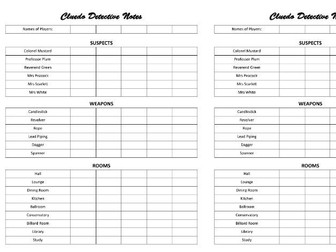
Replacement detective notes for the popular board game, Cluedo! Easily printable pdf document for A4 with options for 2 or 1 note sheets per A4 page, therefore creating an A4 or A5 note size option. Each sheet also has space for the names of players. There are two versions, one with a column for your own cards and one without.
The Tree DetectiveQuick View
Nat Schools Pship

The Tree Detective

(1)
'The Tree Detective&' is a creative cross-curricular activity developed to support KS2 teachers within the curriculum framework. It is packed with seven exercises that feed pupils&'; imagination, encouraging them to investigate, learn about nature-related topics, and increase their environmental awareness.
Detective Fiction SOW - KS3 EnglishQuick View
Tactful_Teaching

Detective Fiction SOW - KS3 English

(0)
This is a bank of 26 lessons (or more depending on the time provided for the two writing tasks) that explore detective fiction using extracts from Agatha Christie and Arthur Conon Doyle. There is also one extract from Wilkie Collins’ “Woman in White” as this is a useful SOW to proceed the teaching of novel, “The Woman in White”. Each lesson contains: a thinking starter a thinking plenary a writing or reading task (including poetry) group work, paired work or individual work open ended tasks where more able students can be extended while those in need of differentiation can also be supported using the numerous resources provided The writing tasks in the unit are based on writing a detective story and a film review of the Sherlock Holmes film. The students are also given the chance to compare and contract TV detectives from the UK and America and extracts from Perry Mason and Murder She Wrote are hyperlinked for easy use. There is a workbook to accompany the SOW - sold as a bundle with this SOW and separately Enjoy!
Creative writing -  a detective playQuick View
SusannahO

Creative writing - a detective play

(0)
This is a fun, accessible class allowing young students to engage with the mystery/detective genre. With lots of prompts it gives children the confidence to plan, write and act out mini detective plays! It is a fun class, enabling students to explore their creative side with a step-by-step guide to creating a detective play. It can be used in a classroom setting, but also works well if you are running a creative writing or drama club or similar. It is a relatively ‘light’ class in terms of academic content. It can (and has been!) enjoyed by students from age 7 up to about age 14 depending on ability and engagement levels. It creates a fun, lively atmosphere and moves very quickly through the different stages of planning, writing and acting. The lesson is structured as follows: a) Introduction to idea of detective plays. What is a play? What is a mystery? What is a detective? There is a short (very cheesy!) play for 4 children to read out to find out the answers to these questions. b) Students are all given a ‘planning sheet’ (This is available to print out at the end of the powerpoint) c) Planning 1 – what is going to be your MYSTERY? (There are lots of visual prompts) d) Planning 2 – who is going to be your DETECTIVE? (Some discussion about how you can make them particularly interesting.) e) Planning 3 – what is going to be your SETTING? (There is a brief child-friendly explanation about the concept of locked-room mysteries – NB that term is not used, just the concept!) f) Dialogue – how do we present dialogue in a play? g) Now students are given some time to write their plays. (This can be done individually, groups or pairs.) h) You can also give students time to act out their plays to the group/class. i) There is an additional optional activity which can be used for extension/homework – Can you turn the opening of ‘A Little Princess’ (text included) into a mystery play. What might happen next? This is a fun class, which prompts student to think more about how we create mysteries and why we need interesting characters and dialogue in our stories.