Great Music ArtistsQuick View
JBlakelobb

Great Music Artists

(2)
I plan to use this PowerPoint at the beginning of singing assemblies every week. Play a variety of music from different periods and genres while the children are arriving and give them a little history about the artists. Please suggest artists I should add to this list. I plan to play music direct from YouTube or Grooveshark to save the need to buy lots of albums.
The Great Wave – Hokusai - Outstanding Art Lesson (KS1/KS2)Quick View
explore_education

The Great Wave – Hokusai - Outstanding Art Lesson (KS1/KS2)

(0)
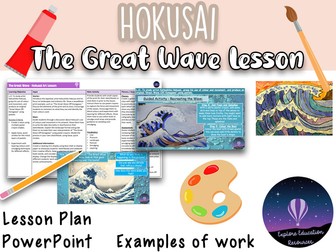
One-off art lesson exploring colour, movement, and Japanese artist study This lesson introduces pupils to Katsushika Hokusai and his iconic print The Great Wave off Kanagawa. Using pastels, students will explore colour blending, shading, and movement to create their own wave-inspired artwork. What’s included: ✔ A detailed lesson plan ✔ 22-slide PowerPoint to guide teaching and discussion ✔ Step-by-step instructions for pastel artwork ✔ Real examples of children’s finished pieces Lesson structure: Introduction – Learn about Hokusai’s life and work, with a focus on The Great Wave. Main input – Discuss Hokusai’s use of colour and movement. Look closely at how he captured the energy of the ocean. Main activity – Create a pastel version of The Great Wave, blending and layering colours to show motion. Plenary – Share work with the class and offer peer feedback. Encourage discussion around technique and colour choices. Focus areas: ✔ Artist appreciation and study ✔ Pastel blending and layering techniques ✔ Colour mixing and control ✔ Art interpretation and peer discussion Perfect for: One-off art lessons or transitions KS1 and KS2 artist study units Water-themed topics Supply cover or interview lessons Easy-to-follow, observation-friendly sessions Tags: KS2, KS1, artist study, one-off lesson, pastel art, wave theme, back to school, transition, supply, observation, interview, art techniques, Hokusai
Art unit-Great artists and war memorialsQuick View
WarMemorialsTrust

Art unit-Great artists and war memorials

(1)
A series of art lessons for primary teachers exploring great artists, architects and designers in history. The six lessons focus on war memorials which were designed by renowned architects and sculptors in the wake of World War I and culminates in pupils designing their own war memorial for the local area. The Armistice was signed on 11th November 1918 brought World War I to an end. After the initial jubilation and celebration about the news the war had ended, communities across the UK expressed a desire to commemorate those who had lost their lives. As the bodies of the fallen were not repatriated and instead buried in military cemeteries aboard, families did not have a place where they lived to grieve for their loved ones. A local war memorial provided relatives with this place of remembrance. Around two thirds of the approximate 100,000 war memorials in the UK were created in the years following the end of World War I. Schools who were involved in projects which commemorated the centenary of the World War I may also like to commemorate the centenary of their local war memorial. This resource has been created to enable schools to incorporate this significant anniversary into their art curriculum whilst finding out about great artists from history. The resources could also be used as part of a local history topic. Resource includes: Unit overview (medium term plan) 6 lesson plans Teachers’ helpsheet ‘War Memorial Designers’ Teachers’ helpsheets about war memorial designers * Sir Herbert Baker * Sir Reginald Blomfield * Sir Robert Lorimer * Sir Edwin Lutyens * Albert Toft Pupil fact cards for the same war memroial designers Resource sheet with links to war memorials designed by Baker, Blomfield, Lorimer, Lutyens and Toft
Artist Research Sheet (Editable)Quick View
MissBraggResources

Artist Research Sheet (Editable)

(0)
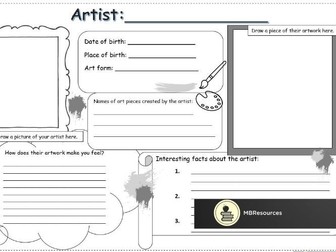
Researching an artist? This sheet supports the children to begin to: Choose an artist to focus on Find out information about their chosen artist, including the art form they use Find out interesting facts about Identify pieces of art created by the artist An opportunity to have a go at the artists piece of work and draw the artist themselves. Consider what they think of the artwork of an artist A great template to use to begin to focus on a particular artist, as a springboard for discussions and further information gathering about artists!
Great Artists Assembly or Class Play - Key Stage IQuick View
suesplays

Great Artists Assembly or Class Play - Key Stage I

(0)
Great Artists Assembly or Class Play - Key Stage I Bruegel and Lowry Script Cast Size - 30 - easily adaptable up or down Duration - around 10 - 15 minutes depending on time spent on children's own artwork. (There is a section of the script dedicated to children showing and describing their own work - this section can be omitted thus reducing duration to around 5 - 10 minutes) Sample Script Bruegel: Oh well! Let me tell you now! I had to disguise myself as a peasant Child 12: Why? Bruegel: Oh so that I could see what it was like …. being a peasant! Child 13: And what was it like – being a peasant? Bruegel: Well, I try to show that in my paintings. Teacher: You see, children. Up to this time, only kings and queens and people with lots of money were painted. Narrator: Lucky for us Bruegel came along – and showed us how the poor people lived! (Bruegel goes back to work at his easel) (Lowry looks up from his work, and stands up) Lowry: So did I! Narrator: Pardon? Lowry: I also showed what it was like to be a worker! (Narrator walks over and holds up Lowry painting, to show cast and audience) Child 14: (To Teacher) That’s like the pictures you showed us, Miss! Teacher: Quite so! Child 15: They show us how people lived in the industrial cities of England. Child 16: Smoking factories Child 17: Long streets Child 18: Long people! Narrator: Pardon? Child 19: Oh, he means – the people look a bit like matchstick men! Lowry: (Laughing) That was my style! This script is one of the Famous People Series based on the lives of significant individuals in the past who have contributed to national and international achievements, comparing aspects of life in different periods. This list of ‘greats’ includes: · Queens - Elizabeth I and Victoria · Explorers - Christopher Columbus and Neil Armstrong · Inventors - William Caxton and Tim Berners-Lee · Women: (i) In Civil Rights - Rosa Parks and Emily Davison (ii) Nurses - Florence Nightingale, Mary Seacole and Edith Cavell. I am happy to write on alternative individuals as per my 'write on request' service - so please drop me a line on sue@plays-r-ussell.com
Artist research template - handout/posterQuick View
amimamim

Artist research template - handout/poster

(2)
Want to improve the quality of your students artist research? This PDF poster aims to guide students guidance and inspiration to produce excellent artist research pages. Primary targets are KS4, but can be used equally with KS3 and KS5. Two versions are included: A3 and A4 printables - stick them up as display for constant reference or photocopy for sketchbooks or focused research lesson. Soon enough they’ll be in the habit of producing great research!
Artist Resource BankQuick View
jessicarape

Artist Resource Bank

(0)
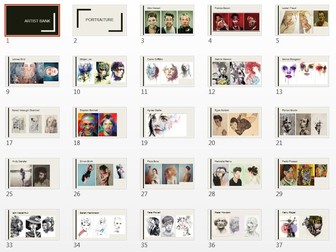
A huge range of 120+ artists ranging from portraits and landscapes to natural forms and abstract art. A great resource for the start of projects, to look at after reading exam papers, or to give inspiration mid project. Images are all artists own, this is a bank of artist images and not my own images.
POPPED! Artists Bundle (Bundle of artist fact sheets)Quick View
camdencreativearts

POPPED! Artists Bundle (Bundle of artist fact sheets)

(0)
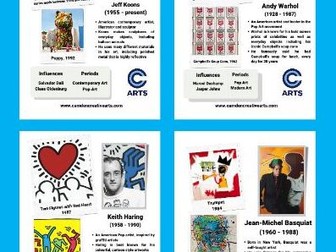
Artist bundle fact sheets cover a wide and diverse range of artists, from all art periods and inclusive of contemporary artists. Each bundle has 4 dynamic and inspiring artists that use similar art elements and have common traits in their art style. The fact sheets have an easy to read and well laid out presentation with key facts about the artist, images of artworks, influences and art periods. They are designed for children to decipher and use easily. These fact sheets are perfect to use to support classroom learning and to support art projects. They are great for students in KS1, KS2 and KS3 and can also be used as a promt or to aid independent research. They are also perfect to use as part of a classroom display. This POPPED! Artists bundle includes: Andy Warhol Jean-Michel Basquiat Jeff Koons Keith Haring
Artist of the TermQuick View
donna1605

Artist of the Term

(0)
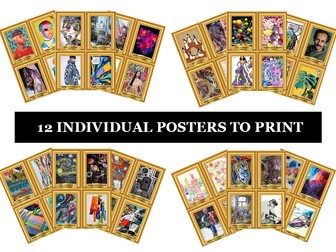
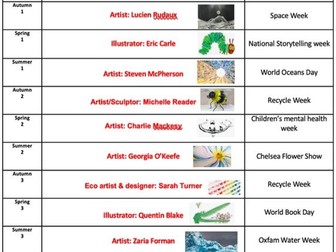
Artist of the Term Posters and Powerpoints. This is a 4 year rota (3 artists per year) but can be changed. 12 artist altogether - linking to certain things throughout the year (Book Day, recycling week, water week etc…). They show great diversity and have well known and lesser known artists. Posters can be put up in classrooms, powerpoints shown during collective worship. Whole school can be involved! Great to spread the love of art!
Artist Analysis TemplateQuick View
amiebarnard

Artist Analysis Template

(0)
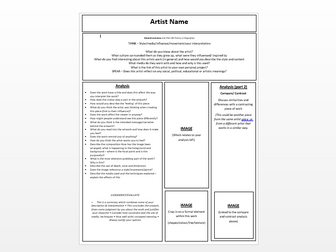
A great resource to aid students with writing an artist analysis. Students can either use the sheet as a template directly onto the computer or useful when printing as a classroom guide.
Artists with a disabilityQuick View
ArtThinking

Artists with a disability

(0)
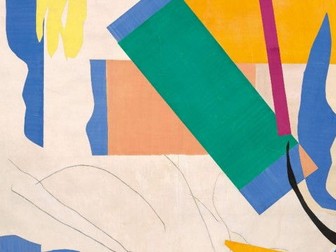
A lesson starter and activity to explore Matisse's cut outs in a new approach. The starter will enable students to challenge their thinking on how an artist can work when faced with physical challenges. This is a great lesson for the promotion of equality and diversity and gives good coverage to AO1 AO2 and AO4 with them commenting on the ways of working and then taking new approaches with the cut outs of Matisse. Great for all age ranges in raising their awareness of equality and diversity. The power point slides give additional information on the artists condition and ways of working.
Portrait based Artist libraryQuick View
tajkaur

Portrait based Artist library

(0)
A collection of artists that base their work around portraiture, there are also some additional artists included. I have used these sheets to add to an artist library i have started to create, the a great to laminate as you can photocopy each sheet in colour for artist research and saves students time.
William Morris Artist Research WorksheetQuick View
MrsC_CreateWithMe

William Morris Artist Research Worksheet

(0)
Dive in to the world of William Morris and allow your budding artists to increase their understanding of PATTERN. Worksheets appropriate for artists ages 11-14. Great for classroom use or homeschooling. Listing includes… -William Morris Fact File -William Morris Research Writing Frame -William Morris Research Writing Page x 3 William Morris Artist Copy Page Size- A4 Please note… This is a digital download only. There will be no product shipped. All digital downloads are nonrefundable. All files are for personal use only and cannot be used commercially or be resold/redistributed. Thank you for your purchase! Mrs C x
Artist research and evaluation worksheetsQuick View
Prettyinpink64

Artist research and evaluation worksheets

(0)
A great resource for both KS3 and KS4. Worksheets that support artist evaluation and research. Easy to use, great as a prompt to ensure all aspects covered. Also covers pupils self evaluation of a project.
Silke Werzinger- Artist AnalysisQuick View
HannahRumbleONeill

Silke Werzinger- Artist Analysis

(0)
An excellent resource for pupils to further develop their artist research skills and write about an intresting illustrative artist. This artists style is great for an introduction on developing digital art skills with drawing tablets.
Creating artists responses and initial developmentsQuick View
lynniepink19781

Creating artists responses and initial developments

(0)
This is a great powerpoint that explains what makes a good response This contains lots of examples and ideas to help explain. Links from the artist research through to ideas generation is all in here. This is great as a stand alone resource or it can even be used as part of the coursework final project and the ESA.