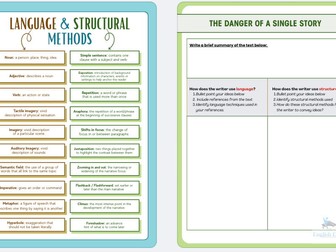
An 11 page resource designed to support students in analysing
language and structure for Question 4 of the Edexcel IGCSE English Language Exam. It provides a structured approach for recording key ideas, making it ideal for both ongoing study and revision.
**Templates included: **
From The Danger of a Single Story
From A Passage to Africa
From The Explorer’s Daughter, Kari Herbert
Explorers or boys messing about? Either way, taxpayer gets rescue bill,
From Between a Rock and a Hard Place,
Young and dyslexic? You’ve got it going on
From A Game of Polo with a Headless Goat
From Beyond the Sky and the Earth: A Journey into Bhutan
From H is for Hawk
From Chinese Cinderella
How to Use This Resource:
During Analysis of texts: Use the templates as students work through each Anthology text, enabling them to organise and record their insights systematically.
For Revision: Provide this resource as a review tool for students to revisit their notes and refine their understanding of key language and structure techniques.
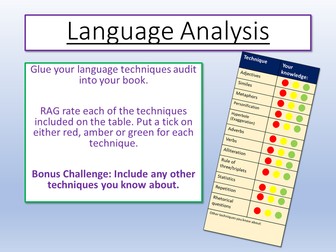
Language techniques and language analysis lesson for KS3 exploring a number of language features and their effects on readers. Useful for English Language Paper 2 Section A preparation. Includes differentiated activities, group worksheets, additional teacher and students notes and more. A useful lesson for KS3 and KS4 classes with differentiated activities, questions and resources.
Check out our English Shop for loads more free and inexpensive KS3, KS4, KS5, Literacy and whole school resources.
AQA English Language Paper 1 and Paper 2 Knowledge Organisers
AQA English Language Paper 1 Section A package
AQA English Language Paper 1 Sections A and B package
AQA English Language Paper 1 package
AQA English Language Paper 2 Question 5 package
AQA English Language Paper 1 Question 5 package
AQA English Language Paper 2 Section A package
AQA English Language and English Literature revision package
An Inspector Calls whole scheme package
An Inspector Calls revision package
Macbeth whole scheme package
Macbeth revision package
A Christmas Carol whole scheme package
A Christmas Carol revision package
Jekyll and Hyde whole scheme package
Jekyll and Hyde revision package
Romeo and Juliet whole scheme package
Power and Conflict poetry comparing poems package
Power and Conflict poetry whole scheme package
Love and Relationships poetry whole scheme package
Unseen Poetry whole scheme package
This comprehensive bundle includes all the texts from the IGCSE Edexcel English Language anthology, each condensed into a concise and accessible one-pager. Perfect for revision, lesson planning, or independent study, this resource is designed to support students in mastering key analysis skills and achieving exam success.
** Covers the IGCSE Edexcel English Language anthology.**
From The Danger of a Single Story
From A Passage to Africa
From The Explorer’s Daughter, Kari Herbert
Explorers or boys messing about? Either way, taxpayer gets rescue bill,
From Between a Rock and a Hard Place,
Young and dyslexic? You’ve got it going on
From A Game of Polo with a Headless Goat
From Beyond the Sky and the Earth: A Journey into Bhutan
From H is for Hawk
From Chinese Cinderella
Key Features:
Concise and Accessible: Each one-pager provides a clear summary, key themes, vocabulary, and analysis of language and structure.
Exam-Focused: Tailored to meet the assessment objectives, helping students effectively analyse language, structure, and writer’s perspective.
Time-Saving: Ready-to-use resources for teachers to enhance lesson planning or for students to revise independently.
Engaging and Informative: Designed to support deeper understanding and confidence in tackling anthology texts.
Language analysis of various language techniques in An Inspector Calls. Model quotation explosions given as a model for students to then analyse their own
This is a fantastic booklet that enables pupils to get in to good habits when approaching language analysis. It can be used in many different ways by a teacher. As a tool for pupils to work with, or for a teacher to save time planning. Examples of how I have used it can be found at the end of this description.
The purpose of this booklet is to help pupils develop their writing style by getting them in to good analytical writing habits.
This booklet will also allow pupils to concentrate more on what they are writing rather than how they are writing.
The aim is that pupils use it until they develop their own style and are confident enough to write without it.
How to use this booklet
There are 3 tables in this booklet:
• Literary language features
• Grammatical language features
• Word classes
Each table has 3 columns:
• The first column is the name of the feature/word class
• The second column is the feature/word class’ effect on a reader/definition
• The third column is a model/writing frame
Using the model/writing frame
1. Read and understand the text(s) you’re studying
2. Read and understand the question being asked
3. Identify the language feature that the writer has used in the text
4. Locate it in the booklet
5. Copy the straight black writing and insert your own words where the writing is red and in italics.
My examples
For a year 10 set 5 class:
After assessing a mock of the new GCSE English Language Paper 1 and realising their language analysis was very weak (identifying features and then explaining/analysing their effect), I created this booklet.
I printed a copy for each individual to have and to use every lesson. I encouraged them to use it when answering language analysis questions (e.g. New GCSE Language P1Q2 + P2Q3). They did, and it had an immediate impact.
Initially the pupil’s responses were similar but as they became more familiar with the technique by practising with these models, their responses became more bespoke, thus collectively their language analysis has improved considerably.
For a year 8 set 2:
I have copies available in the classroom; if a pupil finds it difficult to write about language, or a particular language feature, then they independently use the booklet, similarly to how they would use a dictionary.
This booklet also contains a revision page.
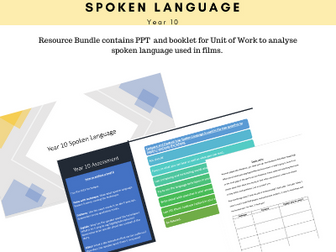
PPT contains a variety of tasks aimed at preparing pupils for analysis of CCEA Spoken Language at GCSE Level.
PPT contains speeches from Braveheart, Coach Carter, Remember the Titans, Legally Blonde and Rocky Balboa on the theme of inspiring and motivating the listener/audience.
Accompanying assessment paper and worksheets to prepare skills for assessment.
Bundle contains booklet to accompany the PPT.
Based upon the Pearson Edexcel LIFT 2.0 qualification, this complete lesson focuses on understanding and analysing how tone, language and structure create an effect on the reader. With chunked tasks that use a variety of skills, such as making inferences, developing word-level connotations, predicting, identifying writer’s methods and analysis, this lesson builds towards an exam-style question. Modelling and sentence starters are provided.
This lesson uses The Pedestrian by Ray Bradbury as a stimulus text, so this lesson could be used as well as part of a dystopian scheme of work.
A lesson covering ‘The Flea’ by John Donne. This is one of the poems from the AQA A-Level Literature ‘Love Through the Ages’ Poetry anthology. The PowerPoint includes:
A summary of the poem
Contextual information
Analysis of language
Analysis of structure
Key themes
Critical thinking questions
This download is a lesson and reading resource aimed at preparing pupils for the new AQA 9-1 English Language Paper 2, Question 3 (Language Analysis). It contains a sample paragraph, interactive evaluation activities and peer assessment. Suitable for all years although would probably be higher sets for KS3. You will need dice to complete this lesson as it stands.
This resource offers a comprehensive guide to analyzing the theme of manipulation in GCSE, English Language fiction using the PEEL (Point, Evidence, Explanation, Link) framework. This booklet enhances students’ analytical skills and deepens their understanding of character dynamics and themes in literature.
Each section provides:
Engaging Extracts - Carefully chosen passages to illustrate different forms of manipulation, such as emotional nudges, fear, and flattery.
Step-by-Step Analysis - Examples of how to write effective PEEL paragraphs with annotated explanations.
Interactive Activities- Exercises to help students identify manipulative tactics and explore their emotional impact.
Creative Writing Tasks - Opportunities for students to craft their own examples of manipulation.
An additional booklet features a modern prose retelling of a key scene from Othello, focusing on Iago’s manipulation of Othello. It includes:
Detailed Extract: A vividly described narrative that captures the essence of Shakespeare’s original text.
Targeted Questions: Prompts to guide students in analyzing Iago’s language, body language, and psychological tactics.
PEEL Paragraph Examples: Clear models to support students in structuring their responses.
This unit is ideal for GCSE, English Language students, providing opportunities for textual analysis and essay writing based on the theme of manipulation.
A lesson covering ‘Sonnet 116’ by William Shakespeare. This is one of the poems from the AQA A-Level Literature ‘Love Through the Ages’ Poetry anthology. The PowerPoint includes:
A summary of the poem
Contextual information
Analysis of language
Analysis of structure
Key themes
Critical thinking questions
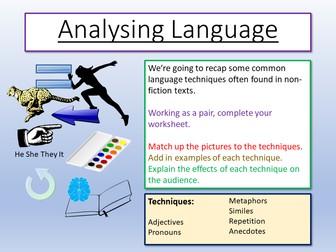
English KS3 non-fiction lesson for AQA English Language Paper 2. Students learn about language features common in nonfiction texts such as anecdotes, metaphors, similes, repetition and adjectives, as well as exploring an example letter written by Oscar Wilde. Students use their analyses to create Q3 style answers, with sentence scaffolds provided. Students explore non-fiction texts and use their new knowledge to analyse specfic examples. Useful preparation for both Section A and Question 5 of GCSE English Language exams, but designed for KS3 students. Includes teacher and student notes as well as differentiated activities throughout.
Check out our English Shop for loads more free and inexpensive KS3, KS4, KS5, Literacy and whole school resources.
AQA English Language Paper 1 and Paper 2 Knowledge Organisers
AQA English Language Paper 1 Section A package
AQA English Language Paper 1 Sections A and B package
AQA English Language Paper 1 package
AQA English Language Paper 2 Question 5 package
AQA English Language Paper 1 Question 5 package
AQA English Language Paper 2 Section A package
AQA English Language and English Literature revision package
An Inspector Calls whole scheme package
An Inspector Calls revision package
Macbeth whole scheme package
Macbeth revision package
A Christmas Carol whole scheme package
A Christmas Carol revision package
Jekyll and Hyde whole scheme package
Jekyll and Hyde revision package
Romeo and Juliet whole scheme package
Power and Conflict poetry comparing poems package
Power and Conflict poetry whole scheme package
Love and Relationships poetry whole scheme package
Unseen Poetry whole scheme package
Or check out some Citizenship GCSE, RE, PSHE + RSE resources at EC Resources
This is a poetry analysis methodology for GCSE English Literature students that aids the consideration of the primary elements of poetry: meaning, imagery, tone, structure, and language.
The first item in this resource acts as an introduction to poetry analysis and, later, a study and revision aid to enable fluent analysis of poetry. It is ideal for Unseen Poetry (or poems from the associating poetry clusters usually included in English Literature Paper 2, but currently removed due to COVID).
This guide breaks down poetry analysis into 5 primary areas of focus, highlighting some of the aspects to consider for each of these broad criteria. It introduces and aids revision of key poetic techniques, and encourages critical thinking and individual interpretation of how the poet employs these techniques. It also requires the student to think about how all of these devices and aspects of the poem contribute to the overall meaning of the poem, and how the poet uses these techniques to explore the themes pervading the text.
The second item is a blank template for the student to note down ideas, devices, and aspects they notice in the poem they are working through during the lesson. This can then be repeated to cement poetry analysis skills, and used as revision or homework exercises to help hone students’ independent work.
Although this is created with poetry analysis in mind, all of these areas of enquiry are relevant when analysing any literary text, so this provides students with the foundational skills necessary to approach both poetry and prose. It is also very useful to work through this prior to approaching Shakespeare. The skills covered in this resource are transportable and fundamental to both English Literature and Language GSCE.
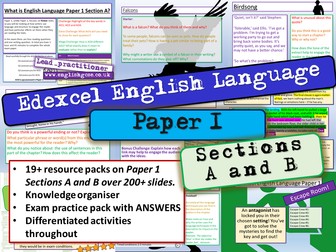
Edexcel English Language Paper 1 materials. A collection of well differentiated lessons and revision materials to prepare GCSE students for Edexcel English Language Paper 1: Fiction and Imaginative Writing, prepared by an Outstanding-rated English specialist and Lead Practitioner.
Resources included:
Edexcel English Language Paper 1 Introduction
Falcons (Language and Character analysis)
Birdsong (Language and Character analysis)
Reluctant Fundamentalist (Language and structure analysis)
Spies (Structure and language analysis)
Evaluation and language lesson
Structure Q3 lesson
Beginnings and endings - structure
Paper 1 Section A Walkthrough
Descriptive writing introduction
Zooming in for description
Imaginative writing examples - analysis
Punctuation workshop
Language techniques
Q5 and Q6 (Section B) planning lesson
Knowledge organiser for Section A
Mock review lesson
Exam practice pack with ANSWERS
Paper 1 escape room revision pack
Paper 1 revision guide
Note: Some resources use 20th century extracts, but these are skills-based lessons that focus on the requirements of Edexcel Paper 1.
This excellent resource gives you everything you need to teach students how to analyse writers’ use of language for the new AQA English Language GCSE. The contents are as follows:
1. 72-slide PDF presentation on Language Analysis – this presentation examines three literary extracts in detail, showing students exactly how to identify techniques, plan their answer and write a structured, comprehensive response to a Language Analysis question. It contains model answers for the first three extracts and also contains an additional three extracts for students to examine and create their own answers. It also features an indepth-examination of the AQA Mark Scheme for the Language Analysis questions, showing students exactly how to maximise their marks.
2. Student Extract Booklets – these three booklets are differentiated: Booklet 3 is for less able students and contains an annotated version of the extracts with hints as to what language features are used in each one. Booklet 2 is for more able students and each page contains hints on the language features. Booklet 1 is for the most able students and features the unannotated version of the extract without any helpful hints.
3. Teacher’s Master Copy – for your convenience, this is a more compact version of the student booklets, containing all six extracts and three model answers.
This resource is also available without any AQA references – ideal for students of all exam boards.
I hope these resources are helpful for you and instructive for your students – as always, I’d be delighted to hear any feedback you may have.
I will be adding lots more English Language revision resources to my shop so please check back regularly!
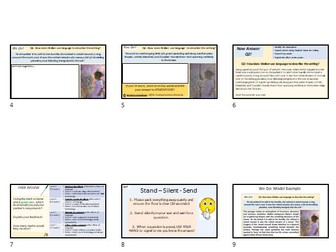
How to write an answer commenting on the effects of language used in a passage. This is aimed at students writing the CIE IGCSE First Language English exam, specifically Paper 2 Question 2.
The question this lesson contains is: ‘How does the Alice Walker use language to describe the setting?’
Q2 Language Analysis.
Uses clear teacher modelling & scaffolding.
Gradual release of responsibility: I DO, WE DO, YOU DO.
Tackles ‘imagery’ linking it to atmosphere.
SEND / dyslexia friendly.
Teacher guidance on slide 1.
Offer opportunities for stretch challenges.
PEER REVIEW.
A worksheet for ‘Checking Out Me History’ by John Agard from the ‘Power and Conflict’ cluster of poems for AQA. Pupils are encouraged to think more deeply about the language that Agard has used to present the figures from Black/Caribbean history.
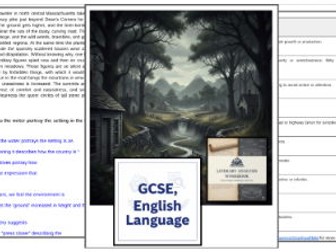
Aimed at GCSE, English Language students, this FREE resource supports learners who struggle to analyse language devices in the reading paper (fiction).
It begins with a vocabulary matching activity where students aim to understand some of the complex words used in the extract taken from, “The Dunwich Horror” by HP Lovecroft.
Students then read the extract and consider the description of setting. After reading, there is a revision activity to assess knowledge of literary devices.
This is followed by a literary analysis section where students are required to analyse chosen phrases from the passage.
Finally, students can complete a GCSE, English language style question on the use of language.
A writing frame is provided to help students structure their response.
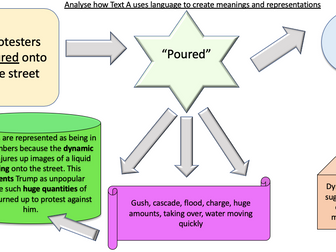
This template is designed to guide students through close language analysis. I found this kind of approach the fastest and most effective way to label language features for AO1 and then to score really good AO3 with in depth analysis and links to wider ideas and meaning. Slide one is a blank template and the second slide is an example of how the template can help analyse a quote.
Hi! If you came from Twitter, thanks for all the retweets, this blew up! If you want to try out the technique yourself, download this resource for free :-) Download to get an editable copy of the BLANK template!
Made for A Level but can be adapted for any level really. Even year 7s or GCSE will benefit from this technique.
Please leave a review!
Follow my twitter to stay updated with more essential free resources and news - @astarlevels


 Quick View
 Quick View
 Quick View
 Quick View
 Quick View
 Quick View
 Quick View
 Quick View
 Quick View
 Quick View
 Quick View
 Quick View
 Quick View