Rhetoric analysis activity ideal for a KS3/ KS4 homework task for a non-fiction unit/ AQA Language Paper 2 revision with full instructions, paragraph structures, success criteria and WAGOLL modelled example.
This project focuses on Martin Luther King Jr’s infamous ‘I Have A Dream’ speech.
Resource tasks:
Read the speech. Highlight and annotate any persuasive techniques on the sheet.
Select one quotation from the speech and write a short analytical paragraph to answer the question: How does Martin Luther King Jr. use rhetoric to gain support from his audience? There are structures and a modelled example on the sheet to follow.
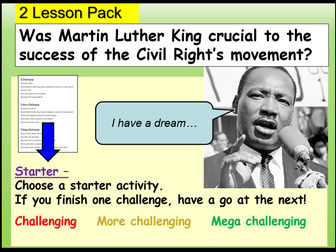
This is a whole-lesson on Martin Luther King. it contains a link to the ‘I have a Dream’ speech, an information sheet on Martin Luther King 's beliefs and a factfile on Martin Luther King, differentiated for the lower ability students.
The factfile can be turned into a spider diagram, or students can categorise information in it into Martin Luther King 's views, actions and consequences of actions.
Students have a writing frame on which to base an evaluation of Martin Luther King’s significance.
Students finish by considering the effect of non-peaceful protest.
This lesson contains:
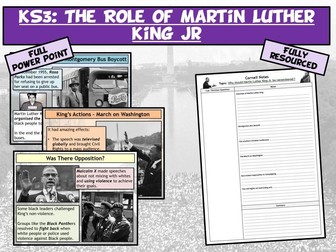
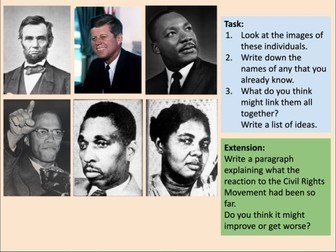
A starter to look at some images that relate to MLK and students guess why.
An activity lasting the whole lesson, to complete Cornell Notes, using the worksheet provided, while the lesson progresses. It’s very effective for student revision.
A YouTube video to start looking at MLK himself. Students complete the questions by writing them out in full in the top part of their worksheet to summarise his life.
A series of slides covering his role in the civil rights movement, from the Bus Boycott to his speaking skills, to Selma. Students take notes in the appropriate section of the worksheet. You can either talk these through with the class, or print the slides as handouts and shared around in groups.
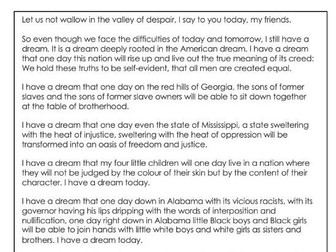
A YouTube video within the activity to watch the ‘I Have a Dream’ speech. There is an optional Word File with a transcript of the essential parts of the speech for students to follow along and annotate if you like.
A brief look at those who opposed MLK, like Malcolm X. There is a YouTube clip which students use to interpret the different message being send from Malcolm X.
A plenary to finish the Cornell Notes and summarise the learning about his contribution. The prompts and sentences for this are on the Powerpoint.
Attachments:
1 x Powerpoint Presentation
1 x Word File
1 x Publisher File
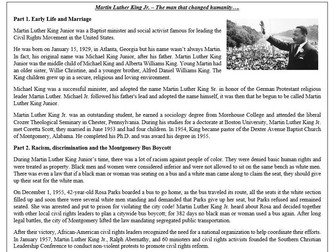
A reading Comprehension on Martin Luther King’s Life and work as a social activist and leader of the Civil Rights Movement in the United States. There are a lot of comprehension exercises after the text including : True or False, multiple choice, gap filling and finding synonyms exercises. The vocabulary used in the text is quite advanced (higher intermediate to proficient level).
This is a fully resourced lesson about how Martin Luther King’s Christian beliefs influenced his actions. It has an excellent starter sheet, carousel activity, discussion tasks, written tasks and an interactive plenary. It goes through the influence of the Bible, group prayer, being a pastor, non-violent protest & Jesus. It includes information on Civil Rights but its focus is on Martin Luther King’s Christian faith.
This pack includes everything you need for this lesson which has been graded Outstanding by Ofsted and included in a Summary report for a secondary school. It has a full lesson plan, differentiated questions, a powerpoint, worksheets and an interactive powerpoint plenary. This plenary can also be adapted and used for other lessons. Buy this and have one lesson for Ofsted totally planned and resourced for you.
This lesson is suitable for KS2, KS3 or KS4 (Ages 7-16). It was originally a 60 minute year 8 lesson but can easily last 90 minutes or it can be shortened if needed.
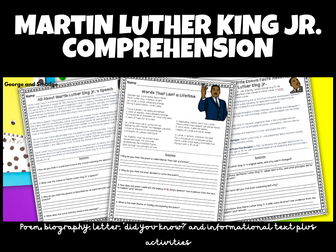
These are Martin Luther King Jr Reading comprehension passages and Questions for KS2, which include a range of nonfiction texts about Martin Luther King Jr., whilst also including comprehension questions about Dr. Martin Luther King Jr. for each one. Each text has a non-fiction reading text, followed by five comprehension questions. There are then black and white versions of the passages, should they be required.
Passages are:
Words That Last a Lifetime (A poem about Martin Luther King Jr.'s infamous speech)
A Letter to Martin Luther King Jr. (a fictional letter to Dr. King from Joy, who was in the crowd that day)
Did You Know (a set of 7 little-known facts about Martin Luther King Jr.)
Martin Luther King Jr. biography
All About Martin Luther King Jr.'s speech
What’s included?
5 nonfiction Martin Luther King Jr. passages - one poem, one ‘little known facts’ page, one biography, one informational text and a letter
20 reading comprehension questions - include questions on main idea and key details, quoting accurately from the text and vocabulary questions
Black and white versions of the worksheets
Your class will enjoy the variety of passages and questions. There is lots to keep them busy, as they work through the questions.
This activity would be perfect for Black History Month.
The passages and activities could be printed out and given to the children as a pack. This would make it perfect for a supply teacher day in the month of October, or anytime!
There’s not much to prepare… All you need to do is print the sheets out and hand to pupils!
Please note that this resource is not editable.
Ready to teach! This lesson is part of a wider scheme of work on the struggle for Civil Rights in America. The lesson prior to this one is Rosa Parks and can be found in my shop. The lesson looks at some of the key moments of MLKs fight for Civil Rights and has students consider what makes MLK so significant in the Civil Rights movement. This lesson includes a data capture sheet and an extended writing task to conclude. Any feedback greatly appreciated!
Full lesson and resources covering the lives and contributions of MLK and Malcolm X and why they were assassinated.
Learning Objectives:
To identify the beliefs of Martin Luther King and Malcolm X.
To understand the events of their assassinations
To evaluate the impact of Martin Luther King and Malcolm X’s assassinations.
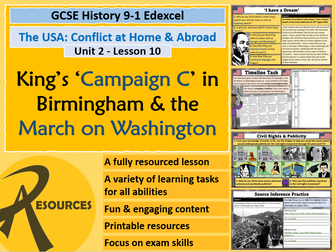
This lesson examines two key civil rights events during 1963 - King’s Campaign C in Birmingham, Alabama and the following March on Washington DC. Students examine the events as well as think about the significance of them for the progress of civil rights in America.
I have included two fact sheets (one slightly differentiated) with the information needed for this part of the course which can be found on the final two slides. Therefore, no other resources are needed for the teaching of this lesson.
The lesson includes:
Slide 1: Title slide
Slide 2: Lesson Key Questions
Slide 3-4: Previous lesson recap quiz with answers revealed
Slide 5: Martin Luther King Source Starter Task
Slide 6-7: Picture Quiz - Identify which civil rights events caused publicity in America?
Slide 8: Brief background information about Campaign C and a map showing the location of Birmingham in the Deep South
Slide 9: Instruction sheet for the timeline exercise
Slide 10: Printable student worksheet for students to organise the events into the correct chronological order
Slide 11-12: Two different style timelines
Slide 13: Follow up challenge questions
Slide 14-15: Photographic evidence of the March on Washington
Slide 16: Inference practice question
Slide 17: ‘I have a Dream’ source analysis
Slide 18: Learning Review activity
Slide 19-20: Fact sheets based on Edexcel specification
Please note that all images (clipart/photographs/vectors) used in this presentation, to be best of my knowledge, are copyright free and in the public domain unless otherwise attributed in the links. If you feel any errors have been made please contact me directly in the first instance to resolve the issue. Thank you.
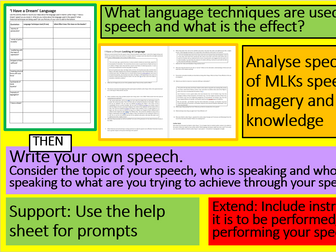
One off English Language lesson on speech writing with a focus on Martin Luther King and analysing effect of language use in his famous speech.
Full lesson including handouts!
The reference to speech writing helpsheet is a sheet used on Twinkl
A powerpoint explaining what Martin Luther King did after his famous 'I have a dream speech’
Focuses on Selma, including some original pictures and footage so may be more suitable for upper Key Stage 2 and above. I personally did not show the full video clip I just selected a part that I thought was suitable.
I do not own any of the images or videos linked in this powerpoint
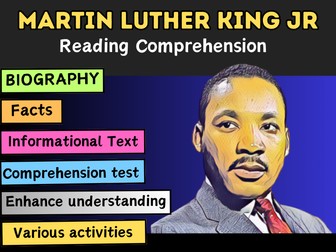
Biography : Martin Luther King Jr
Informational Text
Written Comprehension Questions
Multiple Choice Questions
True or False Comprehension Questions
A Report OF the Student: Translating understanding and revealing the facts of the topic.
Crossword Puzzle: To enhance understanding.
Word Search
This is a rich and enjoyable resource for the student, containing activities that are crucial to their learning and motivation, encouraging them to focus
Martin Luther King Jr. (1929-1968) was a prominent leader in the American Civil Rights Movement. Known for his advocacy of nonviolent resistance, he led pivotal campaigns like the Montgomery Bus Boycott and the March on Washington, where he delivered his iconic “I Have a Dream” speech. Awarded the Nobel Peace Prize in 1964, King’s assassination in 1968 marked a tragic loss, but his legacy of promoting equality and justice continues to resonate globally.
Non Fiction lesson on an extract from Martin Luther King Jr’s “I have a dream” speech. A variety of activities, including contextual information on segregation and Martin Luther King, questions on the text, summary writing exercises, a question on analysing the language of the speech, and more.
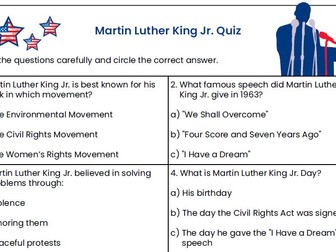
This multiple-choice quiz is designed for KS2 students to learn about the life, legacy, and achievements of Martin Luther King Jr. The worksheet includes 10 carefully crafted questions about MLK’s role in the Civil Rights Movement, his famous “I Have a Dream” speech, and the values he stood for, such as fairness, kindness, and equality.
Perfect for classroom use or as a homework activity, this quiz encourages critical thinking, develops historical knowledge, and inspires students to reflect on the importance of standing up for what is right.
Created by PrimaryLeap
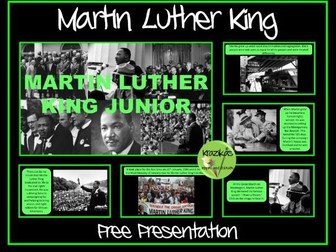
This resource contains a short presentation about Martin Luther King. It is an ideal resource for Martin Luther King Day celebrated in January and Black History Month in October.
You may also be interested in:
Martin Luther King - 60 Slide Presentation
This resource contains a fully editable, 60 slide presentation on the life of Dr. Martin Luther King Junior, the famous civil rights leader. The PowerPoint makes reference to his parents and family, his schooling and education, involvement and leadership in the civil rights movement leading campaigns and his impact upon civil right reforms. The PowerPoint contains hyperlinks to some of his famous speeches - I Have a Dream, The Mountain Top and The Drum Major. There are also links to a short video presentation of his life and the hymn sung at his funeral.
A simple text version of this presentation is also available:
Martin Luther King Simple Text Presentation
Martin Luther King Texts and Comprehensions
This resource contains a set of eleven texts and comprehension questions (and answers) on the life and achievements of civil rights leader, Martin Luther King.
These resources will help students' Spiritual, Moral, Social and Cultural (SMSC) development by learning about the history and heritage of communities and the lives of those that overcame the challenges they faced.
More Black History Resources
Thinking of publishing your own resources or already an author and want to improve your resources and sales? Check out this step-by-step guide:
How to Become a Successful TES Author: Step-by-Step Guide
This is a simple lesson that looks at the assassination of MLK. Using visual and video sources it asks students to reflect on the event and what they tell us about the importance of Martin Luther Kings influence.
This lesson links with the divided union GCSE text book: the book is a useful if not necessary resource.
These lessons focus on the role Martin Luther King played in the fight for civil rights. They are fully resourced lessons with PowerPoints, a variety of tasks throughout, worksheets, clip links and accompanying tasks focusing on the Martin Luther King and the Civil Rights groups.
Designed to meet Ofsted Good-Outstanding criteria by a experienced History teacher in a UK secondary school.
Please see our other resources in our TES shop: https://www.tes.com/teaching-resources/shop/History_Geeks
If you are happy with your resource, please leave us a review! If, by any chance, you encounter any issues with the resource, please email us at historygeeksuk@gmail.com and we’ll try to solve them for you.
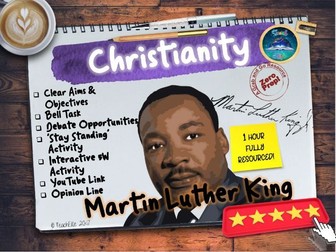
This is a fully resources Grab and Go lesson based on the life and works of Martin Luther King / MLK Jr.
Included in this lesson:
Bell task based on a fundamental question surrounding this topic.
Starter: Stay standing activity
Activity: Pupils watch a YouTube clip on the life and works of Martin Luther King and fill in our 5W sheet based on this information.
Activity: Pupils will have the opportunity to take part i an opinion line activity on the significant events of Martin Luther King’s life.
Activity: Pupils will have to answer a 12 mark evaluation question based on the evidence they gather from lesson and formulate a response as to whether they think non-violent protests are effective.
Peer Assessment-Pupils swap their answers and peer assess.
Plenary: INTERACTIVE emoji Selector (worth £3)
We hope that you enjoy this resource! If you review this resource we will give you another resource of the same value for FREE.
We would love your feedback, if you like what you see, please follow us: on Tes TeachElite’s Shop click the’Follow this Author button’ . We will keep you updated on any sales we throw or FREEBIES we upload.
You can find us on Twitter: https://twitter.com/TeachEliteRE
and Facebook: https://www.facebook.com/TeachElite/


 Quick View