English resources for teaching Macbeth key themes

Explore the dark and intriguing key themes of Macbeth, from the supernatural, ambition and power to guilt and appearance versus reality

Tes Resources Team

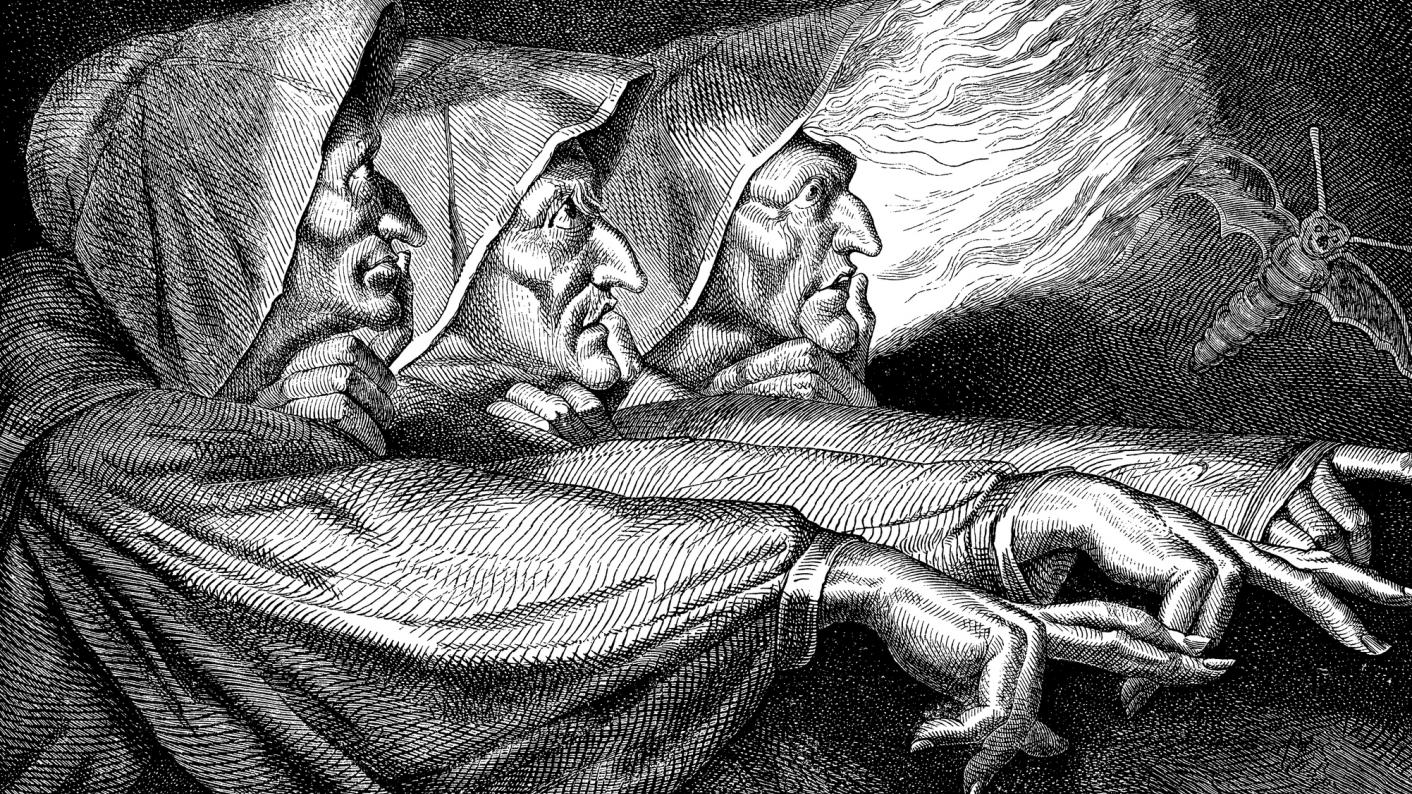
The three witches from Macbeth for teaching Macbeth key themes for secondary English

Macbeth key themes resources for secondary English

Studying the Shakespearean tragedy, Macbeth, gives secondary English students the opportunity to explore themes that provide both a glimpse into the fascinations of the past and concepts that still resonate with us today. These themes include power, the consequences of unchecked ambition, guilt, the supernatural and representations of appearance versus reality. With Macbeth being a key text to study for GCSE English Literature, as well as an effective introduction to Shakespearean tragedy at upper KS3, it is one of the most frequently taught of Shakespeare’s plays.

To understand the significance of Macbeth's themes to a Jacobean audience, students can also explore the context of the play. They can consider the threat posed by the concept of witches and the supernatural to Jacobeans, and in particular King James, along with their horror at the thought of regicide and the devastating tragic consequences that interrupting the Great Chain of Being, or the Divine Right of Kings, would have.
Themes mapping

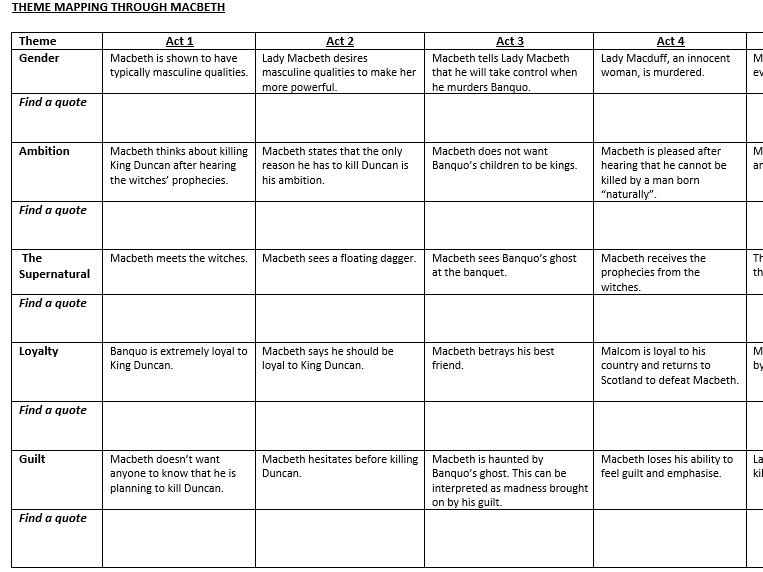
Why not use a themes grid template or themes wheel to track the representation of themes in Macbeth, and the significance of key quotes and scenes relevant to specific themes? Consolidating the use of motifs and language techniques to convey Macbeth key themes, can help students to grasp the ongoing tragic downfall of Macbeth, from his first encounter with the Three Witches to his defeat in the final scenes.

Macbeth Theme Mapping Sheet
benjrose89

Macbeth Theme Mapping Sheet

(12)
A worksheet for students to use when studying themes in Macbeth. They must find a quote representing each theme for every act of the play.
Macbeth Theme Wheels
creativesquirrel

Macbeth Theme Wheels

(1)
Five A4 theme wheels covering: * Guilt * Violence * The Supernatural * Ambition * Kingship and Tyranny Each wheel includes key acts/ scenes where the theme is shown / explored, along with a short description. Each A4 page also contains two extension tasks that are linked to the specific theme. T...


Ambition theme Macbeth

From Macbeth’s realisation that the witches’ first prophecy has come true, we can see an initial spark of ambition grow, with Lady Macbeth’s powerful encouragement, into an all consuming force propelling him on to his tragic downfall. The Weird Sisters’ dark and sinister intentions are lived out by Macbeth until his hamartia secures his tragic fate.

Selected key scenes for exploring ambition: Act I Scene 3 (the Three Witches’ prophecies), Act I Scene 5 (Lady Macbeth’s influence), Act I Scene 7 (prior to the murder of King Duncan), Act II Scene 1 (the floating dagger scene), Act III Scene 1 (Macbeth’s soliloquy before ordering the murders of Banquo and Fleance), Act IV Scene 1 (the Three Witches’ apparitions)

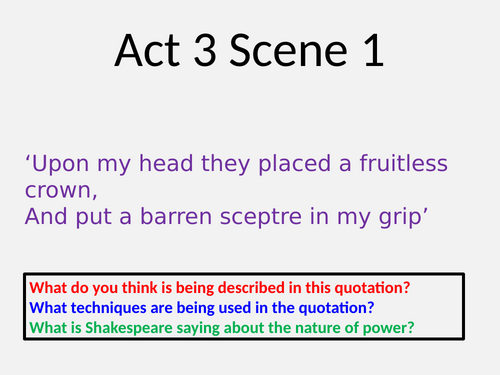
To focus on the theme of ambition in Macbeth with your students, take a look at this structured lesson on responding to an essay question on the theme. The full lesson takes your KS4 students along the path Macbeth’s hamartia takes him, as he attempts to fulfil the ambitions the Weird Sisters have fired in him. Analysing a key scene or soliloquy, with a particular theme in mind, can also allow students to grasp how the theme is conveyed, and the following activity on ambition in Act III Scene 1 does just that!

Ambition in 'Macbeth': exploration and essay (GCSE)
MsLarkinsResources

Ambition in 'Macbeth': exploration and essay (GCSE)

(3)
An engaging, super clear 40 slide powerpoint which takes a class through the theme of ambition in 'Macbeth'. There are plenty of opportunities for short, focused activities by the students to help consolidate skills of language analysis and writing about context. The lesson finishes with an exam ...
Macbeth  Act 3 Scene 1 - Scaffolded extract
Engschemes

Macbeth Act 3 Scene 1 - Scaffolded extract

(1)
Here is an easy to use scaffolded resource for Macbeth. Based on Act 3 Scene 1 with a focus ambition, students are given an extract and exam question with the task being to add their ideas and annotations into the sheet. A great sheet to use with lower ability students who have trouble accessing t...


Theme of power in Macbeth

Power transforms Macbeth into a tyrannical figure, and in his attempt to hold onto his power and status as King he commits progressively more amoral acts. Both Lady Macbeth and Macbeth demonstrate the effects of this moral deterioration. Their damnation after committing regicide and breaking The Chain of Being, followed by further murderous acts to desperately hold onto power and eliminate any threats, is inevitable.

Selected key scenes for exploring power: Act I Scene 5 (Lady Macbeth’s influence), Act I Scene 7 (Lady Macbeth’s power of manipulation prior to the murder of King Duncan), Act III Scene 1 (Macbeth orders the murders of Banquo and Fleance), Act IV Scene 3 (Malcolm and Macduff on power and tyranny), Act V Scene 5 (Macbeth’s ‘Tomorrow and tomorrow’ soliloquy)

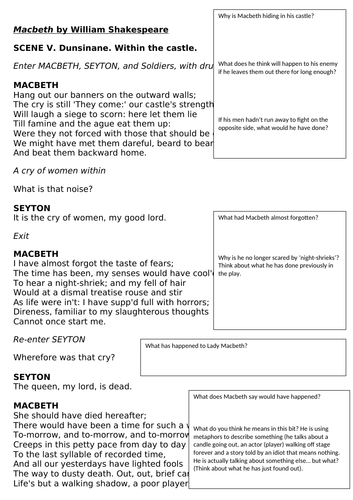
To analyse the decline of Macbeth and how he attempts to hold onto his power, this lesson focusing on Act III Scene 1 gives students the task of closely analysing the language and techniques used to show Macbeth’s motivation and state of mind. Another key scene to analyse when tracking the theme of power in Macbeth, covered in this ready to use activity sheet, could be Act V Scene 5, in which we see Macbeth near the end of his reign.

Act 3 Scene 1 Macbeth
HMBenglishresources1984

Act 3 Scene 1 Macbeth

(1)
A complete ready to teach lesson that includes a differentiated starter, detailed line by line animated annotations of the full scene following by comprehension questions to text students' understanding of the annotations.


Supernatural theme Macbeth

The Jacobean audience’s fascination with witches and the supernatural is played out in Macbeth with the Three Witches, who open the play and exert their influence on the plot and the fate of Macbeth from the beginning. Representations of the supernatural and evil continue through the course of the play, from the three apparitions the witches conjure up to the ghost of Banquo appearing to further disturb Macbeth’s state of mind and the effect of visions on the Macbeths.

Selected key scenes for exploring the supernatural: Act I Scene 1 (opening the play with the Three Witches), Act I Scene 3 (Macbeth’s first encounter with the Three Witches), Act II Scene 4 (unnatural occurrences following the King’s murder), Act III Scene 4 (Banquo’s ghost scene), Act IV Scene 1 (the Three Witches’ apparitions)

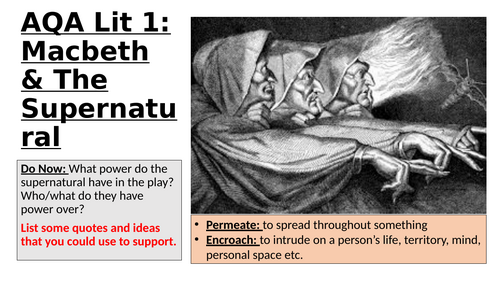
Explore these lessons for KS4 examining the theme of the supernatural and representations of evil in Macbeth, with a close analysis of the representation of the Three Witches in Act IV Scene 1, and a wider look at the context of the play including how to answer an essay question on representations of the supernatural and evil.

AQA Literature Paper 1: Macbeth and the Power of the Supernatural
zsmall

AQA Literature Paper 1: Macbeth and the Power of the Supernatural

(1)
A lesson exploring the power of the supernatural within the play Macbeth. Has slides supporting key context and Shakespeare's driving message in the play, alongside a practice AQA extract based question, writing frame and opportunity to complete essay based question. A very scaffolded pick-up-and...
Supernatural in Macbeth - revision lesson
AmyEnglish

Supernatural in Macbeth - revision lesson

(1)
Benefits to teachers: 1) Comprehensive essay plan with high-level thesis statements and evidence choices for the question: "How does Shakespeare present the influence of the supernatural on Macbeth in this extract and in the wider play?" 2) Differentiated essay plan resources for low, mi...


Macbeth theme of guilt

From the murder of King Duncan onwards we see the toll that guilt takes on the Macbeths, albeit more rapidly in Macbeth, who appears to feel the consequences of his actions as soon as he has committed the murder. Lady Macbeth initially appears more dismissive of the magnitude of what they have done, and suffers a rapid decline later in the tragedy, with her descent into sleepwalking and torturous visions of blood and murder.

Selected key scenes for exploring guilt: Act II Scene 2 (following the murder, ‘A little water clears us of this deed.’), Act III Scene 4 (Banquo’s ghost scene), Act V Scene 1 (Lady Macbeth sleepwalking, ‘Out damned spot!’) Act V Scene 8 (Macbeth before his death, ‘My soul is too much charged …’)

To analyse one of the key scenes, Act II Scene 2, this worksheet activity and assessment allows students to formulate their ideas on the theme of guilt. To practise answering an essay question on guilt, why not also use the following lesson on analysing an extract and structuring cohesive written responses?

Macbeth Act 2 Scene 2- Guilt Assessment and Worksheet
NovelTeachingUK

Macbeth Act 2 Scene 2- Guilt Assessment and Worksheet

(1)
Students write a response to the question: 'How does Shakespeare present the theme of guilt in this extract, and elsewhere in the play?' Using the powerpoint, encourage students to consider key quotations from this scene. Students then highlight on the worksheet where the model paragraph has me...
Macbeth - Essay planning on Guilt
begum

Macbeth - Essay planning on Guilt

(1)
Macbeth - a lesson on answering the question on how Shakespeare presents the theme of guilt using the sleep walking scene. The ppt goes through how to break down the question, annotate the extract and finally how to structure PETAZLE paragraph. The lesson includes a power point, extract, sentence op...


Appearance versus reality in Macbeth

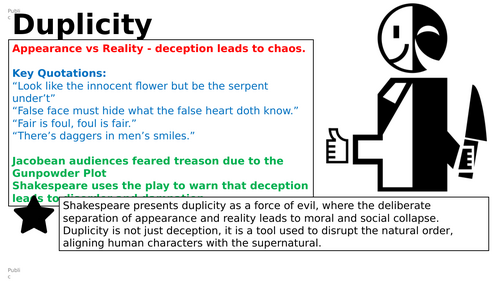
In the opening of Macbeth the Three Witches proclaim ‘Fair is foul, and foul is fair’, which introduces the audience to the significance of the theme of appearance versus reality. The theme manifests in different forms throughout the play, from The Three Witches’ apparitions to further influence Macbeth, showing the threat of the supernatural, to a myriad of examples of things not being as they seem: hallucinations born out of a disturbed state of mind, the exploration of dreams and sleep and characters navigating treacherous times with their deceptive actions and speech.

Selected key scenes for exploring appearance versus reality: Act II Scene 1 (the dagger scene), Act III Scene 4 (Banquo’s ghost scene), Act V Scene 1 (Lady Macbeth’s sleepwalking & visions)

Help your students consolidate their knowledge of the key quotations on the theme of appearance versus reality in Macbeth with this scene by scene grid, including analysis and comment. Alternatively, the knowledge organiser below can be used for students to fill out with evidence they have gathered on the theme, either to track the theme as they read Macbeth or as a whole class review once they have completed the play.