Teaching the Victorians at KS2

Find out more about the Victorians and explore hand-picked resources to complement your teaching of this popular KS2 topic

Tes Resources Team

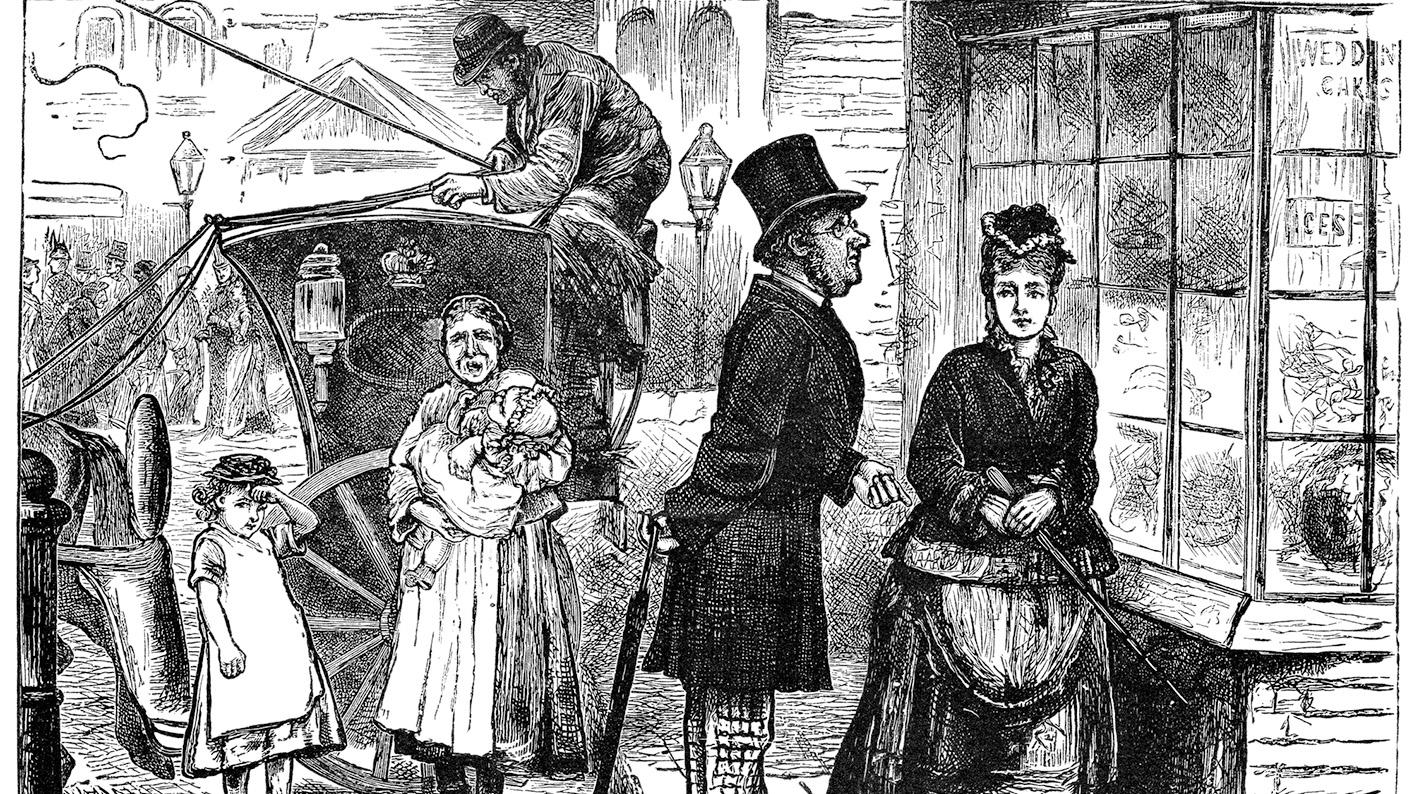
Victorian life with Victorian children to represent KS2 Victorians teaching resources

A short introduction to the Victorians 

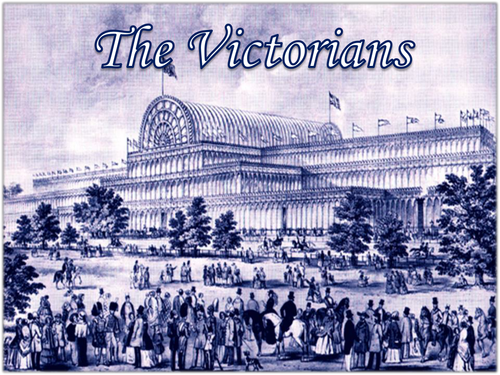
The Victorian era derives its name from the reigning monarch at that time, Queen Victoria, and spanned from 1837 to 1901. A great deal of change happened during the Victorian period, most of which came from the impact of the Industrial Revolution, the growth of the British Empire and medical and scientific discoveries. 

Who were the Victorians? 

The Victorians were people who lived during Queen Victoria’s reign from 1837 to 1901. The Victorians had defined social classes and people were categorised by social class based on both economic and social factors including their wealth and income, occupation, education, political alignments and family structure. There were three overarching social classes during the Victorian era, the upper class (sometimes also known as the aristocracy), the rising middle class and the working class.  

Many Victorians saw a huge period of change and growth due to industrialisation and urbanisation during the Industrial Revolution which changed everyday life as the Victorians knew it. 

Many famous Victorians are still referenced today including Charles Dickens, Florence Nightingale, Alexander Bell, Emily Brontë, Charles Darwin and many others. 

Find resources to support your teaching of the Victorian era at KS2 

Victorians
KS2History

Victorians

(6)
A fully-resourced unit of 10 history lessons for KS2, covering the Victorians topic. This KS2History planning pack includes 10 detailed lessons plans, each with accompanying pupil resource sheets and Powerpoint slides. The ten sessions in this unit aim to give an overview of the Victorian period in...
KS2 History - The Victorians
BBCTeach

KS2 History - The Victorians

(1)
This full set of downloadable lesson plans from [BBC Teach](https://bbc.co.uk/teach) accompanies the [School Radio collection of audio clips on the Victorians](https://www.bbc.co.uk/teach/school-radio/history-the-victorians/zh2w47h), covering topics from key individuals like Queen Victoria and Isamb...

Queen Victoria 

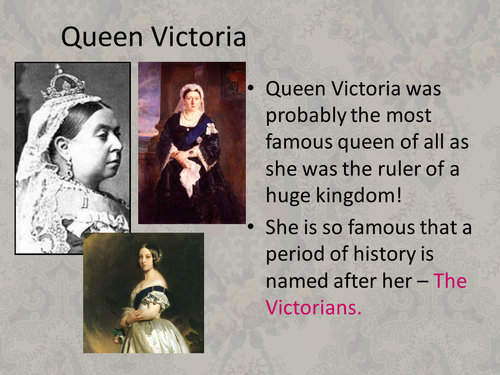
Queen Victoria was born at Kensington Palace in London on May 24, 1819. Her father died shortly after her birth and she became heir to the throne as her three uncles, who were ahead of her in the line of succession, had no legitimate children who survived. In 1837, Victoria became queen at the age of 18 and her coronation was held the following year on 28 June 1838 (it famously lasted for 5 hours!).  

Queen Victoria is known for the large amount of change that happened in Britain and around the world during her reign. She is associated with Britain's great age of industrial expansion, economic progress and empire.  

Queen Victoria married her cousin, Prince Albert, on 10 February 1840 and together they had nine children. Queen Victoria and Prince Albert popularised many traditions in England that are still around today such as decorating your tree at Christmas and having a Christmas dinner! When Prince Albert died in 1861, Queen Victoria went into a period of mourning which lasted the rest of her lifetime; she symbolised her period of mourning by only wearing black clothing until she died in 1901.  

Discover resources to support your teaching of Queen Victoria at KS2

KS2 History - Queen Victoria
BBCTeach

KS2 History - Queen Victoria

(1)
[Queen Victoria](https://www.bbc.co.uk/teach/class-clips-video/ks2-queen-victoria-the-ultimate-victorian/z79vhbk) was the monarch who gave her name to an era of discovery, invention and change in Britain. In this short film from the [BBC Teach](https://bbc.co.uk/teach) series [The Victorians](https...

Life during the Victorian Era and the Industrial Revolution

Life during the Victorian era varied greatly for the different social classes with large disparities between income and living situations. Upper classes would earn anywhere upwards of £1,000 per year and live in large houses that were kept by servants including cooks, house maids, butlers and nannies. The middle class, made up of people with occupations such as doctors, bankers, clerks and factory owners, saw large growth during the Victorian period that created a huge demand for goods and services which were once only available to the upper class. Income in the middle class ranged significantly and could be anywhere between £100 and £1,000 per year and living situations varied depending on income. The working class and people in poverty earned less than £100 per year often through working in the most manual, labour intensive and dangerous jobs in factories, mines and docks. The working class lived in cramped conditions and in close proximity with multiple families in small, terraced houses, sharing water closets (privies) and water pumps often with the whole street! 

During the Victorian era, and largely due to the impact of the Industrial Revolution, several reforms and acts were introduced to give children from poor families who often had to work in factories, mines and docks more rights and opportunities. In fact, the Victorian Era became the first period to acknowledge that childhood was a significant period of life and family life became idealised due to Victoria and Albert’s large family who were often in public view. In 1819, the Factory Act was passed meaning that factories couldn’t employ children under the age of nine and children between the age of 9 and 16 were not allowed to work more than 12 hours a day. In 1833, a Factory commission took place which led to another passed Factory Act. This Act banned children of any age from working before 5:30am and after 8:30pm, gave them a one-hour lunch break and made education a right for them all. It also introduced a mandatory factory inspection to check that conditions for workers were always being improved. In 1880, education became a universal need and eventually a universal right and as such, education was made compulsory for all children up to the age of 10. 

Explore resources to support your teaching of Life during the Victorian Era at KS2

The Victorians
HyperBunny

The Victorians

(54)
A ppt about The Victorians. It contains links to the BBC website, you may have to click on the individual videos to watch them.
Victorians- Workhouses - Lesson 6 - KS2
ami_amri123

Victorians- Workhouses - Lesson 6 - KS2

(1)
Victorians - Workhouses (KS2) This lesson focuses on the experiences of poor Victorian people in workhouses, it details their uniforms, meals, jobs, rules and punishments. This PowerPoint slide also has a short extract of Charles Dickens Oliver Twist and a link of the movie scene of please sir...

Victorian inventions

The Victorian era was a period of huge growth and the Industrial Revolution paved the way for new inventions and innovation. In 1876, Alexander Graham Bell made the first telephone call on his patented device to his assistant Thomas Watson. In 1879, Thomas Edison and Joseph Swan developed upon pre-existing work to create the first successful incandescent filament electric lamp. Thomas Crapper invented the first lavatory, not to be confused with inventing the first flushing toilet, in which a toilet and sink basin were located together in one contained room. In 1861 Thomas Crapper was hired by Prince Edward to construct lavatories in several royal palaces.   

Looking for fun ways to teach some Victorian inventions? Explore a selection of resources for your KS2 classes

Alexander Graham Bell and the Telephone: An Inventors Unit
Kiwilander

Alexander Graham Bell and the Telephone: An Inventors Unit

(1)
This mini-unit on Alexander Graham Bell is a great resource to be used as you teach about Alexander Graham Bell and his invention of the telephone. It includes: - Informational text for students to learn about his life and inventions - Comprehension questions ranging from knowledge questions to hi...
Making a pinhole camera
IET Education

Making a pinhole camera

(1)
**With our history of design KS2 lesson plan teaching resource, learners will make a pinhole camera inspired by the early photography of the Victorian era.** Inspired by the theme of the Victorians, this activity supports the teaching of design and technology in context by making a pinhole camera b...

Victorian Christmas

Christmas grew in popularity during the Victorian era and by the end of the 19th century it was regarded as one of the most important holidays of the year. Many Victorian traditions are still present in the modern day for those who celebrate Christmas. 

Victorian Christmas traditions you may recognise today: 

The Christmas card - in 1843, Sir Henry Cole introduced the idea of the Christmas card, but it wasn’t until Prince Albert popularised various Christmas traditions, including decorating trees in the home, that the Christmas card became popular. 

A Christmas cracker - in the 1840s Tom Smith, a sweet shop owner, was looking for new inventive ways to sell his sweets. Inspired by a trip to Paris, Smith came up with the cracker. It wasn’t until the 1860s that he perfected the cracker and added the explosive ‘snap’ sound that we’re all used to hearing around the Christmas table these days. 

Decorating Christmas trees - although the first decorated Christmas tree was brought to England in the 1800s by Queen Charlotte, it was Prince Albert who popularised the tradition when he and Queen Victoria were famously illustrated with their children standing next to a decorated Christmas tree adorned with lit candles and trinkets.  

Christmas dinner and Christmas pudding – another one that the Victorians didn’t invent but popularised during the Christmas period. Christmas dinner often featured a turkey or festive bird but would largely depend on income. Richer families may have opted for turkey, whilst families who were poorer may have opted for goose, which may have even been paid for in instalments throughout the year. Christmas puddings were also a treat enjoyed by the richer Victorians, many of whom would have finished their meal with a Christmas pudding. 

Discover fun Victorian inspired Christmas activities you could use with your KS2 classes

A Victorian Christmas: Cornucopias
Discovery_Museum

A Victorian Christmas: Cornucopias

(2)
A Victorian Christmas craft resource. A popular Victorian decoration was a cornucopia. This was made from paper and decorated with pictures, lace, and ribbons. It was then filled with sweet treats and hung on the tree. Resource includes instructions and template for making a cornucopia decoration.
The First Christmas Card
falabalam

The First Christmas Card

(3)
A lesson looking at the first Christmas card created in 1843 by Sir Henry Cole. Pupils then created their own versions of his original card, using the blank provided (pdf and publisher versions). This was used in conjunction with the whole school looking at Victorian Christmas traditions.

Victorian toys

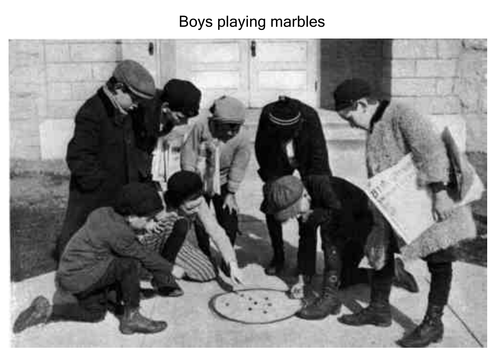
Although toys were common and often seen as a staple for children in rich Victorian families, many children from poorer families didn’t get the opportunity to play with them until the Factory and Education Act. With compulsory schooling, toys and playground games became commonplace for children during school breaks. Many popular Victorian toys and games are still around today such as teddy bears, dolls and doll houses, rocking horses, skipping ropes, hopscotches and skittles.  

Resources to support your teaching of toys at KS2

Victorians - Victorian Toys - Lesson 9 - KS2
ami_amri123

Victorians - Victorian Toys - Lesson 9 - KS2

(1)
Victorians - Victorian Toys (KS2) This lesson has many pictures of Victorian toys and pictures of Victorians children with their toys. Rich and poor children s toys. A link is also included that shows lots of different Victorians toys that children may recognise. Also included in one of the slide...
Victorian Toys
loretolady

Victorian Toys

(24)
A4 colour photographs of a range of Victorian toys and children playing with their toys.