The Anglo-Saxons is an engaging topic to teach within the primary classroom. Learning all about who they were and how they settled and lived develops primary pupils' knowledge of the history of Britain and allows them to discover more about how times have changed over the centuries.
Who were the Anglo-Saxons?
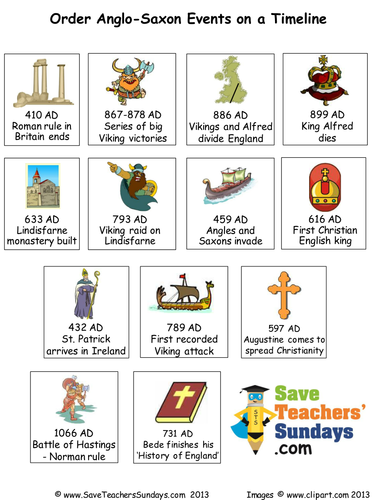
The Anglo-Saxons were the people who came to live in England in around 410AD, after the Romans had left. They originally came from different parts of Europe, mainly Germany, Denmark and the Netherlands, and consisted of several tribes, the biggest being the Anglos, the Saxons and the Jutes.
The Anglo-Saxons travelled to England on ships and settled in various places, forming new kingdoms. During their rule, Britain was separated into seven kingdoms: East Anglia, Essex, Kent, Mercia, Northumbria, Sussex, Wessex. Each of the kingdoms were ruled by a King and they often fought each other for power and land.
The Anglo-Saxons era lasted in England until 1066 when William the Conqueror took control following his victory at the Battle of Hastings and the Normans seized power.
Anglo-Saxon invasions and settlements
The Anglo-Saxons invaded Angle-land (England) over a period of time with different tribes arriving in waves for various reasons. Some had been asked to fight in England to help defend Britons against invasion as they were seen to be skilled fighters. Others came as the land was more fertile so they could farm and grow crops which they were struggling to do in their homelands due to flooding.
Once they had settled in England, Anglo-Saxons lived in village communities. Their houses were typically made of wood or wattle and daub with thatched roofs and generally consisted of a single room with a place for a fire. The villages were usually within a fenced area called a palisade to protect them and their livestock from wild animals and other invaders.
Anglo-Saxon life
Most Anglo-Saxons were farmers. They lived off the land and made ploughs and tools to enable them to do this. Their diet consisted of foods that they grew (grains and vegetables), foraged (fruits) or that were produced by their animals (eggs, milk). Meat was also eaten - however, this was generally only consumed by the wealthy as poorer families couldn’t afford it. Ale and mead were the most popular drinks, even with children, as they were safer than the water available.
The Anglo-Saxons were skilled craftspeople. They crafted with wood, made textiles through weaving and created intricate jewellery from metal. Items that were made could be traded for other resources that they needed.
During the Anglo-Saxon period, childhood was much shorter as children were considered adults from around the age of 10. There was no formal education. Children would help their parents with work and would often learn their parents’ trades and skills; boys would learn skills such as farming or carpentry and girls would learn skills such as weaving, cooking and spinning.
At the end of life, Anglo-Saxons were buried or cremated. Their graves would include grave goods including items such as jewellery, weaponry and tools. These graves provided valuable insights into the person’s life, wealth and position in society.
One of the most famous Anglo-Saxon burial sites to have been discovered is at Sutton Hoo. It was discovered by archaeologists in 1939 and has since revealed remarkable details about Anglo-Saxon life, traditions and beliefs.
Anglo-Saxon religion and beliefs
When the Anglo-Saxons first arrived in England, most held pagan beliefs. They believed in many deities, including Woden (king of the Gods), Thunor (God of thunder), Tiw (God of war) and Frige (Goddess of love, marriage), and had many rituals and superstitions.
However, over time many Anglo-Saxons converted to Christianity. This was due to Pope Gregory sending a group of monks to Britain to convert the people to the Christian faith. One of the most notable missionaries to be sent to do this was St Augustine who successfully converted King Ethelbert of Kent.
With lots to learn about the Anglo-Saxons and many different learning paths to choose from, we’ve hand-picked a selection of resources, made by the Tes teacher community, to support you in the classroom.