Night and DayQuick View
rtyler62

Night and Day

(0)
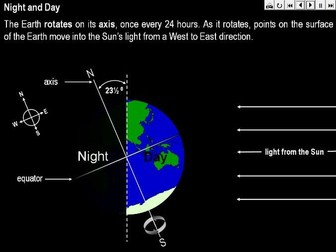
The main presentation is a PowerPoint with animated sequences showing how the rotation of the Earth results in night and day. Support Material Readme (instructions for whole lesson) Learning Outcomes (PowerPoint) Starter Activity (PowerPoint and Worksheet) Main Activity (PowerPoint with worksheets and answer sheets) Lesson Notes (hand-out) Plenary Activity (PowerPoint and worksheet) It is intended for all science teachers but particularly those who are not physics specialists. It is, primarily, aimed at 11 to 14 year old pupils but can also be used with younger pupils as a precursor to a more in-depth study of this topic. Normally, the activities would fill a 45 to 60 minute lesson. If you buy this resource, please print the Readme document as it contains the instructions and details of the files included. Learning Outcomes The learning outcomes are based on Bloom’s taxonomy of hierarchical classification: knowledge, comprehension, application, analysis, synthesis and evaluation. The lesson title and learning outcomes are: Why Do We Have Night And Day? Learning Outcomes Knowledge to describe the Earth’s 24 hour cycle and how this results in day and night to recognise the effect that the tilt of the Earth’s axis has on the northern and southern hemispheres Analysis to compare the relative times of day in different parts of the World. Differentiation The activities have varying degrees of differentiation; please refer to the Readme document.
A day out in a seaside townQuick View
madcatlady

A day out in a seaside town

(0)
Describing a seaside town, saying what you can do there, why you like it EPI work and activities based on a sentence builder Our local seaside town in Skegness but obviously please change it to yours
Writing to DescribeQuick View
dshowarth

Writing to Describe

(27)
A resource that provides material for lessons to improve student writing with the pupose of describing. It contains many examples of description from both fiction and non-fiction writing and numerous tasks for students that will assist in their ability to describe events, people and places.
Figure me out! First day at school activity.Quick View
IoanaD

Figure me out! First day at school activity.

(0)
You could let them create a profile of themselves, describing some fun facts using arithmetic. Children have to figure out the person by calculating the facts. Then they have to guess who that person is.
Book DayQuick View
Teachallenjoy

Book Day

(0)
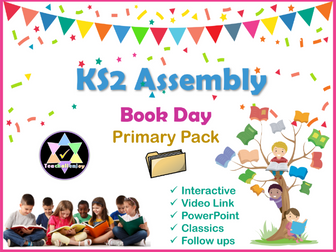
Inspire your school with an assembly designed for Book Day on a 26 slide PowerPoint. Includes higher order questions, interactive activities, inspiring video link, many classic books, author quotes, follow up activities and much more. Covers: What is Book Day? What famous people like to read? Video What can we read? Where can we read? When is reading useful? Who is the funniest author? Vote Match the author to the book Top Tips for choosing a new book What book has this as the opening line? Guessing game Favourite Characters - Optional Fashion Show Looking Forward Written for KS2. This assembly takes about 20 minutes to complete. Follow the engaging and colourful PowerPoint for a ready-to-go assembly. Animations, images, video and more will inspire every child to keep reading. Highlights: Interactive Inspiring Involving Use the range of activities to structure the assembly and share some high quality books that are recommended for children of KS2. Could also be used as a lesson, as it includes 3 differentiated writing tasks: Draw and describe your favourite character Write a book review of your favourite book Use 3 favourite characters to write a new story Printable templates included. Enjoy and celebrate this important day. Check out my other popular assemblies on special occasions: World Poetry Day National Speech and Debate Day National Storytelling Week
'Commas to Separate Items in a List' in a description of a day out.Quick View
Jazel

'Commas to Separate Items in a List' in a description of a day out.

(0)
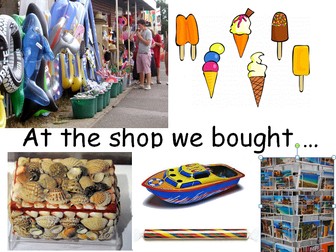
Children watch the PPT or Smart board presentation showing pictures of a day out at the beach. They talk about what they take with them, their picnic lunch, what they do at the beach and what they buy at the shop. They do this orally, or on whiteboards, using the picture prompts, thinking carefully about where the commas should go. They then write a paragraph describing the day out, using the given sentence openers. There is a check list to help them to remember to use commas correctly. Finally, they could go on to write a descriptive paragraph about another day out using commas in a similar way, such as a day at the zoo, or a visit to a big city. Fully editable. For further resources see - https://www.tes.com/teaching-resources/shop/Jazel
"5 a Day" French Revision ActivitiesQuick View
Rayjem

"5 a Day" French Revision Activities

(0)
While your students are working remotely, it is more important than ever that they keep previously learned knowledge fresh in their minds. Why not set them an extra “5 a day Challenge” or use one of the slides as no-prep starter for your lessons? This PowerPoint contains 27 sets of “5 a day” questions drawn from the content covered in Studio GCSE French Modules 1-4. a) A word / short phrase to translate into English b) A word or short phrase to translate into French c) A sentence to translate into English d) A sentence to translate into French e) An open-ended question to answer in French The following topics are covered: Describing people Describing my town Talking about what I do with friends Talking about family relationships Arranging to go out (future tense) Describing a day out (past tense) The person I admire Revising leisure activities Revising films / going to the cinema Talking about sport Talking about using technology Talking about books and music Talking about tv programmes Talking about a night out with friends Talking about food and meals Describing clothes and what to wear Describing daily life Shopping for clothes Describing festivals and traditions Talking about shopping for a special meal Describing family celebrations Talking about where you live and what you can do there Revising places in town and asking the way Describing a region Finding out tourist information Discussing plans and the weather Talking about your town, village or neighbourhood
Out of this world!- The movement of the earth and moonQuick View
nee901

Out of this world!- The movement of the earth and moon

(0)
A power point presentation and supporting worksheet about the movement of the earth and moon to use as a basis for your planning . This presenation includes: *Links to the National Curriculum for Science-describe the movement of the earth relative to the sun; describe the movement of the moon relative to the earth; describe the earth and moon as approximate spherical bodies; use the earth's rotation to describe day and night *Dynamic animations, videos and links to demonstrate key concepts to pupils. *KWL worksheets (Know;Want to know and Learned) to show pupil progress from opener to plenary. Both presentation and worksheets are fully adaptable to suit your needs and those of your pupils.
Year 1/2 Writing Plans & Resources: The Snail and The Whale (Week 1 out of 2) (FUN BOOK WEEK IDEA!)Quick View
RMeleady

Year 1/2 Writing Plans & Resources: The Snail and The Whale (Week 1 out of 2) (FUN BOOK WEEK IDEA!)

(0)
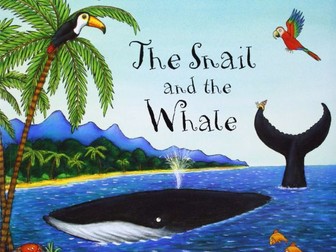
Curriculum Target: To write an extended piece of writing Main outcome: To create an ending for a story Text: The Snail and The Whale Day 1) LO: I can explore different settings Day 2) LO: I can describe a range of settings Day 3) LO: I can sequence a story Day 4) LO: I can explore a character Day 5) LO: Learning Outcome: I can explore my senses Includes: All daily resources required (labelled and listed in lesson plan) Images for classroom display A child friendly version of the story for the teacher to model daily (without an ending) as the lesson starter so children can create actions (Talk for Writing). This supports the children when they come to write independently in week 2 (so they can copy the model from memory). * I created a flag and stuck it in the middle of the school field and the initial hook. I also planted a message in a bottle from the snail. (Detailed in lesson plan). Lots of opportunities for creative thinking and talking.
Our Day Out KS3 Unit (21 Lessons) - SOW, PPT, Homework, Resources, Exam!Quick View
ryan_wood16

Our Day Out KS3 Unit (21 Lessons) - SOW, PPT, Homework, Resources, Exam!

(0)
A tried, tested and engagaing unit focused upon Willy Russell's play 'Our Day Out'! This unit has been created specifically to intigrate KS4 skills into the KS3 curriculum to prepare students for the rigors of the new 100% exam GCSE specification. The unit allows students to study the whole play, with particular focus upon key themes and characters. The unit culminates in an end-of-unit reading and writing exam styled upon the 2017 GCSE Specifications for English Language and English Literature. This detailed and high quality unit includes: * 21 lesson plans (with 13 differentiation strategies) * 87 slide PowerPoint presentation (divided into lessons) * All resources and worksheets (10 sheets) * Homework project (7 tasks) that includes both reading and writing skills * End-of-unit reading/writing exam * End-of-unit exam mark scheme (suitable for KS3 Levels 3-6, with GCSE 1-9 conversion) Unit's lessons include: * Contexts cloze activity * Shared reading and discussion of the whole play * Creating theatre publicity posters * In-depth analysis of the theme of lack of education and opportunity * Exploring and comparing the characters of Mr Briggs and Mrs Kay * Essay writing skills * Writing to describe - script to prose * Features of writing to inform and explain * AfL - improving a sample letter to inform/explain * Role play - creating and performing an extra scene for the play * Spelling tests on key vocabulary (differentiated by writing level) * SPaG starter activities * Crosswords * Huge 60-question revision quiz * End-of-unit reading exam (GCSE English Language/Literature style) * End-of-unit writing exam (GCSE English Language style) * Teacher/peer/self assessment opportunities
Year 1 Writing Planning: Where The Wild Things Are (Week 1 out of 2)Quick View
RMeleady

Year 1 Writing Planning: Where The Wild Things Are (Week 1 out of 2)

(3)
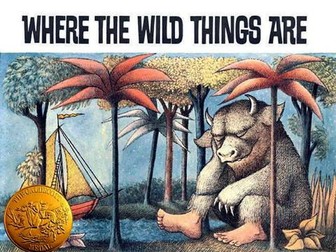
Talk For Writing Termly target: To use wow words, a range of openers, connectives and punctuation. Main outcome: Retelling a Fantasy Story through role play and writing. Text: Where The Wild Things Are. Monday: LO: I can explore a main character Tuesday: LO: I can describe a main character Wednesday: LO: I can write in role as a character Thursday: LO: I can use question marks (SPAG) Friday: LO: I can describe a setting Includes all resources for each day: Includes Guided Reading activity. Includes a weekly SPAG lesson. Includes teacher model of 'where the wild things are' to be used for Talk for Writing. Includes assessment grids.
Seven Out-of-the-Ordinary Valentine’s Day Customs : Reading ComprehensionQuick View
MariaPht

Seven Out-of-the-Ordinary Valentine’s Day Customs : Reading Comprehension

(0)
This Reading Comprehension worksheet is suitable for higher elementary to proficient ESL learners. The text describes a number of strange Valentine’s Day traditions from history! After carefully reading the text, students are required to complete some comprehension exercises including: True or False, a crossword, a fill in the gap exercise and a word search. The handout can be completed in class or assigned for homework. Ideally, it could be used around Valentine’s Day. A full answer key is included
Si tuvieras un tatuaje: Using the Conditional to describe your fantasy tattooQuick View
wumpus30

Si tuvieras un tatuaje: Using the Conditional to describe your fantasy tattoo

(0)
Every teen seems to fantasize about getting a tattoo, some of my student already have several. This activity is designed to get kids talking about what they would get using the conditional tense. The activity can be given out as homework for the day you introduce the conditional. The fun begins when they bring the assignment back the next day. I have put kids in small groups to share them out, but even more fun is to stick the assignment under a document camera and let kids see what their classmates have drawn. This assignment works best for a level III or higher class where students have been introduced to the conditional tense. There are some guiding questions to help students think about the tattoo of their dreams.
Father's Day ActivitiesQuick View
jlimb

Father's Day Activities

(0)
This animated Power Point has three humorous poems about Dads. One describes a Dad for every day of the week; another describes a Dad who is a super hero (but only up until 6pm when he relaxes into his slippers); the third suggests Dad is less than fragrant and could make birds fall from trees cross-eyed from the stench of his cheesy feet. A foot-note is added by Joe who can’t decide what to buy for Dad and needs assistance writing out his shopping list. Answer is included. A chocolate themed crossword is included which will appael to fans of Roald Dahl. This resource is ideal for Father’s Day and gives lots of suggestions for creative activities. Similar resources can be found in my shop https://www.tes.com/teaching-resources/shop/jlimb Suitable for all ages.
Pollution: a day at the sea-sideQuick View
jlimb

Pollution: a day at the sea-side

(0)
This animated Power point resource describes a day out at the sea-side for the Lute family who think they know all about pollution and yet show that their knowledge is as shallow as the sea lapping up against the litter with which they have decorated their sandcastle. The audience are requested to think how the family could have behaved differently and to question what their own families do on days out at the coast. Included is the famous riddle about St Ives and so the pupils can see how a small problem can be multiplied and that we should be all doing our bit by picking up the plastic one piece at a time. Ideal as a discussion starting point on the effects of pollution especially in a coastal setting and as the Summer holidays approach, a cautionary tale! This resource will stretch reading and comprehension skills as well as providing an opportunity to demonstrate maths skills at the same time… recommended for ages 8+
Describing Settings - Wild West ThemeQuick View
robwilk01

Describing Settings - Wild West Theme

(0)
A presentation that takes the children through how to expand nouns with adjectives through to writing a quality description of a Wild West setting. Includes work on 'phrases', 'similes' and how to drive around the scene using prepositions and noun starters.
At the beach: describing a seaside town and what you can do thereQuick View
madcatlady

At the beach: describing a seaside town and what you can do there

(0)
A day out a the beach using a Sentence Builder to describe a seaside town, what there is in a town and say why we like it, what you can do there We re-wrote our SoW to be more relevant to our local context and we love Skegness, our nearest seaside town You could of course change the name of the town to your closest resort, I hope it’s as fun as Skeg Lots of activities and EPI style content of course
AS Geography Coasts Revision 30 daysQuick View
anderssonn

AS Geography Coasts Revision 30 days

(0)
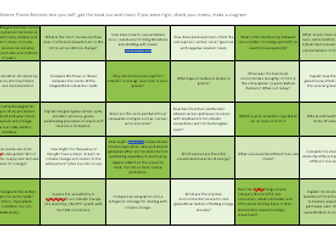
These are so useful for AS and A Level students, they find them a good way to trigger some investigation into their notes or the text book. My most recent A*-C group found them useful in class because if the students pick a question for a classmate there is no hiding, sometimes we have to ‘phone a friend’ and see if anyone can answer it, this shows up the gaps in knowledge and we make more notes, get the old lesson powerpoint out and recap what is missing. The theme of the question can also be used with multiple command words, this builds confidence and depth of knowledge. It is handy for working through from describe, explain, assess, evaluate, describe a case study, recall the facts you remember about… to compare that with and what is your standpoint in relation to,
AS Geography 30 days revision bundleQuick View
anderssonn

AS Geography 30 days revision bundle

4 Resources
These are so useful for AS and A Level students, they find them a good way to trigger some investigation into their notes or the text book. My most recent A*-C group found them useful in class because if the students pick a question for a classmate there is no hiding, sometimes we have to ‘phone a friend’ and see if anyone can answer it, this shows up the gaps in knowledge and we make more notes, get the old lesson powerpoint out and recap what is missing. The theme of the question can also be used with multiple command words, this builds confidence and depth of knowledge. It is handy for working through from describe, explain, assess, evaluate, describe a case study, recall the facts you remember about… to compare that with and what is your standpoint in relation to,