Powerpoints and scratch files showing clearly how to code a zombie game in scratch.
Two powerpoints showing how to first of all make a scratch game then how to add extras e.g. make it two player
Links to the youtube videos which were adapted into teachable powerpoints.
These lessons are very engaging for KS2, KS3/ KS4 and useful for game design.
Students will learn:
Use drawing tools
Be able to identify and use:
Events
Loops
Selection
Variables
Use problem solving skills to:
Create code in Scratch to control sprites
Develop code in Scratch – independently if possible
A set of 7 full lessons for KS3 (Year 7/Year 8) on Scratch Programming.
Lessons cover:
Lesson 1 & 2 - Introduction into Scratch, What are Sprites, How do we add a background, How do we add a sprite, How do we control sprites, What is looping/loops, Creating Variables in Scratch, Creating loops in Scratch, Creating a simple game of cat and mouse in Scratch.
Lesson 3 - Understand what a costume is and how to create one, Understand what broadcast means and where we find this code block, Finishing off the cat & mouse game in Scratch off.
Lesson 4 - Understand how to sense events and where to find this in Scratch, Understand what a variable is and where to find one in Scratch, Creating a game of shark attack in Scratch.
Lesson 5 - Understand what sensing is and how it is used in Scratch, Understand what a variable is and where to find them, Understand how to draw our own sprite using the paint feature, Apply our new knowledge to start creating a Flappy Bird game.
Lesson 6 - Understand what coordinates are, Understand how coordinates affect the movement of characters, Understand how to use the coordinates code blocks to move our character, Continue creating our Flappy Bird game.
Lesson 7 - Understand how to add pipes to our Flappy Bird game, Understand how to use operators to compare variables, Understand how to add a high score feature to our Flappy Bird game, Understand how to add instructions to our Flappy Bird game. Add to our game using the extension/challenge tasks.
Lessons include:
Teacher Slides PowerPoint
Student Worksheets (Word Documents)
Starter & Plenary Activities (Word Documents or in Teacher Slides PowerPoint)
Extension Tasks (Word Documents)
Extra Class Work - Scratch Booklet (Word Document)
Scratch is a visual programming language that makes coding simple and fun.
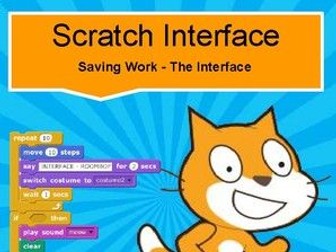
It can be used to create all sorts of programs. This package is a great resource to have your students follow. It will teach them about saving their projects in Scratch as well as working with the interface.
What You Get:
• Saving your work
• The interface
• Menu bar
• Stage area & Sprites
• Block Palettes
• Scripts Area
• Next steps
My Scratch Resources:
This resource is part of a numbered set. It can be used separately or in conjunction with my other Scratch resources. You can also get this resource part of my bundled Scratch Basics package here.
• Starting from Scratch (Basics #1) [FREE]
• Scratch: Interface (Basics #2)
• Scratch: Sprites (Basics #3)
• Scratch: Colored Blocks and Scripts (Basics #4)
• Scratch: Cat vs Dragon - Game Programming (Basics #5)
• Scratch Bundle: Basics To Your First Game (Value Pack)
21 pages
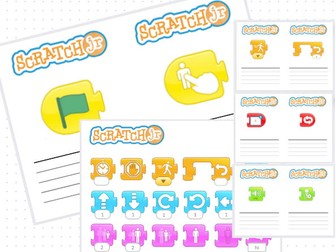
Two commands on each A4 page
Plus three sizes of cut outs (Small, Medium. Large)
Using cut-out blocks to teach coding and sequencing skills relevant to Scratch Junior can be a hands-on and engaging approach for children. Here’s how it can be done:
Mental Recall: Provide children with physical printed “blocks” representing different Scratch Jr commands and actions. Challenge students to pick a card and then explain the action it represents.
Sequencing Activities: Encourage children to arrange the cards in a sequence to create a series of actions or commands. Start with simple sequences, such as moving a character from one point to another, and gradually increase complexity as children become more proficient.
Algorithm Design: Teach children to design algorithms using the blocks to solve specific tasks or challenges. For example, they can design algorithms to navigate a maze, collect items, or complete a puzzle within Scratch Junior.
Debugging Practice: Introduce the concept of debugging by intentionally introducing errors into the sequences of blocks. Encourage children to identify and correct these errors to achieve the desired outcome.
Storytelling and Creativity: Encourage children to use the blocks to create interactive stories, games, or animations within Scratch Junior. They can sequence events, movements, and dialogues to bring their creative ideas to life.
Collaborative Projects: Foster collaboration among children by assigning group projects where they work together to design and implement coding sequences using the blocks. Collaboration not only enhances coding skills but also promotes teamwork and communication.
Reflection and Iteration: After completing coding activities using the blocks, encourage children to reflect on their process. Ask questions such as what worked well, what challenges they encountered, and how they could improve their sequences. Encourage iterative refinement of their coding designs based on reflection.
Integration with Scratch Junior: Once children are comfortable with coding concepts using the cards and manipulatives, transition to using Scratch Junior on a device. They can apply their understanding of sequencing and coding to create projects digitally within the Scratch Junior environment.
By using cut outs and flash cards to teach coding and sequencing skills, children can develop a strong foundation in computational thinking and problem-solving while having fun and being actively engaged in the learning process. This approach also provides a tangible and accessible way for children to understand abstract coding concepts before transitioning to digital platforms like Scratch Junior.
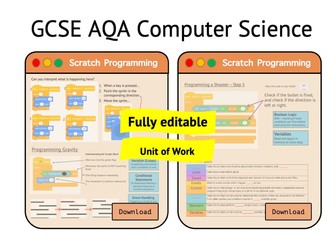
An easy to follow assessment based around Scratch and key programming concepts. Q1 covers “sequencing”, Q2 covers “variables”, Q3 covers “sequencing”, Q4 covers “operators” and Q5 covers “iteration” and “debugging”. There is an easy to follow mark scheme and a revision powerpoint which could be set as homework, prior to the assessment. It is ideal for KS3, especially Year 7 or 8 and is really well differentiated, as there are easy questions and then increasingly trickier ones. It can be set as an end of unit assessment or as a baseline test to find out how much students already know about key programming terms, such as sequencing, variables, selection and iteration.
Bring the excitement of game development into your classroom with this engaging tutorial on building Space Invaders in Scratch! This comprehensive resource includes everything you need to guide students through creating their own version of the classic arcade game. The tutorial is paired with a detailed class worksheet, a ready-to-use teacher’s PowerPoint presentation, and a fully functional model of the game.
This is perfect for introducing students to the fundamentals of programming, logic, and game design in an interactive and fun way. Suitable for beginners and adaptable for various skill levels, this tutorial will have students coding and problem-solving like pros in no time!
This activity pack contains five Christmas themed coding activities which can be used by students in KS2 and KS3. Students learn about sequence, selection and iteration, as well as how to use variables and arrays. All instructions on how to develop the code using Scratch 3.0 have been included, as well as several challenges for each activity. The pack is 35 pages and will take around 3 hours to complete all activities and challenges.
Activity 1 - Decorating the living room ready for Christmas - Make the Christmas decorations sparkle!
Activity 2 - Dancing Santa - Get Santa to dance - simple dances to choreographed dances.
Activity 3 - Christmas Gift Game - Christmas presents float around the screen and if you can click on a present you get to see what’s inside!
Activity 4 - Catch the Reindeer Game - In this game Santa has lost his reindeer (including Rudolph) and he has to catch them. At the same time he must avoid the dog pretending to be a reindeer.
Activity 5 - Naughty or Nice - In this activity Santa must check the Nice list before he gives a present.
The Python Programming Christmas Activities is designed for KS4.
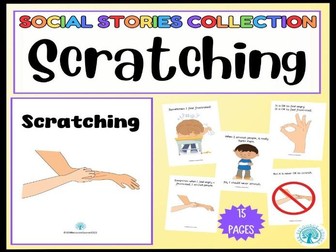
This social story is designed to help children understand why scratching others is hurtful and can make them feel upset. Using simple, child-friendly language, the story explains the importance of not scratching and provides alternative ways to express feelings, such as using words or asking for help. It encourages children to recognize the impact of their actions and offers strategies for interacting positively with others, promoting kindness and better emotional regulation.
What’s Inside?
Along with a 15-page social story, there’s also a shorter, adapted version with movable pictures to help engage children on each page.
Why Is This Social Story Helpful?
Social stories use a gentle and reassuring tone to teach children about social situations in a way that’s easy to understand. They are particularly useful for:
• Children who struggle to grasp social concepts.
• Learning social skills, social cues, and appropriate responses.
• Providing guidance on expectations, emotions, and problem-solving.
• Supporting autistic children who may find social interactions challenging and benefit from clear, structured explanations.
How to Use This Story Effectively
• Create a focused environment – Read the story in a quiet space with minimal distractions.
• Read it regularly – Start by reading it twice, then revisit it often to reinforce learning.
• Incorporate it into daily routines – Use the story as part of a structured schedule.
• Use it when needed – If the child struggles with apologising, read the story at relevant moments (without making it feel like a punishment).
• Encourage and praise – Keep the experience positive, reinforcing good behavior with encouragement.
Durability & Reusability
For long-term use, consider laminating and binding the pages or placing them in a display book. This allows for repeated reading and reinforcement, making the lesson more effective over time.
This engaging 5-stage scheme of work introduces students to Scratch programming through the creation of a fully playable platformer game using the online version of Scratch.
Designed for beginner to intermediate learners, this unit develops core computational thinking and programming skills while keeping students motivated through game-based learning. Each lesson builds progressively, allowing students to scale their projects from simple mechanics to more complex game features.
Unit Overview – 5 Progressive Stages:
Introduction to Scratch & Player Movement
Understanding the Scratch interface, sprites, movement, and controls.
Shooting Mechanics
Adding projectiles, events, and basic collision detection.
Baddies & Scoring
Creating enemies, scoring systems, and game logic.
Levels
Designing multiple levels and increasing game complexity.
Coins & Collectables
Implementing collectables, variables, and win conditions.
What’s Included:
Complete Scheme of Work
Scaffolded Student Support
Step-by-step guidance to support learners while encouraging independence.
Lesson Slides & Activities
Hands-on tasks in every lesson to learn Scratch features and apply them immediately.
Game Development Focus
Students create a working platformer game that can be extended into more advanced projects.
Why Teachers Love This Resource:
Perfect for KS3 / beginner programmers
Uses online Scratch (no installation required)
Clear progression and built-in differentiation
Encourages creativity, problem-solving, and perseverance
Minimal preparation required
Perfect For:
Introducing programming through Scratch
Game-based learning units
Computing clubs, cover lessons, or enrichment projects
Students who thrive with visual and interactive learning
Download now to deliver a structured, engaging Scratch programming unit that empowers students to design, build, and extend their own platformer games with confidence.
This Scratch-based quiz game is a fun and interactive way to assess students’ understanding of key computing concepts. Designed for KS3 learners, the game challenges students with multiple-choice questions while reinforcing programming logic and digital literacy skills.
This booklet allows teachers to undertake four activities, which cover (and exceed in places) the KS1 and KS2 programming elements of the 2014 Computing curriculum. In addition to step-by-step instructions, each activity contains an explanation for the relevant blocks of code. The booklet also includes a fifth activity, which covers some areas of the KS3 curriculum.
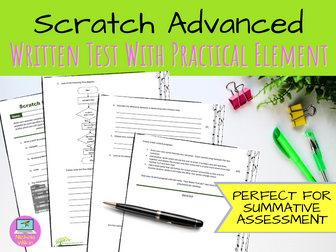
This end of unit test can be used to assess the pupils’ understanding of Scratch advanced features.
This resource includes the test (part written test and part practical test) and the answers to assist with marking.
This test takes most students 40 - 60 mins to complete.
FREE BONUS PRODUCT INCLUDED
As a special thank you for purchasing this product I am pleased to be able to also include a surprise FREE bonus gift. This gift is one of my complete resources for which I usually charge full price but is yours absolutely free when you purchase this product. Just my little way of saying thank you to my valued customers. I hope you enjoy it and get use out of it, with my compliments.
The “Bring Your Drawings Into Scratch” activity teaches learners how to import their own hand-drawn artwork into Scratch, transforming traditional art into digital creations. This process bridges the gap between physical and digital mediums, empowering students to combine their artistic and coding skills.
Everything here for a great KS2 or KS3 scratch lesson.
Make the snow fall in a fun snow scene.
All assets are included as we learn how to make the snow fall in this fun Xmas themed lesson!
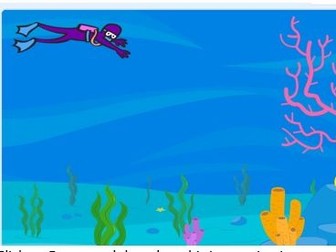
Step-by-step guide to show pupils and teachers how to code a scuba diver to swim in the ocean. A simple beginner’s guide for lower key stage two pupils.
**UPDATED for Scratch version 3 **
Click here for a full listing of all my Scratch Projects
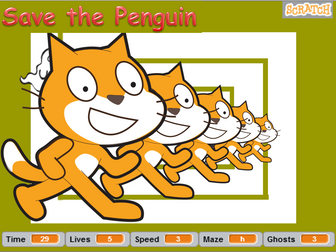
In this project, the player must move a sprite through the maze using the keyboard. Timers, obstacles (floating sprites) and a more difficult maze can be added as enhancements .
There are many sites offering Scratch Projects. However, many tend to be like recipes - students almost mechanically enter code and create “delicious cakes”, without learning a lot about Scratch.
My goal is to get students to create a fun project, and at the same time learn how the instructions work and fit together. I use the following approach:
- break the project into manageable chunks
- present “pseudo-code” for each chunk
- provide the Scratch commands to implement the pseudo-code, but jumbled up
In this way, students learn about pseudo-code (an important part of coding), and have to understand the Scratch instructions in order to sequence them correctly to match the pseudo-code.
The lessons comprise:
1. a PowerPoint with instructions
2. a Word document with the instruction slides printed 2 to a page as a handout
3. accompanying Scratch files for teachers that match each stage of the project
ALL my postings are FULLY “classroom-tested”, and continually updated. But there is always the possibility of error and room for improvement, so please provide constructive feedback.
Click here for a full listing of all my Scratch Projects
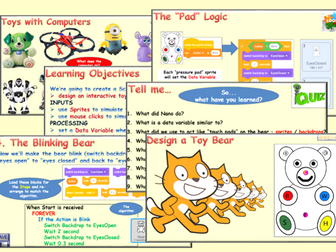
In this project, students create a toy bear, using sprites to simulate “touch pads” -making the bear smile, blink, change colour, etc. Enhancements include using the keyboard instead of sprites, and adding sound.
There are many sites offering Scratch Projects. However, many tend to be like recipes - students almost mechanically enter code and create “delicious cakes”, without learning a lot about Scratch.
My goal is to get students to create a fun project, and at the same time learn how the instructions work and fit together. I use the following approach:
- break the project into manageable chunks
- present “pseudo-code” for each chunk
- provide the Scratch commands to implement the pseudo-code, but jumbled up
In this way, students learn about pseudo-code (an important part of coding), and have to understand the Scratch instructions in order to sequence them correctly to match the pseudo-code.
The lessons comprise:
1. a PowerPoint with instructions
2. a Word document with the instruction slides printed 2 to a page as a handout
3. accompanying Scratch files for teachers that match each stage of the project
ALL my postings are FULLY “classroom-tested”, and continually updated. But there is always the possibility of error and room for improvement, so please provide constructive feedback.


 Quick View