ShakespeareQuick View
EnglishGCSEcouk

Shakespeare

(1)
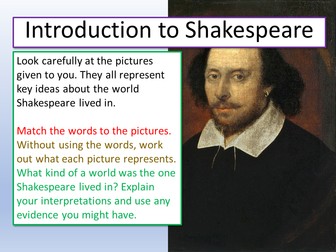
Shakespeare introduction! A fully differentiated and resourced lesson that introduces students to William Shakespeare’s, the world he lived in and explores the genres he wrote in as well. A great way to introduce any unit of work on Shakespeare that covers context but also specific elements of different genres of Shakespeare’s plays. Query or question? Get in touch at info@englishgcse.co.uk. Please leave a review if you are able to. Check out our English Shop for loads more free and inexpensive KS3, KS4, KS5, Literacy and whole school resources. AQA English Language Paper 1 and Paper 2 Knowledge Organisers AQA English Language Paper 1 Section A package AQA English Language Paper 1 Sections A and B package AQA English Language Paper 1 package AQA English Language Paper 2 Question 5 package AQA English Language Paper 1 Question 5 package AQA English Language Paper 2 Section A package AQA English Language and English Literature revision package An Inspector Calls whole scheme package An Inspector Calls revision package Macbeth whole scheme package Macbeth revision package A Christmas Carol whole scheme package A Christmas Carol revision package Jekyll and Hyde whole scheme package Jekyll and Hyde revision package Romeo and Juliet whole scheme package Power and Conflict poetry comparing poems package Power and Conflict poetry whole scheme package Love and Relationships poetry whole scheme package Unseen Poetry whole scheme package
Shakespeare Booklet: Exploring Shakespeare's World (KS3)Quick View
laurajholder

Shakespeare Booklet: Exploring Shakespeare's World (KS3)

(8)
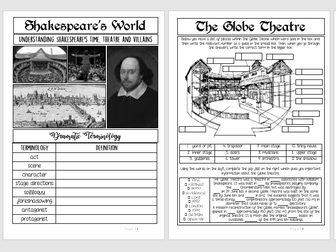
This is an extremely dense 12 page booklet with easily an entire scheme of work. This has been created to give year 7 an introduction to Shakespeare: to understand his life, works, times, theatre and to grasp how a script works. There are two pages which focus on Shakespeare’s villains (Don John and Iago) but in reality this is to simply expose students to Shakespeare’s life and characters rather than to complete in depth analysis of a plot and character. Although this was created with year 7 in mind it would fill a gap at any level of Key Stage 3 if students’ knowledge of Elizabethan England is lacking. Both the editable Word document and .pdf are provided - please note the word document may not appear like the booklet pdf because of font use and formatting. This booklet is also available as part of a Shakespeare bundle with two other KS3 booklets covering Shakespeare heroes and the idea of tragic heroes and Shakespeare’s relationships. The booklet is as follows: 1 - front cover and basic dramatic terminology glossary 2 - William Shakespeare information with space to create a fact file 3 - Shakespeare’s works - basic information, followed by a task to understand the difference between comedies, tragedies and histories then sorting key plays into each type 4+5 - a double page spread with a timeline across Elizabethan and Jacobean England. At the top students can create a timeline of historical events and then plot Shakespeare’s life underneath (perhaps using page 2) 6 - Elizabethan entertainment - 4 boxes for students to complete information about bear baiting, bull baiting, cock fighting and the theatre - I have attached the factfile made to accompany this lesson. 7- The Globe Theatre - A label the Globe picture followed by a gap fill about its history (in image) 8- Understanding a script - the first scene of Macbeth is used to explain the layout of a script, followed by a gap underneath for students to make their own mini script using a similar layout and features. 9- Stage directions- a list of common Shakespeare stage directions with definitions for students to match followed by some complex stage directions to "translate" 10 - An explanation of the character and his motives, an extract from the play (1.3) and a series of questions which track students through the extract. 11 - An explanation of the character and his motives,an extract from 1.1 alongside a modern translation followed by a series of questions. 12- a common words glossary where students should independently record new words learnt.
Shakespeare Richard III Whoosh TextQuick View
charlottenash15

Shakespeare Richard III Whoosh Text

(0)
Whoosh! text for Shakespeare’s history play, Richard III. A Whoosh is an activity based on Royal Shakespeare Company training and it’s an extremely useful tool to help engage students with the story of a play through drama-based pedagogy. It’s super useful for introducing the main events of plays and can be used whether the class are ultimately going to read the whole play or not. Acting out the scenes helps cement the events in pupils minds. Richard III, in particular, can be quite confusing so a Whoosh is a great way to introduce important characters which can then be tracked through the whole story. This text includes a summary of the important events of the play, with characters in bold for Whoosh purposes. The teacher can choose students to act out each part or students can jump up and choose themselves. There are also quotations embedded at strategic points. For reference, this Whoosh took about forty minutes with a group of Year 8 students.
SONNETS BY SHAKESPEAREQuick View
Raphella

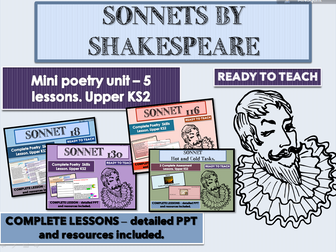
SONNETS BY SHAKESPEARE

4 Resources
A MINI UNIT OF 5 LESSONS, BASED AROUND THE SONNETS OF SHAKESPEARE. WRITTEN FOR UPPER KS2 (YEAR 6 ) BUT FULLY DIFFERENTIATED, SO EASILY ADAPTED. EACH LESSON INCLUDES A DETAILED PPT AND ALL RESOURCES.
Macbeth Mega Quiz - William ShakespeareQuick View
RavenResources

Macbeth Mega Quiz - William Shakespeare

(1)
A varied 1 hour to 1 hour 30 minute end of unit quiz or a good way to start revising Macbeth by William Shakespeare. Eight rounds with 75 questions appropriate for secondary school and college students (key stage 4 and 5, 11 to 18 year olds). Appropriate for teams or individuals (more fun with teams). Eight different rounds with a total of 75 questions (most with ten questions and an anagram round with five). The quiz will take between an hour and 1 hour 30 minutes to complete. A response sheet is included with a teacher’s sheet that includes all the answers. Round One: Character Anagrams Round Two: Context Multiple Choice Round Three: Who says what? Round Four: Word Meanings Round Five: What happens when? Round Six: Techniques and Terms Round Seven: Who am I? Round Eight: Complete the Quotation Tie breakers Students work through a highly visual PowerPoint answering questions in each round. The animations in the PowerPoint allow you to create interest and allow students time to answer questions. Examples of the Character Anagrams, Who says what?, Word Meanings, Techniques and Terms, Who am I? and Complete the Quotation are included to make instructions clear and accessible. The What says what?, Word Meanings, Techniques and Terms and Complete the Quotation have an electronic voice readings. Either turn on your speakers, or not, depending on your preference. Once the quiz has been completed, students mark the answers of the other teams and work through the questions that can create further discussion. Questions are appropriate to a secondary school and college aged student. The eight rounds of questions last for between 50 minutes and 1 hour (depending on how much time you give students to answer the questions). You can also give students longer to complete the questions. For example, the Who am I? clues could be left on the board to allow students to discuss possibilities in groups. The other questions in the quiz can be moved through at a brisk pace. Working through the answers takes between 15 and 20 minutes. You can slow the progress down or speed it up depending on your group or lessons. Whole quiz time: 1 hour to 1 hour 30 minutes. The PowerPoint can be edited and adapted allowing you to change any questions to suit your students. Try out the free end of term quiz.
SHAKESPEARE’S VILLAINS - A COMPLETE KS3 SOWQuick View
btmmadstuff

SHAKESPEARE’S VILLAINS - A COMPLETE KS3 SOW

(0)
An entire SOW which consists of 20 PPT LESSONS, RESOURCES, a MEDIUM-TERM PLAN and a KNOWLEDGE ORGANISER based on VILLAINS in SHAKESPEARE. Lessons include: Context, Society, Women, Religion and Beliefs, Theatre, Shakespearian Language (Cliches, Insults), Genres, Themes, ‘The Seven Ages of Man’, Protagonist, Antagonist, Tragic Hero which leads into some of Shakespeare’s well-known plays and their VILLAINS: ‘Romeo and Juliet’ (Tybalt), ‘Macbeth’ (Macbeth, Lady Macbeth, The Witches), ‘Hamlet’ (Claudius), ‘The Tempest’ (Caliban) leading up to a Reading Assessment based on an Evaluation of Lady Macbeth (Model PEEZA Paragraph, New Vocabulary, Sentence Starters, Planning Sheet etc). A fantastic SOW for Year 7’s and lower-ability Year 8’s and Year 9’s.
Julius Caesar - William Shakespeare – Shakespeare’s Use of Blank Verse and ProseQuick View
ftbnemesis

Julius Caesar - William Shakespeare – Shakespeare’s Use of Blank Verse and Prose

(0)
Julius Caesar - William Shakespeare – Shakespeare’s Use of Blank Verse and Prose A concise and professionally structured resource exploring how Shakespeare uses blank verse and prose to shape power, persuasion and audience response in Julius Caesar. This resource provides focused analysis of form as a political and dramatic tool, examining how blank verse creates control, elevation and rhetorical pressure, while prose can suggest ordinary speech, directness, scepticism or strategic plainness. It explores Brutus’s measured verse, Casca’s conversational prose, the commoners’ opening prose, and the contrast between Brutus’s funeral prose and Antony’s blank verse. Key features: Clear analysis of blank verse and prose as meaningful dramatic choices in the play Focus on Brutus, Antony, Casca, the commoners and the changing registers of Roman public life Exploration of iambic pentameter, prose, caesura, enjambment, antithesis, rhythm, register, hierarchy and persuasion Activities to reinforce and practise key concepts, including terminology, Brutus’s self-control, opening-scene prose, Casca’s prose, funeral-speech comparison, rhythm, interpretation and creative form transformation Detailed answer key included for straightforward checking and review
Shakespeare English Classroom DisplayQuick View
Cre8tive_Resources

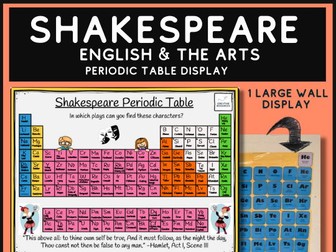
Shakespeare English Classroom Display

(0)
Shakespeare - English Classroom Periodic Table wall display of all the elements that link to this subject area. This display has a summary A4 page and then over 40 A4 pages to print and assemble into a fantastic large Shakespeare wall display. We have transformed the traditional science periodic table into a careers one displaying 118 Different terms closely linked to the same initials as all the original elements and this subject area This is a one off fantastic display resource that will grab staff and students attention. This resources come in a nice PDF and in the original editable PowerPoint version just in case you want to edit some of the jobs to make them more specific to your local labour market information. How could you use this resource? Print A4 Copies for students and use as a discussion prompt get students to colour code the jobs into categories of their own choosing Great for a huge open evenings display Brighten up up a dull classroom display down the hall or even your own… Give a copy to the pastoral department Minimal preparation required – Just print and go! ✰✰✰✰✰✰✰✰✰✰✰✰✰✰✰✰✰✰✰✰✰✰✰✰✰✰✰✰✰✰✰✰✰✰✰✰✰✰✰✰✰ You may also want to check out these other unique classroom displays; ☞ Careers Across Curriculum Classroom Display ☞ Emotions and feelings PSHE Display ☞ Maths Classroom Display ☞ Christmas Classroom Display ☞ Employability Skills Classroom Display ☞ Musical Instruments Classroom Display ☞ RSE Classroom Display ☞ Humanities and Careers Classroom Display ☞ Careers - PE and Sport Display ☞ PSHE Classroom Display ☞ World Travel Display ✰✰✰✰✰✰✰✰✰✰✰✰✰✰✰✰✰✰✰✰✰✰✰✰✰✰✰✰✰✰✰✰✰✰✰ Search ‘Cre8tive Resources’ for support with our library of resources or send us an email. Leave a review and email TheCre8tiveResources@gmail.com for a free resource as a thank you!! Explore all our resources on TES
Merchant of Venice - ShakespeareQuick View
Cre8tive_Resources

Merchant of Venice - Shakespeare

(0)
Merchant of Venice Escape Room Knowledge Escape Room Quiz - End of term fun for the whole class. No printing required! Just project the Powerpoint and off you go. Built in timers, Video clips and answer reveals after every slide. This is an educational fun immersive ‘Bank Heist themed Escape room’ experience. Have the students compete individually, in teams or as a whole class the choice is yours! This resource is a great team-building activity to keep your students engaged during the last few days (or week) leading up to the end of term. There are seven different challenging puzzles and you have the choice of setting the timer at easy, medium or high difficult level for each escape. Students will complete a variety of tasks using different skills including: problem-solving, critical thinking, reading comprehension, literacy challenges and some clever deduction. The puzzles, bonus questions and challenges are a fun way to assess a topic or subject area. This resource covers a variety of different elements including: vocabulary, key terms. key themes, general subject knowledge, literacy and much more… Merchant of Venice Escape Room is fully editable and takes less than 1 Minute to set up. Merchant of Venice Bank Heist Escape Room Contents ☞ Interactive 26 slide Powerpoint Escape Room Challenge ☞ Optional Escape Certificates ☞ Optional Team Sheet (Print it or use scrap paper instead) Common FAQ’s ★Group sizes: 1-30 students per team - (Participants up to 180) ★Time: Approximately 50-60 minutes (Provide hints along the way if time is a factor!) ★Materials: Aside from Powerpoint - all students need is a pen / pencil. How to run this escape challenge This escape room can be done without any printing we have however still included a team sheet (Slide 2) should you wish to use it, if not plain paper will more than suffice. The escape room is story driven by a YouTube video which is split into 9 sections. Introduction - Puzzle 1 – Puzzle 2 - Puzzle 3 – Puzzle 4 – Puzzle 5 – Puzzle 6 – Puzzle 7 - Success At various points you will be instructed to pause the video at these points you can go to the next slide in the presentation. Each video section (excluding Introduction and Success) will be followed by a puzzle. Every puzzle has three built in timers in the lower right hand corner to put the teams on a time limit of your choice if you so wish. Once the timer has expired or everyone has completed the puzzle teams can check their answers on the next slide using the CLICK TO REVEAL boxes. Once all answers for the current puzzle have been revealed move on to the next video section and subsequent puzzle until all 7 puzzles have been completed and everyone has escaped successfully (Optional) Give out winning certificates to the highest scorers.
IB  SL study and assessment guide to Shakespeare's Othello.Quick View
zakden

IB SL study and assessment guide to Shakespeare's Othello.

(0)
A comprehensive 60-page IB English A: Literature SL study and assessment guide to Shakespeare’s Othello. The resource combines detailed act-and-scene analysis with character, theme, imagery, symbolism, dramatic structure and stagecraft. Students explore race, jealousy, manipulation, gender, reputation, love, violence, evidence and appearance while developing understanding of IB concepts and global issues. Dedicated sections support the Individual Oral, Paper 1 analytical skills and comparative Paper 2 writing. Large-print pages, evidence-building tasks and extensive writing space make the guide suitable for classroom teaching, homework, independent study and examination revision.
Inference Loops (editable) ShakespeareQuick View
11rshields

Inference Loops (editable) Shakespeare

(0)
Get students to think more deeply - inference loops help students analyse language more effectively. This resources offers examples from Shakespeare’s Much Ado About Nothing, but can be adapted.
Complete 50-page study guide to William Shakespeare’s Antony and CleopatraQuick View
zakden

Complete 50-page study guide to William Shakespeare’s Antony and Cleopatra

(1)
Prepare students confidently for Cambridge IGCSE Literature in English 0475 with this complete 50-page study guide to William Shakespeare’s Antony and Cleopatra. Designed for the 2027 Paper 2 and Paper 3 Drama examinations, it provides clear five-act, scene-by-scene analysis, character and relationship studies, historical context, tragic structure, themes, symbols, language and stagecraft. Focused activities develop evidence selection, interpretation, personal response and examination technique. The guide supports classroom teaching, homework, independent revision and assessment preparation. Its accessible organisation helps learners analyse love, duty, empire, honour, identity, loyalty and mortality while producing thoughtful, well-structured literary essays with confidence, precision and greater insight.
Romeo and Juliet Mega Quiz - William ShakespeareQuick View
RavenResources

Romeo and Juliet Mega Quiz - William Shakespeare

(0)
A varied 1 hour to 1 hour 30 minute end of unit quiz or a good way to start revising Romeo and Juliet by William Shakespeare. Eight rounds with 75 questions appropriate for secondary school and college students (key stage 4 and 5, 11 to 18 year olds). Appropriate for teams or individuals (more fun with teams). Eight different rounds with a total of 75 questions (most with ten questions and an anagram round with five). The quiz will take between an hour and 1 hour 30 minutes to complete. A response sheet is included with a teacher’s sheet that includes all the answers. Round One: Character Anagrams Round Two: Context Multiple Choice Round Three: Who says what? Round Four: Word Meanings Round Five: What happens when? Round Six: Literary Techniques Round Seven: Who am I? Round Eight: Complete the Quotation Tie breakers Students work through a highly visual PowerPoint answering questions in each round. The animations in the PowerPoint allow you to create interest and allow students time to answer questions. Examples of the Character Anagrams, Who says what?, Word Meanings, What happens when, Literary Techniques, Who am I? and Complete the Quotation are included to make instructions clear and accessible. The What says what?, Word Meanings, Literary Techniques and Complete the Quotation have an electronic voice readings. Either turn on your speakers, or not, depending on your preference. Once the quiz has been completed, students mark the answers of the other teams and work through the questions that can create further discussion. Questions are appropriate to a secondary school and college aged student. Please note: Romeo and Juliet has two possible spelling of Friar Laurence/Lawerence. The quiz has adopted the spelling Friar Lawrence but the text of the slide can be changed to Friar Laurence, if that is your preference for your students. The eight rounds of questions last for between 50 minutes and 1 hour (depending on how much time you give students to answer the questions). You can also give students longer to complete the questions. For example, the Who am I? clues could be left on the board to allow students to discuss possibilities in groups. The other questions in the quiz can be moved through at a brisk pace. Working through the answers takes between 15 and 20 minutes. You can slow the progress down or speed it up depending on your group or lessons. Whole quiz time: 1 hour to 1 hour 30 minutes. The PowerPoint can be edited and adapted allowing you to change any questions to suit your students. Try out the free end of term quiz. Also Available: FREE Romeo and Juliet Task Cards.
KS3 Shakespeare Year 7 Unit – Shakespeare and Elizabethan England (20 Full Lessons)Quick View
11001584

KS3 Shakespeare Year 7 Unit – Shakespeare and Elizabethan England (20 Full Lessons)

17 Resources
KS3 Shakespeare Year 7 Unit – Shakespeare and Elizabethan England (20 Full Lessons) A fresh, student-friendly introduction to Shakespeare – building contextual knowledge, analytical skills, and creative confidence from the very start of KS3. This unique 20-lesson bundle takes a bold and engaging approach to teaching Shakespeare to Year 7 students. Rather than starting with a full play, this unit immerses learners in the world Shakespeare lived and wrote in, gradually building the knowledge, vocabulary and interpretive skills they’ll need for successful GCSE study. Through structured, accessible lessons, students explore: Life in Elizabethan England and Shakespeare’s theatre Universal themes like love, power, betrayal and ambition Key dramatic techniques such as soliloquies, irony, and comic relief Creative responses including short stories, soliloquy writing and poetry Extracts from Romeo and Juliet, Macbeth, and Shakespearean sonnets Every lesson follows a consistent format with: ✔️ A guiding Key Question ✔️ Vocabulary development tasks ✔️ A Focus Zone activity (analytical, creative, or performance-based) ✔️ Final reflection tasks ✔️ Supportive scaffolds and SEN-friendly structure throughout This scheme doesn’t just study Shakespeare – it helps students understand why he matters, how he wrote, and why his stories still resonate. Ideal for laying contextual and conceptual foundations in Year 7 and setting students up with confidence for KS4.
The Story of Shakespeare’s GlobeQuick View
PhilBrooks78

The Story of Shakespeare’s Globe

(0)
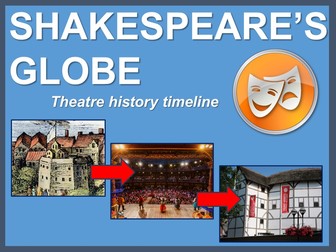
Step back in time to explore the thrilling story of Shakespeare’s Globe Theatre; from its fiery beginnings in 1599 to its stunning modern-day rebirth on London’s South Bank. This engaging, classroom-ready 15 slide resource brings history and drama to life for pupils aged 10–12, guiding them through the Globe’s remarkable journey of creativity, destruction, and restoration. Packed with a clear timeline, fascinating facts, and up-to-date modern statistics, pupils discover that Shakespeare’s world is far from old-fashioned; it’s still inspiring millions today! With over half a million visitors each year and thousands of pupils taking part in Globe workshops and performances, interest in Shakespeare’s plays remains as strong as ever, more than 400 years after his death. Perfect for teachers wanting to combine History, Drama, and English, this resource helps learners understand why the Globe continues to shine as a symbol of imagination, resilience, and the power of storytelling.
ShakespeareQuick View
TeacherCentral

Shakespeare

(0)
L1: Who was Shakespeare? Romeo and Juliet FREE - Lesson Two: Bundle Sow: https://www.tes.com/teaching-resource/romeo-and-juliet-12908632 This SoW is designed in detail and is both differentiated and engaging, and allows you to move pupils through content efficiently. Made to the highest standard and constructed using current research, both dual coding and retrieval practices are at the heart of this unit. A colour scheme also runs throughout to ease both your delivery and students comprehension. SoW: Can the World Ever Become Fully Developed? L1: Who was Shakespeare? L2: How is Romeo and Juliet Set Up By the Prologue? L3: Why is Act 1 Scene 1 Significant? L4: How Does Romeo’s Emotions Evolve Upon Meeting Juliet? L5: Why Does the Capulet Party Advance the Story? L6: How Do Romeo and Juliet Display Their Attraction to Each Other? L7: How Romeo and Juliet Present Themselves to Each in the Balcony Scene? L8: What is the Significance of Friar Laurence? L9: Why is the Nurse Included in Romeo and Juliet? L10: How Do Mercutio and Tybalt Change the Direction of the Story? L11: How Does the Story Develop After Tybalt’s Murder? L12: How Does the Presence of Paris Complicate the Story? L13: What are the Strengths and Weaknesses of Fairer Lawrence’s Plan? L14: How does Friar Lawrence’s Plan Start to Go Wrong? L15: How does this Story of Romeo and Juliet End? If you leave a review of any of our resources, you can claim any **FREE ** single resource from our ever growing library. Simply message the above email, which is monitored daily. teachercentralltd@gmail.com
Sonnet 116 (William Shakespeare)Quick View
Sazo123

Sonnet 116 (William Shakespeare)

(5)
A powerpoint designed to help students understand the poem Sonnet 116. Students are given details of the social and historical context of the poem, and then asked to annotate it, looking specifically for certain items and features.