Defending a CastleQuick View
mrshopehistory

Defending a Castle

(5)
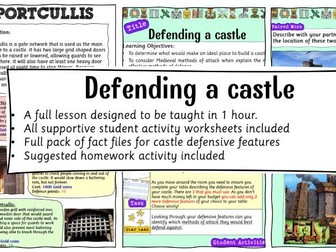
A well presented lesson on the defensive features of Medieval castles created for KS3 history students on Microsoft Powerpoint A little about the lesson Students are encouraged to design their own castle and its defences. Students are provided with a king-sized budget and challenged to research and to buy the latest medieval castle defences. Students must therefore consider effectiveness against budget. When considering castle defences students are challenged to use prior knowledge on the most effective and damaging methods of attack. This is a lesson that excites students and really engages them in their learning. Take it a step further and challenge groups to ‘duel off’ against each others castles. Whats included? A whole 1 hour lesson powerpoint is included (there are teacher notes also under some slides). Student worksheets/resources are included in hidden slides in the relevant points of the presentation and also as an additional Powerpoint for ease of printing. Homework, Learning Objectives and outcomes have also been completed in this resource, however, they can easily be tweaked to suit the needs and ability of your classes. Keep an eye out for more new and updated lessons in my store and my weekly tutor time quizzes! If you enjoyed this lesson, please review and check out my other lessons in this scheme of work looking at ‘How did William keep control of England after 1066’? Motte & Bailey castles Stone keep castles Attacking a castle The Feudal System Harrying of the North
Medieval Castle LifeQuick View
RAResources

Medieval Castle Life

(0)
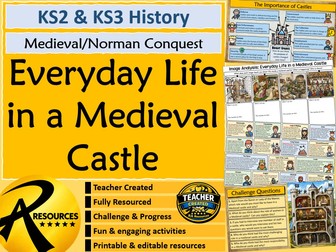
In this lesson, students will investigate the various roles and jobs which took place in a Medieval castle. They will then use the information from the lesson to complete a variety of activities. The lesson includes the following printable resources: 1 x fact sheet about life inside a Medieval castle 1 x worksheet (various tasks) 1 x Diary writing frame 1 x Crossword The main Power Point for the lesson includes: Title page and lesson aims Starter tasks and discussions Key term activities Background information about life inside a Medieval castle A choice of tasks activities A choice of learning reviews including a crossword (answers revealed). All images used in this lesson are in the public domain and are therefore copyright free at the time of publishing. Images which require attribution have been attributed in the notes section of each slide where the image appears. If you feel any errors have been made, please contact me at raschoolresources@gmail.com in the first instance to resolve any issues. My lessons are completed using PowerPoint and designed on widescreen formatting. Thank you. This resource is for personal use only and for copyright reasons should not be copied/amended for commercial use. The lesson is property of RA Resources.
Year 1 Making CastlesQuick View
ventori

Year 1 Making Castles

(0)
This is a complete unit for D&T making castles. This contains presentation, lesson plans, all the worksheets (which I would normally print as a booklet) and resources you would need. Everything is editable if you want to make changes.
Attacking a castleQuick View
mrshopehistory

Attacking a castle

(1)
A well presented lesson on the ways and effectiveness of attacking castles in Medieval times. Students are engaged through detailed resources. I would recommend printing out on A3/in colour and laminating resources for re-use. MAP/HAP worksheet included and colour coded to suit. This could easily be adapted further for LAP students to access.
AQA Norman England - Historic Environment 2026 Pevensey CastleQuick View
Rhurst2012

AQA Norman England - Historic Environment 2026 Pevensey Castle

(0)
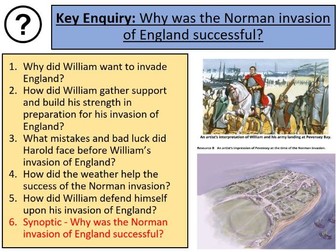
Complete set of lessons and resource for the Norman England 2026 Historic Environment - Pevensey Castle. The lessons have been designed around the factor of ‘cause and consequence’: However, these could be easily adapted if you believe the concept will be different. E.g. Q4: The reason for the success of the Norman invasion was… We teach these lessons stand alone before the control section so have already taught 1066. Lesson 1: Why did William want to invade England? Lesson 2: How did William gather support and build his strength in preparation for his invasion of England? Lesson 3: What mistakes and bad luck did Harold face before William’s invasion of England? Lesson 4: How did the weather help the success of the Norman invasion? Lesson 5: How did William defend himself upon his invasion of England? Lesson 6: Synoptic - Why was the Norman invasion of England successful? Resource Booklet Knowledge Organiser Sheet Each lesson starts with a retrieval grid which can be easily populated with questions from your topics. Disclaimer - This resource set was done using the AQA resource booklet. There is actually limited information on Pevensey as a castle and is very different to the last time this site was used.
Medieval Castle Attack & Siege Strategy Game (Open Day/Night or Transition)Quick View
RAResources

Medieval Castle Attack & Siege Strategy Game (Open Day/Night or Transition)

(0)
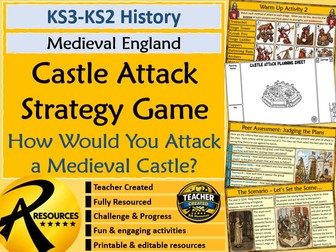
This resource is a fun addition to any unit about Medieval castles and from personal experience has been great for Year 6/7 subject transition days and school open evenings. Following a recap of Medieval weaponry, students work as a team or individually to plan either a castle siege or castle attack based on a list of costings. This resource contains: 1 x Castle game costings list (PDF & PPT) 2 x Castle game rules worksheets/printouts 1 x Main Power Point which includes: Slide 1: Title slide Slide 2-3: Recap Activity covering the main weapons of castle attack such as trebuchet, siege ladders, archers etc. Slide 4-5: Recap Activity 2 covering the images of castle attack weapons Slide 6: Setting the scene for the castle attack to give the attack historical context. Slide 7-10: A choice of three castle attack sheets each with a slightly different castle (stone keep, concentric and motte and bailey). These need to be printed out onto A3 Slide 11-12: Peer Assessment cards Slide 13: Learning Review All images used in this lesson are in the public domain and are therefore copyright free at the time of publishing. Images which require attribution have been attributed in the notes section of each slide where the image appears. If you feel any errors have been made, please contact me at raschoolresources@gmail.com in the first instance to resolve any issues. My lessons are completed using PowerPoint and designed on widescreen formatting. Thank you. This resource is for personal use only and for copyright reasons should not be copied/amended for commercial use. The lesson is property of RA Resources.
Castles IntroductionQuick View
EC_Resources_EXTRA

Castles Introduction

(2)
Perfect for a Medieval History Unit for Year 7. This lesson allows students to explore and discover different types of castles, why they were built and how they changed over time. Great for practicing source work and extended writing tasks, with clip and other tasks also included. The lesson will last up to two hours and is detailed, editable and suitable for KS3. The download includes: a detailed PowerPoint, differentiated tasks, a variety of activities, clip tasks, exam-style practice plenary, peer teaching tasks and more. It’s very easy to follow and can be used straight away :) If you are happy with your resource, please leave us a review! If, by any chance, you encounter any issues with the resource, please email us at historygeeksuk@gmail.com and we’ll try to solve them for you. Many more history lessons - both inexpensive and free at our store: HISTORY GEEKS
William of Normandy and Castles in EnglandQuick View
jess_weeks28

William of Normandy and Castles in England

(0)
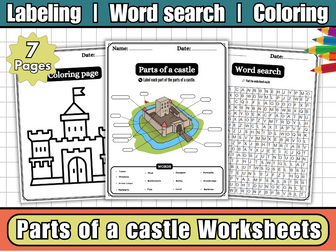
After William defeated Godwinson, he used castles to help gain control of England. This presentation is on the different types of castles. There is a castle to label, and a worksheet on castles. KS3 Y7.
The Development of Castles - How and why did castles change over time?Quick View
M1nstrelResources

The Development of Castles - How and why did castles change over time?

(1)
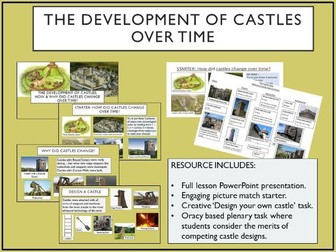
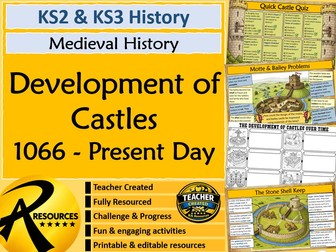
This lesson looks at the development of castles from the earliest Motte and Bailey style castles to the sophisticated concentric castles of the 15th century. The lesson is aimed at students in KS3 and focuses on the main features of attacking and defending castles and how this influenced the development of castles over time. The lesson begins with an engaging starter which introduces the students to different types of castles. Students then acquire knowledge of how and why castles changed over time before moving onto the main task of the lesson. This is an active learning task which involves the students designing their own castle based on their understanding of the strengths and weaknesses of various castle features. The final task involves students debating the effectiveness of their castle designs to evaluate the success of their creations.
Shape Castles- design a castle and identify 2d shapes usedQuick View
coolclassroom

Shape Castles- design a castle and identify 2d shapes used

(0)
A fun cross-curricular way of developing identification of 2D shapes. With 2 printable sheets, your class can design their own individual castles. There are examples included that the class gain inspiration from. Once complete, can you identify which shapes they have used and how many of each. They can write this on the special scroll.
Norman Castles - Norman ConquestQuick View
PilgrimHistory

Norman Castles - Norman Conquest

(1)
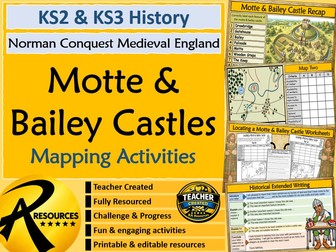
This lesson further explores the theme of William the Conqueror’s control and tightening grip on England as rebellion and opposition dominate his early years. Students will study William’s castle building program, from the Motte and Bailey through to stone keep castles and analyse their strengths and weaknesses. They will question why the Normans placed their reliance on these eye sores and how their features gave them control and defence against a hostile population. Furthermore they will evaluate how much control he was able to exert over the population using a control ‘o’ meter. Finally there is an interactive question and answer session with an Anglo-Saxon castle builder at the time who has some interesting things to say about his compliance in all of it. This lesson is therefore designed to be fun, challenging and engaging. The lesson is enquiry based with a key question using a lightbulb posed at the start of the lesson and revisited at the end using a rate ‘o’ meter to show the progress of learning. The resource is differentiated and gives suggested teaching strategies. It comes in PowerPoint format which can be amended and changed to suit.
Medieval Stone Keep Castle DiagramQuick View
nichola_gammogo

Medieval Stone Keep Castle Diagram

(0)
This is a simple diagram outlining all of the new advantages that the Stone Keep Castle had over the Motte and Bailey Castle. It can be edited by teachers. Ideal for sticking in exercise books.
Pevensey CastleQuick View
liam0001

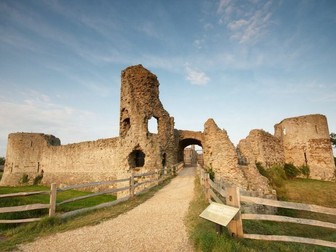
Pevensey Castle

(1)
Describe Pevensey Castle. Explain the features and functions of Pevensey Castle. Lesson Objective: to what extent does the study of Pevensey Castle reflect Norman attitudes? AQA GCSE History: British Depth Studies: Norman England, c1066–c1100 - The Normans: Conquest and Control. The resources are also suitable for Edexcel, OCR, WJEC GCSE History and iGCSE History. Each lesson is fully inclusive and differentiated to challenge high-attaining students, whilst offering support to students with SEND and low-attaining students. The resources that I have created have helped my GCSE History classes achieve and sustain results that far exceed the national average: 2024 P8: +0.49 2023 P8: +0.25 2022 P8: +0.87 and +0.33 2021 P8: +1.42 2020 P8: +0.47 2019 P8: +0.57 My average P8 since 2019 is +0.63 and my GCSE History classes consistently attain the most Grade 9s in any subject and/or class at my current school of over 1300 students. I have worked with the examination boards for over 12 years, and I have utilised feedback from students, fellow professionals, experienced colleagues and used my own professional judgement to ensure that each resource will help you to teach quality history lessons so that each student achieves their personal best. I am proud to be recognised as a ‘Gold’ TES Author, a status awarded to top-rated contributors. My 5-star resources, recommended by TES, have been trusted by educators around the world and have been downloaded nearly a million times to help students achieve success. Copyright Protection ©
I'm the King of the Castle bundle and scheme of workQuick View
jhbriggs

I'm the King of the Castle bundle and scheme of work

(1)
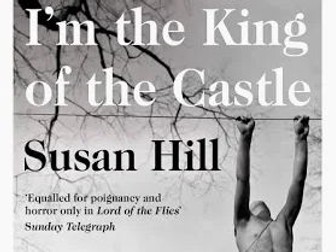
A full scheme of work and chapter by chapter set of resources, powerpoint, essay questions, extracts to annotate. Plus end of unit resources, quiz and fun activities for the end of term. You won’t need anything else to support your planning and teaching of this IGCSE text.
CastlesQuick View
sarahbaker73

Castles

(17)
This is a thoughtful song about the stories and history of castles. I hope it will provoke discussion about what castles were used for and about how they are portrayed in stories as well as their role in our documented history.
CastlesQuick View
choralsongster

Castles

(11)
A PowerPoint on early castles, looking into motte and baileys and then onto stone castles
Castle attackQuick View
Ciaran s

Castle attack

(2)
Based on the Norman conquest pupils place themselves in the role of the English trying to attack a Norman castle. They can buy equipment to plan and attack the castle with. They have a piece of writing to do to justify and evaluate their plans. They have some sources to help with their planning.
The development of castlesQuick View
timjohnson100

The development of castles

(19)
Students carry out Dragon's Den style pitches. The information to help with the pitches is on the final few slides on the PPT. Credit for the idea for this resource needs to go to one of my department Miss N Brown.