A fully resourced personification lesson on the theme of Remembrance Day and the poppies in Flanders Fields.
Includes:
An interactive teaching powerpoint
An example Remembrance Day poem including examples of personification
A writing template to support
Vocabulary lists
A range of poppy borders with different sized lines
Let your students creativity flow with this poetry pack for REMEMBRANCE DAY including acrostic, haiku & more!
ACROSTIC: Remember, Poppy, Poppies.
HAIKU: Planning with instructions to crate word bank and how to make a haiku & write up sheets in colour and black and white.
REMEMBER WHEN: Planning sheet for children to brainstorm ideas of what would have happened on that day.
BLANK TEMPLATES: colour and black and white with Remembrance Day poem by:_____ with poppy and frame.
Each planning sheet and write up sheets comes in both colour and black and white.
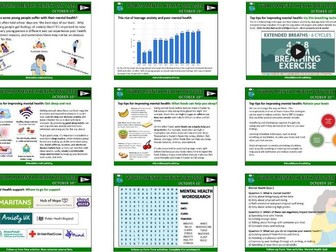
An assembly to support work during World Mental Health Day in October. This highly dynamic presentation has an assembly plus a range of ideas and resources for follow-up form time activities.
This beautifully-designed and editable 26-slide Powerpoint presentation creatively presents information on this event and can be showcased to any age group and includes specific pages for primary or secondary students. It includes images, dynamic transitions, informative text, video and links for extension work in form time – including extra video and classroom activities.
Slide 1: What is World Mental Health Day? Includes video.
Slide 2-3: Why do some young people suffer with their mental health?
Slide 4: This rise of teenage anxiety and poor mental health [inc national research graphs]
Slide 5: Top tips for improving mental health: Breathing exercise. Includes video.
Slide 6: Top tips for improving mental health: Move more. Includes video.
Slide 7: Top tips for improving mental health: Sleep habits.
Slide 8 and 9: Top tips for improving mental health: Healthy eating. Includes video.
Slide 10: Top tips for improving mental health: Get outside. Includes video.
Slide 11: Top tips for improving mental health: Be social.
Slide 12: Top tips for improving mental health: Retrain your brain
Slide 13: Closing Thought
Slide 14: Follow-up form time activities title screen
Slide 15: Form time activities: Support links to explore
Slide 16: Form time activities: Art activity
Slide 17: Form time activities: Wordsearch activity
Slide 18: Form time activities: Poetry activity
Slides 19-23: Form time activities: Mental Health quiz – with answers
Slides 24-25: Other form time ideas to support anxiety strategies.
As reviewers have stated for previous resources shared:
“I sat down to plan my assembly for next week and found this resource, and it’s perfect. The best £2 spent. Thank you. I can teach this straight from the slides.”
“Just buy it!”
“Your resources have been life savers!”
“Well worth the money and really saved my life”
“I just wanted to say that as a non-specialist these resources are worth every single penny! Thank you so much for making and sharing them.”
“Blown away by this! Can’t thank you enough!”
“They have saved me a huge amount of time and the detail that goes into your work is second to none. You put others to shame who charge twice as much for very little. Can’t thank you enough.”
“Your new spec resources are saving me hours & hours of work! Thanks, they are really good.”
“These resources are so useful - I cannot tell you how much time they have save me - very clear to follow and easy to adapt for revision material — well worth the money”
Celebrate World Poetry Day: Inspire Creativity, Expression, and Literary Exploration!
Celebrate World Poetry Day with this captivating and interactive assembly presentation, designed to introduce the beauty of poetry and its power to express emotions, stories, and ideas. Perfect for schools, community groups, and literary programs, this presentation highlights the importance of poetry in culture, language, and personal expression.
Explore different types of poetry, discover famous poets, and learn how poetry can ignite creativity and connect us to the world around us.
Why choose this presentation?
Educational and Inspirational: Provides an engaging overview of World Poetry Day, highlighting key poets, poetic forms, and the history of poetry as an art form.
Encourages Creativity and Self-Expression: Promotes discussions on how poetry can be a powerful tool for expressing thoughts, feelings, and ideas in a creative and personal way.
Interactive Ideas: Offers fun, hands-on activity suggestions like writing your own poems, exploring different poetic forms, and analyzing the impact of words through poetry readings.
Visually Engaging: Designed with vibrant visuals, accessible language, and multimedia elements to make poetry come alive for audiences of all ages.
This assembly presentation is an excellent resource for celebrating World Poetry Day, fostering creativity, and inspiring students to discover the power of words.
This is a Key Stage 2 or 3 assembly for Remembrance Day. It begins with the story of two men who were recruited into the army to fight in the First World War - it focuses on their different fates. It then includes some WW1 poetry followed by the red/white poppy debate.
Powerpoint on World Poetry Day. Including What, Why and How as well as example poems and discussion questions for KS1-KS5. I have included the text and audio of each poem as well as a number of discussion questions. KS2-4 poems would be interchangeable with differentiated questions.
An engaging KS2 assembly to celebrate World Poetry Day in your school.
Includes a 36 slide PowerPoint, 8 famous poets from around the world, 8 poems, map skills, higher level thinking questions and role models.
This assembly teaches the children about 8 famous poets from around the world introduced with a short biography and a famous poem they have written. All the poems are short, relevant for KS2 and inspiring. Includes map skills, higher level thinking questions and inspirational writing role models.
Each country has a map, flag and landscape picture to develop geographical understanding as well.
Reasoning questions and answers about each poem are provided and time at the end of the assembly to reflect and look forwards.
Celebrate World Poetry Day every year on March 21st to encourage diversity, a shared understanding and endangered languages around the world.
Use this assembly to inspire your pupils to become writers whilst developing their understanding of how everyone in the world has the same questions and feelings. Show them how poetry can capture the creative spirit of the human mind.
All reviews welcome.
You might also be interested in my packs of poems and lessons:
India Culture Poem Collection
Arctic Tundra Poem Collection
5 Reading Lessons on Writing Poetry
5 Reading Lessons on Performing Poetry
This is a FREE resource by Bob Cox to help you celebrate World Poetry Day.
Poetry allows children’s creativity to flourish in more ways than one. This is a day that helps celebrate creativity in writing.
Use this lesson plan to explore Kate Wakeling’s poem, ‘My Treasures’ and encourage your pupils to write their own poetry.
This KS2 World Poetry Day PowerPoint introduces pupils to poetry in an engaging, accessible and inspiring way. The presentation explores what poetry is, the different forms it can take and why poets write. Pupils are introduced to a range of poetic features, examples from well‑known poets and opportunities to analyse, discuss and respond to poems. The PowerPoint also includes interactive tasks and a guided activity to help pupils create their own poem, encouraging creativity, vocabulary development and confident self‑expression. Ideal for English lessons, assemblies or creative literacy sessions, this resource supports pupils in developing a deeper appreciation of poetry and its place in cultures around the world.
Some visuals in this resource were made with AI to help bring ideas to life and support student understanding.
7 pages of poems ready to print with photos and pictures including title page
Contents:
1 My body
2 My Rabbit
3 Fed up of Winter
4 Spring
5 Hurrah for Snow
6 Summer has Arrived
7 Summer
8 Rain
9 Grumpy Goat
10 Polly Parrot
11 Three Little Pigs
12 Washing Day
13 Addicted to Phones
All of my resources are created using the Widgit software program ‘Communicate in Print’
Permission has been granted for me to use their symbols and pictures.
Poems are all my own work
Please rate if you download
Thank you for looking
This PowerPoint presentation celebrates World Poetry Day, a global event dedicated to honoring the art of poetry and its impact across cultures. In this presentation, we’ll explore the history and significance of World Poetry Day, discuss the ways poetry inspires and connects people, and highlight key figures and forms in poetry. Through this celebration, we aim to inspire appreciation for the beauty and power of poetic expression, encouraging everyone to find and share their voice through verse.
National Poetry Day:
https://www.tes.com/teaching-resource/resource-13329116
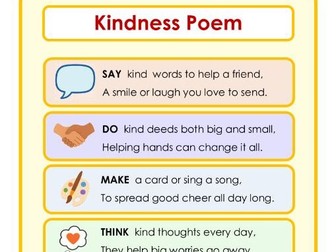
A poem to celebrate World Kindness Day, which links to the six acts of kindness I have made a poster for.
Say kind words
Do kind deeds
Make something thoughtful
Think kindly of others
Give freely
Listen with empathy
Children could use the template attached to write their own kindness poem!
A detailed lesson on The Soldier by Rupert Brooke that explores attitudes before 1914 and how these changed as the First World War progressed. The lesson includes differentiated activities throughout, as well as detailed notes on the poem, a model paragraph, scaffolds, a range of engaging tasks to make war poetry relevant and interesting for students and more. Useful for Remembrance Day as well.
Inspire your pupils with this KS1 assembly celebrating World Poetry Day.
Includes an engaging PowerPoint, 4 poems, geography map skills, video link, reasoning questions and interactive activities.
This ready-to-go 27 slide PowerPoint leads you through the assembly explaining World Poetry Day and poetry. Read the children 4 world habitat poems written about environments from across the globe.
Choose poems from a world map, before reading about the animals, landscape and climate of jungles, grasslands, deserts and the arctic. Enhance geography skills whilst developing vocabulary and a passion for poetry.
An engaging video is included to provide a range of role models who clearly enjoy reading poetry and bringing it to life.
Celebrate World Poetry Day every year on March 21st to encourage diversity and a shared understanding of the world.
Use this assembly to inspire your pupils to become writers, enjoy the video link of a range of people reading a poem about how poets can write anywhere.
Check out my other popular KS1 assemblies:
Mental Health Awareness Week KS1 Assembly
Albert Einstein KS1 Assembly
Charles Darwin KS1 Assembly
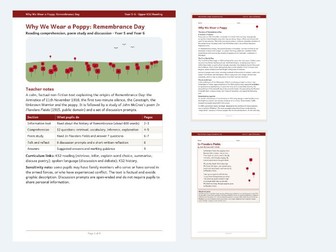
A Remembrance Day comprehension for Year 5 and Year 6: why we wear a poppy, the Armistice and the poem In Flanders Fields.
A calm, factual text about the history of Remembrance (the Armistice, the two-minute silence, the Cenotaph, the Unknown Warrior and the poppy), plus a study of “In Flanders Fields”, discussion prompts and full answers. Print-ready PDF, 9 pages.
Explain why we wear a poppy with a respectful, accurate reading pack for Upper KS2.
What’s included (9-page A4 PDF):
Teacher notes with a sensitivity note (some pupils have family in the armed forces or have experienced conflict)
“Why We Wear a Poppy”: about 600 words covering the First World War (including soldiers from India, the Caribbean and across the Empire), the Armistice at 11am on 11th November 1918, the first two-minute silence in 1919, the Cenotaph and the Unknown Warrior (1920), Moina Michael, Anna Guérin, the first Poppy Appeal (1921), and Remembrance today (red, white and purple poppies)
12 comprehension questions with marks: retrieval, vocabulary, inference, sequencing, true/false and explanation
The full text of “In Flanders Fields” by John McCrae (1915, public domain), background notes and 7 poem questions (speaker, imagery, rhyme, the “torch” metaphor, repetition)
“Talk and reflect”: 8 open discussion prompts and a written reflection for a class display
Answers and marking guidance
Name/date line on pupil pages. British English spelling. Clear, dyslexia-friendly font.
This resource was created with AI assistance (Claude), then fact-checked and proofread in a separate review pass.
Need an engaging activity to lead your students in this WORLD POETRY DAY?
Need to get your students interested in and responding to key texts?
If so, you’re in the right place!
Includes:
-Clear instructions
-A diverse selection of poems to print for students to work on
-Assessment Criteria
-Exemplar work & ideas
Ignite the spirit of creativity and appreciation for literature with our captivating PowerPoint presentation designed for World Poetry Day assembly. This comprehensive and visually engaging resource is tailored to inform and inspire students about the significance of poetry as a universal art form.
Our PowerPoint presentation is thoughtfully crafted to capture the essence of World Poetry Day, highlighting its origins, purpose, and global significance. Through dynamic visuals, informative text, and interactive elements, students will gain a deeper understanding of the role poetry plays in expressing emotions, exploring cultural identities, and fostering empathy and understanding among diverse communities.
Special World Poetry Day Presentation: To Be or Not to Be?
The special lesson about the origin and the impact of The World Poetry Day which is celebrated on 21st of March, 2018.
The lesson contains 12 slides.


 Quick View