Teaching atoms, elements and compounds at KS3 and GCSE

Explore teacher‑made lessons and activities designed to save time when covering atoms, elements and compounds

Tes Resources Team

Diagram of an anatomic structure

Support your teaching of atoms, elements and compounds in KS3 and GCSE science with this selection of lessons, activities and worksheets

Understanding atoms, elements and compounds is core to teaching chemistry and physics in secondary science and we know how important it is to find simple, engaging ways to support student understanding and development as they transition from KS3 to GCSE. At KS3, pupils are introduced to the particle model, learn what atoms and elements are and how to recognise differences between compounds and mixtures using simple symbols, formulae and word equations. As they transition into GCSE science, students revist these foundations and develop their learning through more detailed study on atomic structure, electron configuration, bonding and chemical calculations.

To support teachers with the planning and delivery of this topic, we’re showcasing a range of teacher‑made resources that break down tricky concepts, offer visual and practical explanations and offer students opportunities to practise and apply their knowledge. So whether you’re laying the foundations in KS3 or supporting GCSE learners with bonding and equations, these hand picked resources will help you bring the topic to life and strengthen student understanding across the secondary years.

Resources for KS3

Support students develop their first meaningful understanding of the particle model and how matter is structured with these resources created by our author community.

Atoms ~ KS3 ~ Year 7
Dr_Troilo

Atoms ~ KS3 ~ Year 7

(1)
Key stage 3 ~ year 7 ~ complete lesson on atoms. In this lesson students will learn how to state what an atom is, explain how one atom is different from many atoms together and relate what they have learned about particle theory and elements to atoms. Extension questions are included on the slides ...
States of matter KS3 complete lesson
adampo

States of matter KS3 complete lesson

(8)
Complete self contained PowerPoint lesson for States of matter KS3 science. Aimed at KS3 pupils (11-14) but is also suitable used a lower ability GCSE KS4 (14-16) class. No additional resources required to deliver the lesson, part of the particle and matter unit. Lesson objectives: * Describe the p...
Elements, Compounds and Mixtures Workbook
bethgrace2312

Elements, Compounds and Mixtures Workbook

(3)
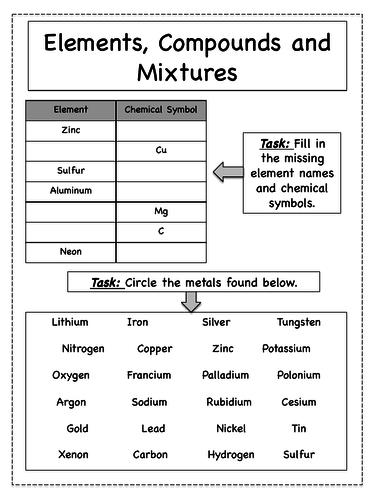
Lesson Workbook This resource is a ten page lesson booklet on the subject of elements, compounds and mixtures. Included within this workbook: * Key Definitions * Diagrams * Element Factfile Task * Simple Reaction Equations * Atoms and Elements in Compounds * Mixture Separation Techniques * Example...
Energy Transfer: Particles
OuttheBoxScience

Energy Transfer: Particles

(1)
KS3 new for the Activate 2 unit Energy . Full lesson ready to use straight out of the box . Similar structure to my other power points following the input - activity - review phasing plenary sections for progress checking Clear learning objectives and outcomes Modern and engaging layout ...

Resources for GCSE

Understanding atoms, elements and compounds forms the foundation of secondary chemistry, and it’s a topic that grows in depth from KS3 through to GCSE. Explore some hand-picked resources our science teachers have created for this topic.

1 Atoms Elements and Compounds
j_claridge

1 Atoms Elements and Compounds

(2)
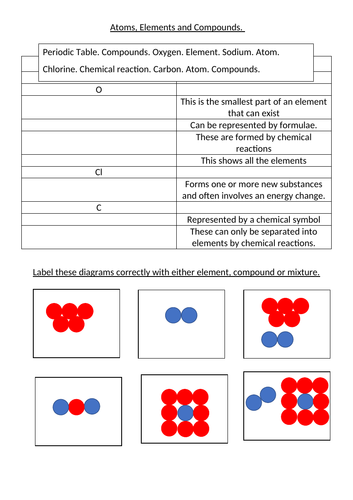
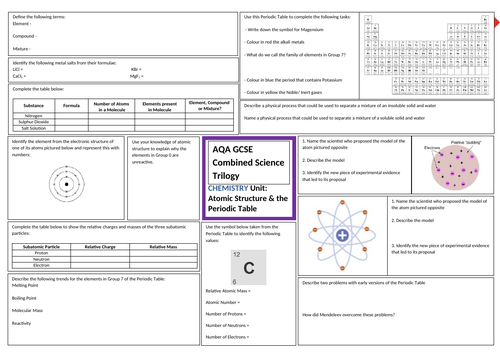
A comprehensive lesson to start 9-1 GCSE chemistry / trilogy course. This lesson introduces elements, compounds and mixtures. Students explore identifying elemental symbols, naming compounds and the start of atomic structure. Everything you need in one resource, including printable "worksheet&q...
Atoms Elements Mixtures Compounds Revision Lesson
stephenkemp193

Atoms Elements Mixtures Compounds Revision Lesson

(3)
This updated chemistry KS4 lesson asks 9-1 graded exam style questions and provides model answers covering symbols, balancing equations, naming compounds and more. It lasts approx 1 hour. It contains keyword helpsheets for students of lower ability. It encourages students to use keywords and link c...
Displacement Reactions - GCSE Chemistry Worksheets
cal-w11

Displacement Reactions - GCSE Chemistry Worksheets

(8)
This resource contains 2 worksheets displacement reactions that can be used in class or as homework to enable your students to practice what they have learnt in the classroom. We have worksheets for the following topics in Chemistry Paper 1: Atomic Structure and The Periodic Table [Atoms, Element...
Atomic structure support worksheets
jlmorgan100

Atomic structure support worksheets

(7)
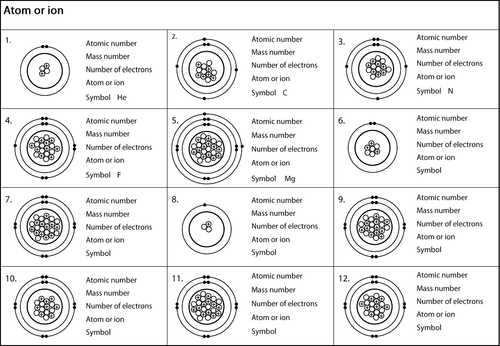
There are two worksheets, the first is to support students to understand the structure of the atom, including the size. The second is to help students understand the concepts of atomic number, mass number, ions and atoms. Both worksheets are visual and designed to help students to understand the con...
Balancing Chemical Equations (Easy) Worksheet GCSE
rocketsheets

Balancing Chemical Equations (Easy) Worksheet GCSE

(2)
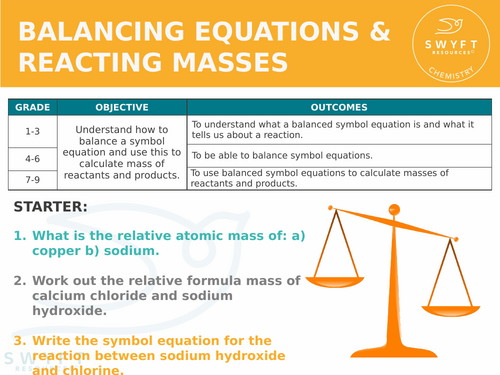
**About this sheet** 📝 This free revision, home learning or class worksheet comes **with answers** and helps GCSE students to practice **Balancing Easy Chemical Equations** in C1 GCSE Chemistry 🧪🔬. This free worksheet has over 20 easy chemical equations for stude...
Mixtures and Separation Techniques - GCSE Chemistry Worksheets
cal-w11

Mixtures and Separation Techniques - GCSE Chemistry Worksheets

(1)
This resource contains 4 worksheets that can be used in class or as homework to enable your students to practice what they have learnt in the classroom. This pack includes: Filtration & Crystallisation Simple Distillation Fractional Distillation Chromatography We have worksheets for the follo...