Computational thinking lessons and activities

A collection of lessons, activities and worksheets for teaching computational thinking in KS3 and KS4

Tes Resources Team

Young people in the classroom working on computing activities

Computational thinking and programming lessons and activities for KS3 and KS4 computing students

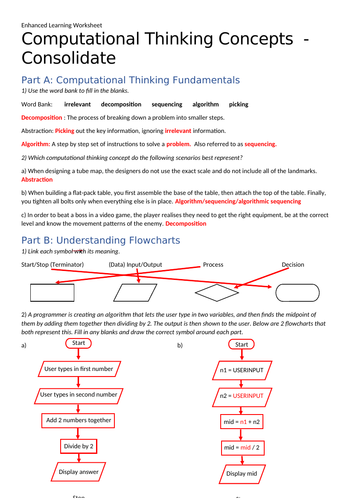
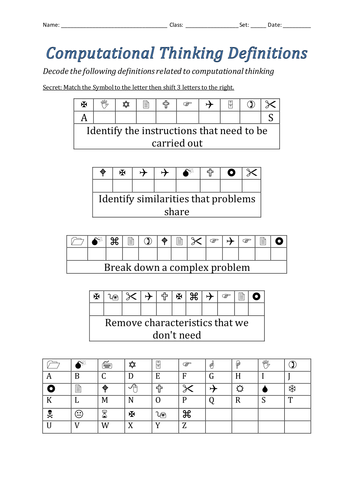
Computational thinking is a problem solving approach that involves breaking down large complex problems into smaller and often more manageable segments that can then be used to develop solutions. There are four key pillars to computational thinking, decomposition, pattern recognition, abstraction and algorithms. 

Computational thinking is a vital skill for today's learners to practise and perfect, both within computing lessons and in general. An important application of computational thinking is in computer programming - we have selected a range of resources below to help you tackle these important areas in your computing lessons.

Looking for even more hand-picked computing resources? Explore our computing highlights or take a look at our GCSE computer science revision collection.

Computational thinking

Check out these resources for some great ways to demonstrate and explore computational thinking with your students at KS3 and KS4.

Computational Thinking for KS3
RobbotResources

Computational Thinking for KS3

(14)
This unit of work introduces students within KS3 to the concepts of computational thinking by helping Rob-bot the robot make a jam sandwich. Through the activity, students will learn about decomposition, pattern recognition, abstraction and algorithm design (through both basic flowcharts and pseudo ...
Searching and Sorting Algorithms Cheat Sheet
MikeySkilton

Searching and Sorting Algorithms Cheat Sheet

(1)
Two pages of pseudocode algorithm. Perfect to laminate 30 double sided and use these as hand outs in lesson. Or print these out for each student to keep a copy in their folders. The sheets cover all of the fundamental elements of the main four algorithms at GCSE and A Level, including: \- Lin...
Computational Thinking Escape Room
Nichola Wilkin

Computational Thinking Escape Room

(6)
This highly interactive lesson that requires the pupils to work in teams and use computational thinking skills to solve a range of puzzles. This activity perfect for pupils about to learn Python programming and you want to show the importance of computational thinking skills. **This resource was...